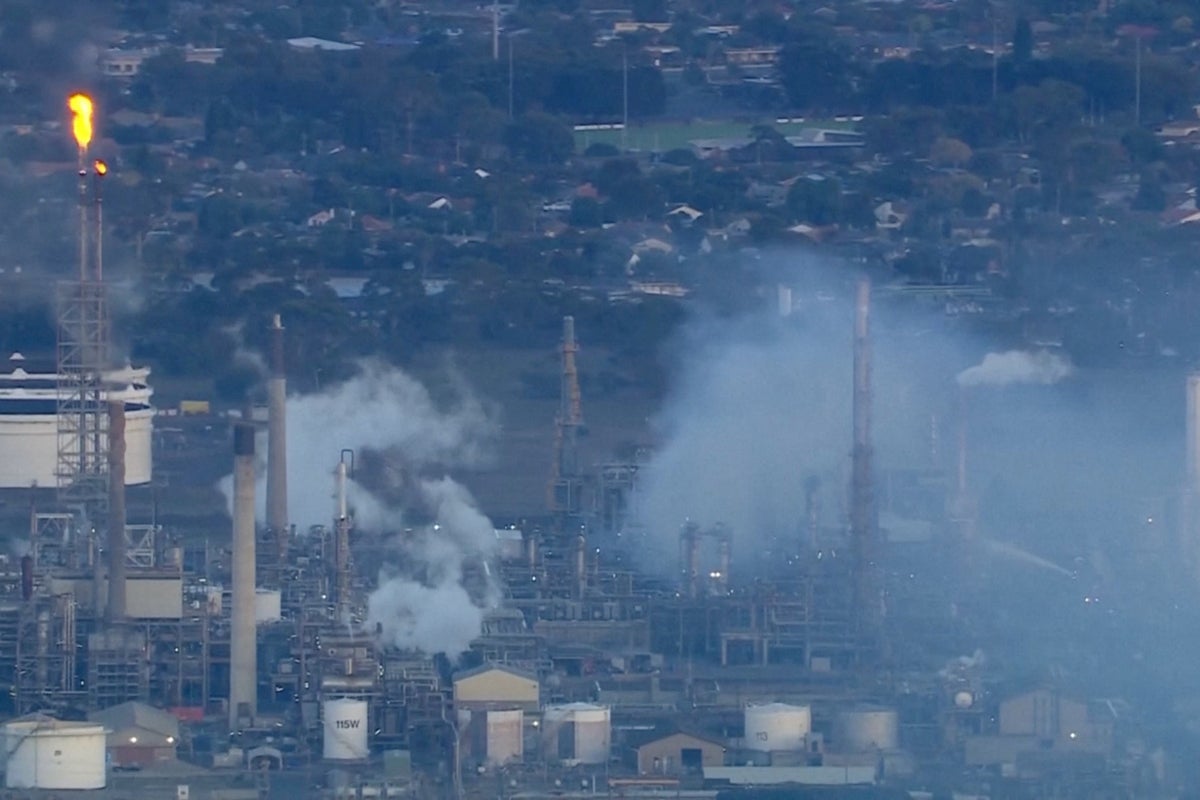
Australia’s liquid fuel sovereignty is a fiction maintained by three remaining refineries and a fragile maritime supply chain. The recent fire at a major domestic refinery does not merely represent an industrial accident; it exposes a structural deficit in the national energy security framework known as the Fuel Security Act 2021. When a single point of failure within the refining process occurs, the resulting supply shock is not additive—it is exponential due to the lack of "warm" redundancy in domestic production.
The Triad of Refining Vulnerability
To understand the impact of a refinery fire on petrol supplies, one must categorize the operational risk into three distinct pillars: Throughput Capacity, Storage Buffer, and Technical Recirculation.
- Throughput Capacity: Australia’s refining capacity has contracted by over 60% in the last decade. The closure of the BP Bulwer Island, Caltex Kurnell, and BP Kwinana facilities has left the nation dependent on a handful of sites. When one site goes offline, the remaining facilities cannot scale production to meet the shortfall because they already operate at near-peak utilization to maintain economic viability against cheaper Asian imports.
- Storage Buffer: The National Emergency Strategic Reserve is designed to meet International Energy Agency (IEA) requirements of 90 days of net imports. However, much of this stock is held "on water" (in transit) or in commercial tanks already allocated for immediate consumption. A fire-induced shutdown forces a reliance on these commercial stocks, which typically hold only 20 to 30 days of supply.
- Technical Recirculation: Refineries are not simple "on/off" machines. They are integrated thermal systems. A fire in a single hydrocracker or atmospheric distillation unit (ADU) compromises the heat integration of the entire plant.
[Image of a crude oil refinery distillation process]
The Cost Function of Supply Disruption
The economic impact of a refinery fire is governed by the lag between the event and the arrival of "top-up" shipments from the Singapore trading hub. This lag creates a price floor that remains elevated even if the fire is extinguished within hours.
- The Procurement Lead Time: It takes approximately 14 to 21 days for a Long Range (LR) tanker to be chartered, loaded in Singapore or South Korea, and discharged in an Australian port. During this three-week window, domestic supply is fixed while demand remains inelastic.
- The Quality Specification Premium: Australia maintains unique fuel quality standards (notably low sulfur requirements for premium unleaded). This means the "pool" of available fuel in the immediate region is smaller than it appears. Australia cannot simply buy any surplus cargo; it must compete for specific batches that meet Euro 6 equivalent standards, driving up the "spot" price during a domestic shortage.
- Infrastructure Bottlenecks: Most Australian ports are optimized for either crude import or refined product import, but rarely both at the scale required to replace a full refinery’s output overnight. The transition from receiving crude for a local refinery to receiving finished petrol involves significant logistical friction, including berth availability and pipeline reconfiguration.
The Mechanism of the "Dwindling Supply" Narrative
Public discourse often confuses "dwindling supplies" with absolute exhaustion. In a modern economy, supply does not hit zero; instead, the mechanism of price rationing takes over.
As inventory levels in terminal tanks drop below a critical threshold (typically 15% of capacity to prevent suction loss in pumps), wholesalers prioritize high-volume contracts and emergency services. This creates a secondary market where independent retailers are forced to purchase at higher premiums, which are then passed to the consumer. The "unprecedented" nature of a fire is less about the flames and more about the timing. If a fire occurs during the peak agricultural harvest or a high-travel season, the velocity of inventory depletion outpaces the ability of the maritime supply chain to respond.
Redundancy vs. Efficiency: The Strategic Trade-off
The Australian refining sector operates on a "Minimum Stockholding Obligation" (MSO). While this requires companies to hold a baseline level of petrol and jet fuel, it does not account for the loss of the processing capability.
The Refining Margin Paradox
Domestic refineries operate on razor-thin margins. To stay competitive with massive "mega-refineries" in India and China, Australian plants have stripped away excess redundancy. There are no "spare" distillation columns or crackers sitting idle. Every piece of equipment is a critical path component. Consequently, a fire in a secondary unit—such as a desulfurization plant—can shut down the entire facility because the refinery cannot legally or technically produce fuel that meets environmental specifications without that specific unit.
The Import Parity Price (IPP) Shift
The price of petrol in Australia is determined by the IPP—the cost of buying the fuel in Singapore, adding shipping, insurance, and taxes. When a domestic refinery fails, the "security premium" is added to this equation. Traders recognize the desperation of the local market and bid up the price of cargoes already en route to the region. This creates a feedback loop where a domestic physical failure triggers a global financial penalty for the Australian consumer.
Identifying the Break Point in Fuel Security
A systemic collapse of fuel availability would require a simultaneous failure of domestic refining and a disruption in the South China Sea shipping lanes. While a refinery fire is a localized shock, it serves as a "stress test" for the broader system.
The current vulnerability is located in the Terminal Gate Price (TGP) mechanism. If the fire results in a prolonged outage (exceeding 30 days), the TGP will decouple from the Singapore benchmark and reflect the local scarcity. This is the point where logistical issues become macroeconomic threats, impacting transport costs and, by extension, food inflation.
The Failure of the Fuel Security Service Payment (FSSP)
The Australian government provides a subsidy (the FSSP) to refineries during periods of low margins to keep them operational. However, this payment is a financial instrument, not a physical one. It ensures the business remains solvent, but it does not mandate the level of physical hardening or fire suppression infrastructure required to prevent a catastrophic outage.
The mismatch between financial security and operational resilience is the core reason why "unprecedented" events continue to threaten the supply chain. The policy focuses on the existence of the refineries rather than the uptime and interconnectivity of the refineries.
Strategic Realignment and Hardening
The current trajectory suggests that Australia will eventually transition to a 100% import model. Until that transition is complete, or until storage capacity is doubled, the following structural adjustments are required to mitigate the fallout from industrial accidents:
- Mandatory Component Redundancy: Legislative requirements for refineries to maintain critical "long-lead" spare parts on-site, reducing repair times for units damaged by fire from months to weeks.
- Decentralized Strategic Reserves: Moving the national stockholdings out of the primary refinery sites. Currently, much of the "security stock" is co-located with the refining infrastructure. A fire at the refinery can simultaneously threaten the very reserves meant to mitigate the shutdown.
- Vessel Charter Pre-emption: Establishing "first-right" charter agreements with tanker fleets to reduce the 21-day procurement lag when a domestic production failure is declared an emergency.
The refinery fire is a symptom of an energy policy that has prioritized market efficiency over system thickness. Without a shift toward physical redundancy, the Australian fuel supply remains one mechanical failure away from a localized crisis. The immediate priority for energy planners must be the decoupling of storage assets from production assets to ensure that a fire in the latter does not paralyze the former.