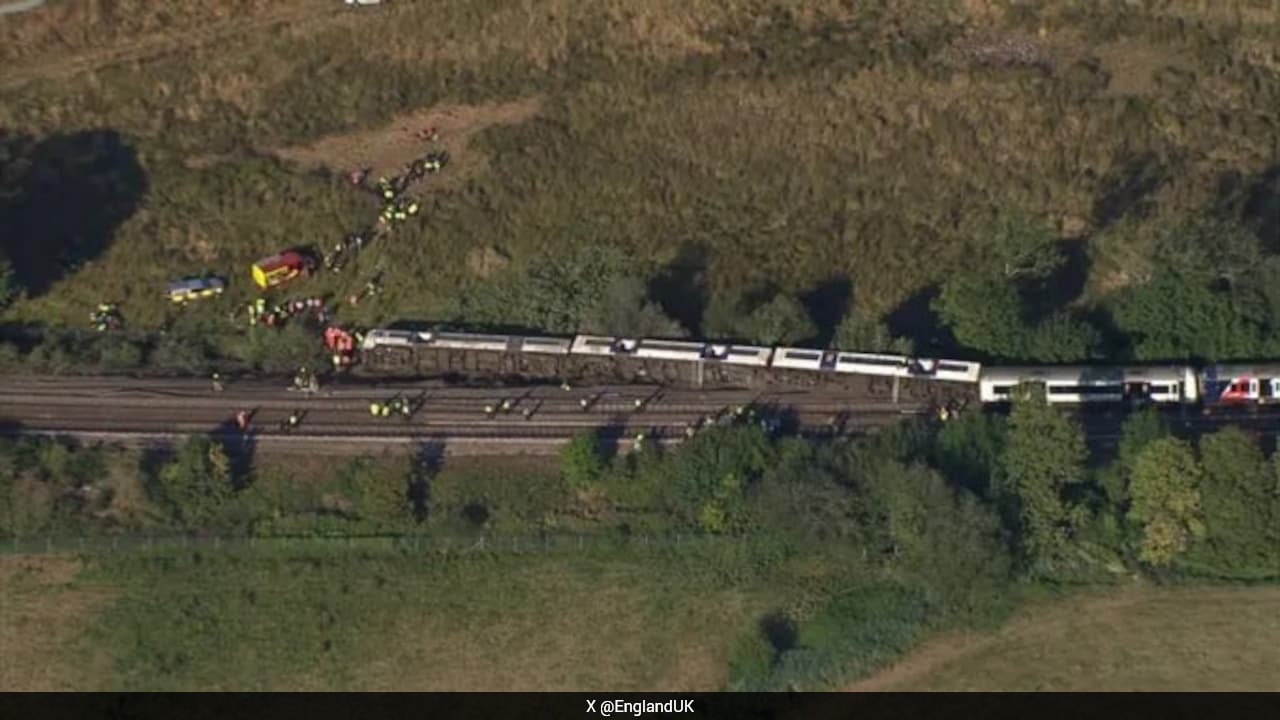
Whenever a passenger train tips onto its side in the United Kingdom, the national reflex is immediate, predictable, and entirely useless. Sirens wail. Pundits line up on television to demand massive, multi-billion-pound overhauls of the entire iron network. Commentators point to aging Victorian infrastructure as if every sleeper laid under Queen Victoria is actively plotting to throw carriages into fields.
It is mass hysteria disguised as public concern. Recently making waves in related news: Why The Low Confidence Assessment on Trump Assassination Plots is Actually Terrifying.
The standard narrative treats every single incident of rolling stock leaving the rails as a catastrophic systemic failure of a crumbling system. That is lazy thinking. It panders to anxiety and ignores basic statistics. I have spent years analyzing transit safety data, and I can tell you plainly: the obsession with avoiding every single physical displacement of steel wheels is making the network less safe, not more.
The Statistical Reality Nobody Wants to Acknowledge
Let us look at the baseline numbers. Rail transport remains statistically one of the safest methods of mass movement ever engineered by humanity. When a derailment happens, it dominates the news cycle precisely because it is an anomaly. Commercial aviation works the same way. A single plane crash commands weeks of coverage, while tens of thousands of daily highway fatalities pass by unnoticed in the local traffic reports. More information regarding the matter are explored by The Washington Post.
Why? Because human psychology dreads institutional failure more than statistically probable danger.
When a coach ends up on its side, the public demands an immediate, absolute guarantee that it will never happen again. That demand is a trap. To achieve absolute zero derailments on an open-air rail network exposed to weather, ground shifting, and mechanical wear, you would have to slow every train to a walking pace, rip up thousands of miles of track, and spend sums that could fund entire healthcare systems.
And even then, it would not work.
The Myth of Victorian Decay
The favorite bogeyman of railway critics is the age of the infrastructure. The narrative goes that Britain runs on tracks built by men in top hats, and therefore, derailments are the inevitable price of neglecting antiquity.
This is historically ignorant and operationally false.
Rails, sleepers, and ballast are replaced continuously. A line might follow a route mapped in the nineteenth century, but the physical assets doing the heavy lifting today are modern steel and concrete. Blaming "Victorian infrastructure" for a modern incident is like blaming the Romans for a pothole on the A1. It sounds poetic, but it tells you nothing about the actual mechanics of the failure.
Track geometry degrades due to heavy axle loads, dynamic forces, and moisture. It has nothing to do with whether the route was surveyed during the Crimean War. By focusing public anger on the ghosts of engineers past, network operators dodge the real, uncomfortable conversations about modern maintenance priorities.
The Cost of Zero Risk
Imagine a scenario where a regulatory body panics after an incident and slaps draconian speed restrictions across half the national network under the guise of an abundance of caution.
What happens?
Capacity drops instantly. Commuters flood onto roads, which are statistically orders of magnitude more dangerous per passenger mile than railways. Freight moves from cleaner electric or diesel rail lines onto asphalt highways, increasing congestion and emissions. In their quest to eliminate a rare, dramatic type of accident, safety bureaucrats inadvertently cause a rise in everyday, mundane road fatalities.
This is the hidden cost of risk aversion. Every pound spent chasing an impossible zero-accident target on the rails is a pound stolen from measures that save lives elsewhere in the transport ecosystem.
The Real Vulnerabilities
If you want to know why coaches end up on their sides, stop looking at the age of the steel and start looking at climate volatility and drainage.
Britain's rail network was built for a predictable, temperate climate. It was not engineered to handle extreme wet-dry cycles that turn embankment soil into sliding paste. Heavy rainfall causes earthworks to slip. When the ground beneath a track moves by a few centimeters under the weight of a heavy train, the geometry fails.
This is an unglamorous problem. You cannot spin a dramatic political campaign around ditch clearance and subgrade stabilization. It lacks the punch of demanding a total overhaul of the national signaling system. Yet, soil mechanics and drainage management dictate safety far more than boardroom policies or PR statements.
The Dangerous Allure of Over-Automation
Another favorite panacea of the tech-solutionist crowd is automated signaling and remote monitoring. Put enough sensors on the track, the argument goes, and derailments will vanish into history.
Sensors are useful. They provide data. But data is not action. I have seen rail operators drown in telemetry while basic maintenance backlogs pile up. Throwing smart technology at a physical infrastructure problem is often just an expensive way to look proactive while ignoring the fact that you have fewer track workers on the ground than you did a decade ago.
Over-reliance on automated diagnostics creates a false sense of security. An algorithm can tell you a rail is stressed, but it cannot shovel ballast or clear a blocked culvert during a November downpour.
What Actually Needs to Happen
If the industry wants to improve, it needs to abandon the defensive posture of promising the impossible.
First, stop treating every incident as a systemic indictment. Accidents happen in complex mechanical systems operating in open environments. The goal must be resilience and rapid recovery, not a fairytale guarantee of absolute immunity from physics.
Second, reallocate capital away from vanity signaling upgrades and toward mundane, unsexy earthwork reinforcement. Ditches, culverts, and retaining walls are the frontline defense against derailments caused by extreme weather and shifting ground.
Third, stop letting politicians dictate engineering priorities based on morning headlines. Safety is a matter of calculated risk management, not public relations triage.
The next time a train leaves the rails and the pundits start hyperventilating about the collapse of modern civilization, ignore the noise. Look at the drainage. Look at the soil. And look at the people trying to sell you a technological silver bullet for a problem that requires a shovel.
The rails do not care about your outrage. They only care about gravity.