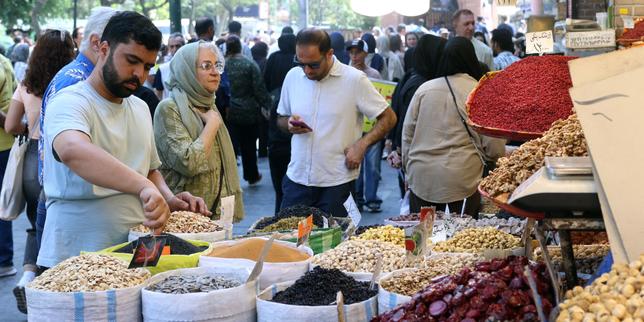
Money shouldn't vanish while it sits in your pocket. Yet, for millions living under the heavy weight of Iran's economic crisis, that is the harsh reality. When you walk through the crowded markets of Tehran, the air feels thick with anxiety. Prices climb daily. Savings evaporate overnight. The rial keeps sliding into historic depths against foreign currencies, and ordinary citizens are left holding the bag.
For years, international sanctions, domestic mismanagement, and structural corruption have squeezed the financial life out of the country. But numbers on a macroeconomic chart fail to capture the human toll. This isn't just about monetary policy. It is about families cutting back on meat, medical patients struggling to find basic prescription drugs, and young professionals giving up on dreams of owning a home. Let's look at how this financial erosion actually works on the ground and what it means for the future.
The Free Fall of the Rial and Why Your Savings Die Instantly
Inflation in Iran isn't a temporary spike. It's a permanent fixture of daily life. When the national currency loses its purchasing power month after month, standard financial planning becomes completely impossible. You can't budget for next year when you don't know what a loaf of bread will cost next Tuesday.
The exchange rate tells the story better than any official government statement. Years ago, a US dollar traded for a fraction of what it commands today. Now, ordinary workers watch the free-market rate like day traders just to figure out if their monthly paycheck can cover rent and basic groceries.
Here is what happens when hyperinflation takes root:
- Cash becomes a hot potato. People spend their rials the exact second they get paid because holding onto cash for even a week means losing purchasing power.
- Gold and foreign currency turn into the only reliable safety nets. If you can't buy dollars, you buy gold coins or scrap jewelry.
- Barter systems and informal credit lines creep back into local commerce as trust in the banking system hits rock bottom.
The government tries to enforce official exchange rates, but reality always wins. A dual-exchange system creates massive corruption loopholes where well-connected insiders cash in on subsidized rates while everyday shoppers pay punishing free-market prices for imported goods.
Empty Plates and Rationed Medicine
Let's talk about the grocery store. Walk down any aisle in a neighborhood supermarket in Isfahan or Mashhad, and you will see price tags crossed out and rewritten by hand almost daily. Red meat has quietly transformed from a regular meal component into a luxury item reserved for special occasions. Families substitute protein sources, switching from beef to chicken, and eventually to lentils and beans as inflation outpaces wage hikes.
Healthcare brings an even darker reality. Iran historically boasted a strong domestic pharmaceutical industry, but sanctions and foreign exchange shortages have crippled the supply chain for raw ingredients. Essential medicines for chronic conditions—ranging from chemotherapy drugs to insulin and specialized cardiac medications—disappear from pharmacy shelves for weeks at a time.
Patients turn to the black market, where smugglers charge extortionate prices for life-saving drugs. When health becomes a luxury, the societal cost climbs infinitely higher than any inflation index can measure.
The Quiet Exodus of Skilled Labor
When an economy breaks down, its most valuable assets pack their bags. Iran currently faces an aggressive brain drain. Engineers, doctors, software developers, and university professors look at their monthly salaries—often worth only a few hundred dollars at real market rates—and realize they have no future at home.
Universities graduate bright, ambitious minds only to watch them emigrate to Europe, Canada, or neighboring Gulf states at the earliest opportunity. This creates a generational talent vacuum. Hospitals lose seasoned surgeons. Tech startups lose senior coders. The institutions that should be driving recovery are instead losing the very people needed to rebuild them.
Those who stay behind are forced to hustle. The gig economy in Iran has exploded, but not in the modern Silicon Valley sense. People work two or three jobs just to stay afloat. Private taxi driving, informal freelance work, and cross-border petty trade keep households breathing, but exhaustion is universal.
Adapting to Perpetual Crisis
Survival requires creativity. Iranians have become masters of informal economics. Cryptocurrencies gained massive traction as a way to move wealth across borders and hedge against the falling rial, despite strict government regulations. Real estate remains a popular store of value for those lucky enough to have capital, driving property prices completely out of reach for younger generations.
Families rely heavily on generational wealth and informal safety nets. Parents support adult children well into their thirties because independent living is financially impossible on an entry-level salary. This interdependence keeps communities tightly knit, but it also traps entire families in cycles of perpetual financial stress.
The government frequently rolls out subsidy reform packages and digital welfare cards, but these cash transfers get swallowed by inflation within days of hitting bank accounts. Patchwork solutions cannot fix structural leaks. Until fundamental macroeconomic stability and international normalization take place, the economic squeeze on everyday households will only tighten.
To understand modern Iran, you have to look past the political rhetoric on the evening news. Look at the balance sheets of ordinary families trying to buy cooking oil, pay rent, and secure medicine. That is where the real story happens, and that is where the future of the nation is being decided every single day.