The foreign policy establishment in Ottawa and Washington has a predictable reflex. Whenever a Western leader steps off a plane in Beijing, the pundits reach for the exact same dusty playbook. They warn of naive appeasement. They fret about security vulnerabilities. They frame every handshake as a zero-sum capitulation to authoritarianism.
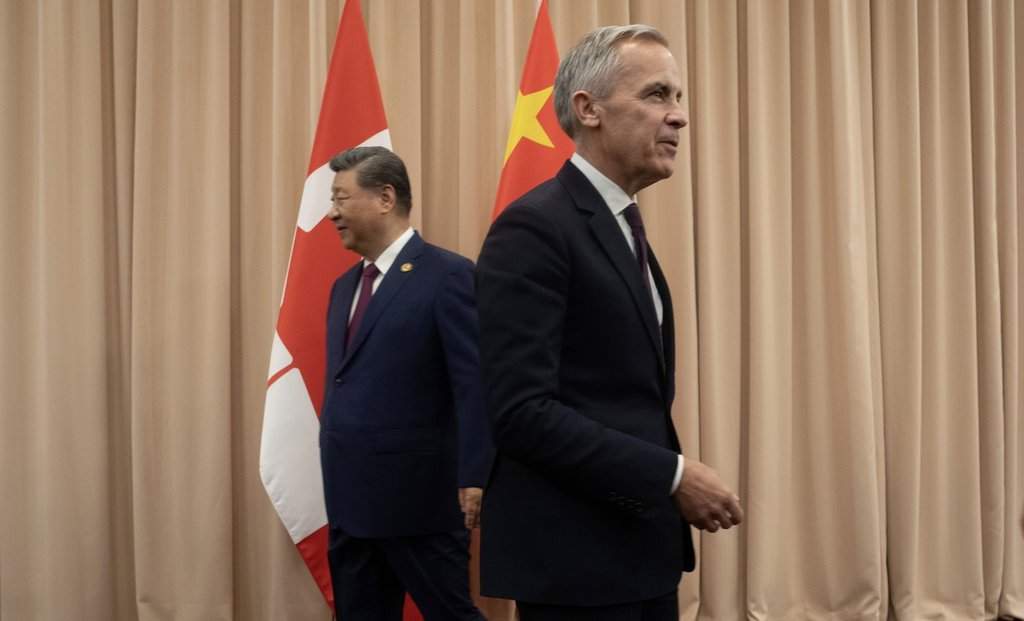
That lazy consensus completely missed the point of Mark Carney’s trip to China.
The mainstream coverage treated his visit like a standard diplomatic tightrope walk between economic opportunity and national security risk. That framing is obsolete. It assumes the global economy still operates on the post-1991 rules of globalization, where trade was simply about efficiency and comparative advantage. Those days are dead. We are living in an era of weaponized interdependence, supply chain regionalization, and industrial policy warfare.
Carney—a former central banker who ran both the Bank of Canada and the Bank of England—did not fly to Beijing to beg for market access or revive the golden era of Sino-Western trade. He went there to manage risk in a fracturing financial architecture. If you analyze his trip through the lens of traditional diplomacy, you miss the actual mechanics of capital allocation, sovereign debt, and industrial survival.
The False Binary of Engagement Versus Decoupling
Most commentators still talk about China policy as a binary choice. Either you engage and get burned, or you decouple and stay safe. Both positions are economically illiterate.
Complete decoupling from the world’s second-largest economy and its primary manufacturing workshop is a fantasy peddled by politicians who have never looked at a bill of materials for a lithium-ion battery or a pharmaceutical supply chain. At the same time, blind engagement—pretending Beijing operates under standard Western corporate governance—is an invitation to intellectual property theft and strategic coercion.
I have sat in boardrooms where executives burned tens of millions of dollars chasing the "China growth story" without understanding the political overhead attached to every joint venture. They treated regulatory shifts in Beijing like market fluctuations in Frankfurt. They got wiped out. Conversely, I have watched supply chain directors try to execute overnight "China-plus-one" exits, only to discover their new Tier-2 suppliers in Vietnam or Mexico were simply buying raw inputs from Shenzhen and slapping a new label on the box.
Carney understands the middle ground that actually exists: de-risking through structured visibility. You cannot manage exposure to a systemic rival by refusing to talk to them. In central banking, opacity is the enemy of stability. When you cut off communication channels with a major counterparty, you do not eliminate systemic risk; you just blindfold yourself before a liquidity crunch.
Why Capital Markets Care More About Beijing Than Ottawa Does
To understand what Carney is actually doing, you have to strip away the political theater and look at balance sheets. Canada is a resource-heavy, export-dependent middle power with a massive productivity problem and an over-leveraged household sector. It cannot fund its energy transition or maintain its standard of living solely by selling commodities to the United States, especially when Washington is increasingly protectionist regardless of who occupies the White House.
Consider the reality of global commodity pricing and green tech manufacturing:
- Critical Minerals: China controls roughly 60 percent of global rare earth mining and nearly 90 percent of processing capacity. Western nations can dig all the lithium and cobalt out of the ground they want, but without refining infrastructure, they are just shipping dirt.
- Capital Flows: Sovereign wealth funds and state-backed Chinese entities remain massive allocators of global liquidity. Ignoring their capital deployment strategies distorts price discovery across emerging and developed markets alike.
- Inflation Mechanics: Western central banks spent years fighting inflation triggered by supply shocks. Intentional, uncoordinated trade wars with the world’s largest exporter of manufactured goods act as a direct tax on domestic consumers and keep interest rates higher for longer.
When pundits criticize high-level visits to Beijing as "risky," they rarely price the risk of total diplomatic estrangement. What happens when a major financial crisis hits and the Treasury Secretary or Finance Minister does not have a working relationship with their counterpart at the People's Bank of China? In 2008, coordinated central bank action prevented a total depression. Today, that coordination machinery is rusted shut.
Dismantling the Lazy Consensus
Let us look at the specific arguments the critics keep repeating—and why they fall apart under scrutiny.
Fallacy 1: Talking to Beijing legitimizes authoritarianism
Diplomacy is not a reward for good behavior. It is a tool for advancing national interest among adversaries. During the height of the Cold War, Washington and Moscow maintained constant backchannels, arms control summits, and trade agreements even while fighting proxy wars across three continents. Refusing to engage with a superpower because you dislike its domestic political system is not moral clarity. It is strategic incompetence.
Fallacy 2: Economic ties inevitably create political leverage for China
This only happens when a country allows itself to become asymmetrically dependent on a single buyer or supplier without building buffers. Australia learned this the hard way when Beijing slapped punitive tariffs on Australian barley, wine, and coal in 2020. Yet what happened next? Canberra did not fold. Australian exporters rerouted shipments to alternative markets, absorbed the short-term shock, and forced Beijing to quietly drop the tariffs three years later because China actually needed the commodities. Leverage cuts both ways when you have assets the other side requires.
Fallacy 3: Alignment with Washington requires identical China policies
The United States is a continental superpower with a massive internal market and the world’s reserve currency. Canada is a trade-dependent economy with a tenth of the population. Washington can afford sweeping, unilateral tariff walls that distort domestic prices because its economy is largely insulated from trade shocks. When middle powers blindly copy American trade barriers without securing guaranteed access to US subsidies or supply chains, they end up taking all the economic damage while Washington reaps the industrial benefits.
The Real Stakes Nobody Wants to Discuss
If the mainstream commentary focused on the wrong risks, what are the actual dangers of Carney’s approach? There are plenty, and pretending otherwise would be dishonest.
First, there is the credibility trap. Beijing excels at using high-profile Western visitors for domestic propaganda, framing every meeting as proof that Western containment is failing. If Ottawa signals openness to Chinese capital without establishing ironclad national security guardrails, it invites predatory acquisitions in sensitive sectors like telecoms, AI, and Arctic infrastructure.
Second, there is Washington’s wrath. The United States-Mexico-Canada Agreement (USMCA) comes up for review in 2026. American lawmakers on both sides of the aisle are paranoid that Canada or Mexico will serve as a backdoor for cheap Chinese electric vehicles, steel, and solar panels to enter the US market tariff-free. If Carney’s outreach to Beijing looks even remotely like an attempt to soften tariffs on Chinese green tech, Washington will retaliate by gutting Canada’s preferential trade access.
Third, there is the illusion of rules-based trade. Any agreement signed with Beijing is only as durable as the Chinese Communist Party’s immediate strategic priorities. Western institutions rely on legal predictability and independent courts. Beijing operates on political expediency. Treating a memorandum of understanding with a Chinese ministry as a binding contract is a rookie mistake.
How Middle Powers Actually Win in a Fragmented World
Stop asking whether Carney’s visit was "pro-China" or "anti-American." That is a question for cable news panels, not serious strategists. The real question is how a middle power extracts maximum economic utility from competing superpowers without becoming collateral damage.
Imagine a scenario where Ottawa plays this properly. Instead of sweeping ideological pronouncements, policy is driven by cold, transactional compartmentalization:
- Enforce Strict Sectoral Ring-Fencing: Draw a hard, non-negotiable perimeter around dual-use technologies, data infrastructure, critical mineral processing, and defense supply chains. Zero Chinese state-linked equity in these zones. Period.
- Monetize Non-Strategic Trade: Aggressively sell agricultural products, consumer goods, financial services, and non-strategic energy to Chinese buyers. Take their currency, capture the margin, and reinvest the proceeds into domestic productivity.
- Demand Reciprocity at the Border: End the asymmetry where Chinese firms enjoy open access to Western capital markets and corporate acquisitions while Western firms face forced technology transfers and local partner mandates in China. Mirror their restrictions down to the regulatory line item.
- Coordinate Quietly, Act Independently: Maintain intelligence sharing and defense alignment with Five Eyes partners, while retaining sovereign flexibility on commercial diplomacy. Do not let another country’s domestic election cycle dictate your trade calendar.
The Verdict on Strategic Realism
The economists and strategists who actually move markets—figures like Henry Farrell and Abraham Newman, who coined the term "weaponized interdependence," or financial historians like Adam Tooze—have spent years pointing out that global finance and geopolitics are now the same discipline. You cannot separate the ledger from the map.
Carney knows this better than almost any politician in the G7. He spent a decade watching central banks clean up the messes created by politicians who ignored systemic tail risks. His trip to China was not an exercise in nostalgia for the 1990s. It was an acknowledgment that you cannot build a resilient economy by pretending a 19-trillion-dollar market does not exist.
Western capitals need to grow up. Moralizing is not a strategy, and isolation is not security. Either you sit at the table with clear eyes and hard boundaries, or you stay home and let someone else write the terms of your decline.