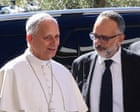
"Localized." "Caught early." "No further treatment needed."
Read enough coverage of Pope Leo XIV’s October 13 surgery at Rome’s Gemelli hospital, and you will walk away thinking a lobectomy is basically a tune-up with a slightly longer hospital stay. The standard wire-service framing treats the removal of the lower lobe of his right lung like a neat, closed chapter. Surgery happened. Pathology came back localized. The pontiff flew to South America less than four weeks later. Case closed.
Except it is not. Not even close.
The lazy consensus around Pope Leo’s lung cancer diagnosis relies on two comforting illusions: first, that "no further treatment" means the cancer threat is over; and second, that a 71-year-old who walks out of the hospital in four days and boards long-haul flights to Uruguay, Argentina, and Peru has already cleared the real physiological and institutional hurdles.
Having spent years analyzing high-stakes executive health protocols, clinical risk modeling, and leadership continuity in high-pressure institutions, I have watched organizations blow fortunes—and misread catastrophic risks—because they confused a clean procedural outcome with permanent biological immunity. When a high-profile leader has a malignant nodule excised, press offices love clean narratives. Biology does not care about press narratives.
You Are Asking the Wrong Question About "No Further Treatment"
Most readers—and plenty of breathless commentators—look at the Vatican’s post-op update and ask: If no chemotherapy or radiation is required, isn't he cured?
That question mistakes an absence of adjuvant therapy for a guarantee of non-recurrence. In thoracic oncology, when a localized early-stage lung tumor is resected via lobectomy and staging shows no nodal spread, skipping systemic chemotherapy or radiation is often standard clinical practice because the downside toxicity outweighs marginal statistical gain at that specific stage. That does not mean microscopic residual cells cannot exist. It does not mean surveillance stops mattering. It means the surgeon removed the visible tumor and the surrounding lobe, and the patient enters active surveillance.
Let’s get the terminology straight before the noise gets louder:
- Lobectomy: Surgical removal of an entire anatomical lobe of a lung—in Pope Leo XIV’s case, the lower lobe of the right lung. That is permanent loss of parenchymal volume, not a minor snip.
- Localized disease: Malignancy confined to the primary site without regional lymph node or distant metastatic spread identified on staging. Favorable compared to advanced disease, yes. A blank check for the next decade, no.
- Surveillance: Scheduled imaging and clinical monitoring over time. With lung malignancies, risk curves extend across years, not weeks.
Clinical frameworks from major oncology bodies like the American Cancer Society and the National Comprehensive Cancer Network emphasize structured longitudinal follow-up after early-stage resection precisely because recurrence—either local or distant—remains a real biological possibility even after complete anatomical excision. Speed of discharge does not rewrite tumor biology.
The High-Altitude Illusion After Lung Surgery
Look at what happened after the operation: discharged in four days, back on the balcony for the Angelus, then off to South America in early November. Critics who doubted he would make the trip looked foolish in the short term. Defenders who treated the rapid recovery as proof of total physical restoration missed the deeper mechanics.
Losing a lung lobe reduces total respiratory reserve and alters ventilation-perfusion matching. Even in a fit 71-year-old who plays tennis and walks early after surgery, pulmonary mechanics take time to adapt. Now layer on repeated international flights, cabin air pressure shifts, fatigue, and high-altitude exposure in South America. At higher altitudes, barometric pressure drops, reducing the partial pressure of inspired oxygen. Healthy lungs compensate by increasing minute ventilation and heart rate. Post-lobectomy lungs have less buffer.
Imagine a scenario where a public figure with a freshly resected lung lobe pushes through back-to-back appearances, travel fatigue, and thinner air during an intense multi-country tour. Even without a cancer recurrence, physiological strain shows up first as subtle fatigue, reduced exertion tolerance, or susceptibility to respiratory infections—the exact kind of secondary stress that can derail a grueling schedule or complicate recovery if an infection takes hold. Remember how quickly a respiratory illness became a decisive turning point in the final stretch of Pope Francis’s life. You do not have to predict disaster to recognize that respiratory margin matters.
Governance Risk Is the Story Nobody Wants to Touch
The medical coverage focuses on scars and stamina. The institutional blind spot is succession and continuity.
Pope Leo XIV has waved off writing a provisional letter of resignation for medical incapacitation and shown no rush to appoint new cardinals. From a personal standpoint, projecting confidence and refusing to govern like a lame duck makes total sense—especially when doctors report a localized tumor and smooth early recovery.
From a governance standpoint, pretending mortality and sudden incapacitation are theoretical after a cancer diagnosis is a classic leadership fallacy. I have seen boards and executives across high-stakes sectors delay contingency planning right up until an acute event forces chaotic improvisation. A localized lung cancer diagnosis at age 71 does not mean the pontiff is on death’s door. It does mean health risk is no longer abstract. Even if his personal odds of long-term survival after resection are solid, the variance around any 71-year-old cancer survivor’s health trajectory over the next several years is wider than it was before October.
What People Actually Ask—And Why the Answers Fall Short
Is lung cancer always fatal in older patients?
No. That fatalism is outdated and lazy. Outcomes depend heavily on histology, stage at resection, molecular profile, and overall baseline fitness. Early-stage, localized lung cancer treated with surgical resection offers substantially better survival odds than late-stage disease, and a 71-year-old with strong baseline conditioning starts from a far better position than a frail patient with advanced illness. Still, "not always fatal" is not the same as "risk-free."
Does walking out of the hospital quickly mean a full recovery?
Walking out in four days proves the surgical team managed acute post-op pain, air leaks, and early mobilization well. It does not mean full tissue healing, full chest-wall comfort, or full cardiopulmonary adaptation has occurred. Early discharge is a milestone in surgical care, not the finish line of recovery.
Why didn't he need chemotherapy or radiation?
Because when a tumor is caught localized and completely resected without evidence of spread, clinicians often judge that additional systemic therapy or radiation adds side effects without proven benefit at that stage. That is a rational risk-benefit call by his physicians, not proof that zero cancer cells exist anywhere in his body.
What You Should Actually Do With This Information
If you are tracking this story—or managing health and continuity decisions in your own organization—stop treating headlines like medical charts.
- Separate short-term resilience from long-term risk. A smooth post-op week and a successful trip tell you how well he tolerated immediate stress; long-term surveillance scans tell you how the disease behaves over time.
- Watch follow-up milestones, not just initial bulletins. Real signal in post-resection oncology comes months and years out, through routine imaging and clinical stability.
- Build continuity plans before you need them. Whether in the Vatican or a corporate boardroom, clear protocols for sudden medical absence protect the institution without diminishing the leader in charge.
There is a real catch to taking this harder-edged view: it can sound overly cynical when a patient looks vigorous, smiles in public, and keeps his calendar full. Being realistic about biological risk and institutional continuity is not wishing ill on anyone. It is refusing to trade clear-eyed analysis for wishful thinking.
The surgery is over, the applause is loud, and the real test of time has just begun.