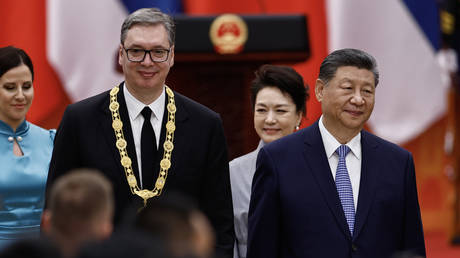
The media is currently obsessing over a lazy consensus. European think tanks and mainstream journalists are wringing their hands over Belgrade, asking a fundamentally flawed question: Can China turn Serbia into a European high-tech hub?
They point to the freshly signed $1.1 billion package in Beijing covering artificial intelligence infrastructure, robotics joint ventures, and electric vehicle capacity. They look at Serbian President Aleksandar Vučić touring highly automated manufacturing plants in Zhejiang, watching humanoid robots perform traditional Balkan dances, and declaring that Serbia will soon have automated infrastructure no one else in Europe possesses.
The mainstream analysis treats this as a genuine bid to establish a Silicon Valley of the Balkans—a sovereign leap from roads to robots.
It is nothing of the sort.
I have watched state planners and multinational corporations blow billions on simulated modernization for over two decades. If you believe Beijing is spending hundreds of millions of dollars to build an autonomous, self-sustaining European competitor in information technology and advanced software, you do not understand the mechanics of Chinese industrial policy.
Serbia is not becoming a high-tech hub. It is being weaponized as a low-cost, tariff-free backdoor assembly line for Chinese hardware, designed explicitly to bypass European Union trade barriers while anchoring Belgrade to Beijing’s proprietary technical architecture.
The Illusion of Knowledge Transfer
The core argument of the consensus view relies on the concept of "industrial upgrading." The narrative claims that because Chinese investments are moving from heavy bricks—like the Smederevo steel plant or the Zijin copper mines in Bor—to silicon and software, Serbia will experience a massive domestic spillover of innovation.
This is a structural misunderstanding of how these international partnerships operate.
True innovation hubs require native venture capital, independent academic research, local intellectual property generation, and an open, competitive regulatory environment. What Belgrade is getting instead is a series of highly localized, closed-loop installations.
Consider the recent agreements with AGIBOT and Minth Group to set up humanoid robot production in Šabac. The hardware arrives as completely knocked-down kits manufactured in the industrial zones of Shanghai and Ningbo. The assembly happens on Serbian soil using local labor, which satisfies the rules-of-origin requirements for regional trade agreements. The high-value intellectual property—the machine-learning models, the proprietary actuators, the sensor fusion algorithms—remains strictly inside the Chinese corporate perimeter.
This is not a technology transfer. It is advanced assembly. The domestic Serbian tech sector gains virtually no foundational knowledge from assembling imported Chinese components, just as a warehouse worker does not learn how to design an iPhone by packing it into a shipping box.
The Iron Cage of a Foreign Tech Stack
The true strategy behind Beijing’s $1.1 billion injection lies in the quiet rollout of what Chinese policy documents call "new productive forces." The shift from building physical highways to laying digital data fabric is a deliberate mechanism of structural lock-in.
When a state constructs a highway, a new government can eventually nationalize it, alter the tolls, or hire local contractors to repave it. The physical asset possesses no inherent political loyalty.
A digital stack is entirely different.
The AI infrastructure, data factories, and surveillance frameworks built by Huawei and other state-adjacent entities across Belgrade, Niš, and Novi Sad are not passive assets. They represent an integrated ecosystem of proprietary Chinese hardware and software standards.
- The Hardware Layer: Custom silicon and server architectures that require specific, non-Western supply components for maintenance and expansion.
- The Software Layer: Proprietary AI liquid-cooling systems, database governance models, and network operating systems managed via external remote protocols.
- The Standard Layer: Data governance frameworks aligned with Beijing's regulatory preferences rather than the European Union's General Data Protection Regulation (GDPR).
Once a state integrates its public administration, national security monitoring, and industrial automation into this stack, the cost of decoupling becomes catastrophic. A future, reform-minded Serbian administration cannot easily rip out a Huawei core network or an AGIBOT automation framework without shutting down the very systems keeping their factories running.
By labeling this a "high-tech hub," Western analysts miss the entire geopolitical objective. The target is not economic development; it is infrastructural custody.
Dismantling the People Also Ask Myth
The public debate surrounding this partnership usually relies on a few repetitive questions that completely miss the mark. Let us answer them honestly.
Does China’s investment in Serbia offer a viable alternative to EU integration?
No. The entire economic logic of the Sino-Serbian corridor relies precisely on the proximity and eventual access to the European market. China is not building factories in Kragujevac or Šid because the domestic Serbian market of less than seven million people can sustain mass-scale EV or robotics consumption. They are building there because the 2023 China-Serbia Free Trade Agreement, combined with Serbia’s unique customs status with neighboring European states, turns Belgrade into a transshipment launchpad. If Serbia permanently abandoned its European integration path, its utility to Beijing’s export-led growth strategy would crater overnight.
Will the Budapest-Belgrade railway and local data centres make Serbia a regional logistics leader?
It makes Serbia a Chinese logistics corridor. The infrastructure is optimized to pull goods from the Chinese-controlled Port of Piraeus in Greece, move them rapidly through North Macedonia and Serbia, and deposit them directly into Central Europe. Serbian companies are the passengers on this network, not the drivers. The logistics modernization serves primarily to optimize the velocity of Chinese supply chains, protecting them from maritime chokepoints and Western tariff walls.
The Blind Spot of Western Protectionism
If you want to understand the durability of this relationship, you have to stop looking at Beijing and start looking at Brussels.
The conventional Western response to the Sino-Serbian alliance is a mix of lecturing and institutional paralysis. The European Commission issues annual rule-of-law reports flagging judicial transparency and third-country dependencies, yet offers no competitive financial or industrial alternatives.
Western institutions operate on a framework of heavy political conditionality. They demand deep structural, legal, and regulatory transformations before a single euro of development capital is released. Beijing operates on a model of absolute tactical transactionalism. They do not care about media freedom or electoral integrity; they care about asset deployment and supply chain security.
The downside to my contrarian view is obvious: for an emerging economy trapped in the geographic periphery, accepting Chinese capital for rapid industrialization is entirely rational in the short term. The Smederevo steel plant was sliding toward collapse before the HBIS Group acquisition in 2016. The mining town of Bor was drowning in debt before Zijin Mining moved in. These interventions saved local jobs and stabilized localized economies.
But let us lose the romantic delusion that this financial survival mechanism is transforming the nation into a sovereign technology powerhouse.
The Actionable Reality for Enterprise Leaders
If you are an investor, a technology executive, or an industrial strategist looking at the Western Balkans, you must discard the marketing brochures broadcast by Belgrade and Beijing. Do not plan your regional strategy around the myth of an emerging Eastern European Silicon Valley.
Instead, operate on these three cold realities:
- Treat Serbia as a High-Risk Transshipment Zone: Anticipate that any technology, component, or product passing through or assembled within the Sino-Serbian corridor will face intense scrutiny, secondary sanctions, or export controls from the United States and the European Union.
- Expect a Permanent Bifurcation of Tech Stacks: If you build operations in the region, do not attempt to merge local infrastructure with your Western corporate networks. Treat the local digital environment as fundamentally compromised by external state surveillance and proprietary architectures.
- Exploit the Assembly Arbitrage While It Lasts: If your business model can benefit from low-cost industrial assembly with direct access to European markets, leverage the localized infrastructure—but keep your high-value intellectual property entirely outside the geographic boundaries of the Western Balkans.
The steel friendship between Beijing and Belgrade has indeed constructed something unique in Europe, but it isn't an incubator for local scientific genius. It is a highly sophisticated, geopolitical tollbooth.
Serbian President Lauds China's Robust Development in Robotics
This footage captures the political theater and symbolic corporate visits in China that underscore Serbia's active promotion of Chinese advanced automation platforms.


.png?width=1200&auto=webp&trim=0%2C0%2C0%2C0)