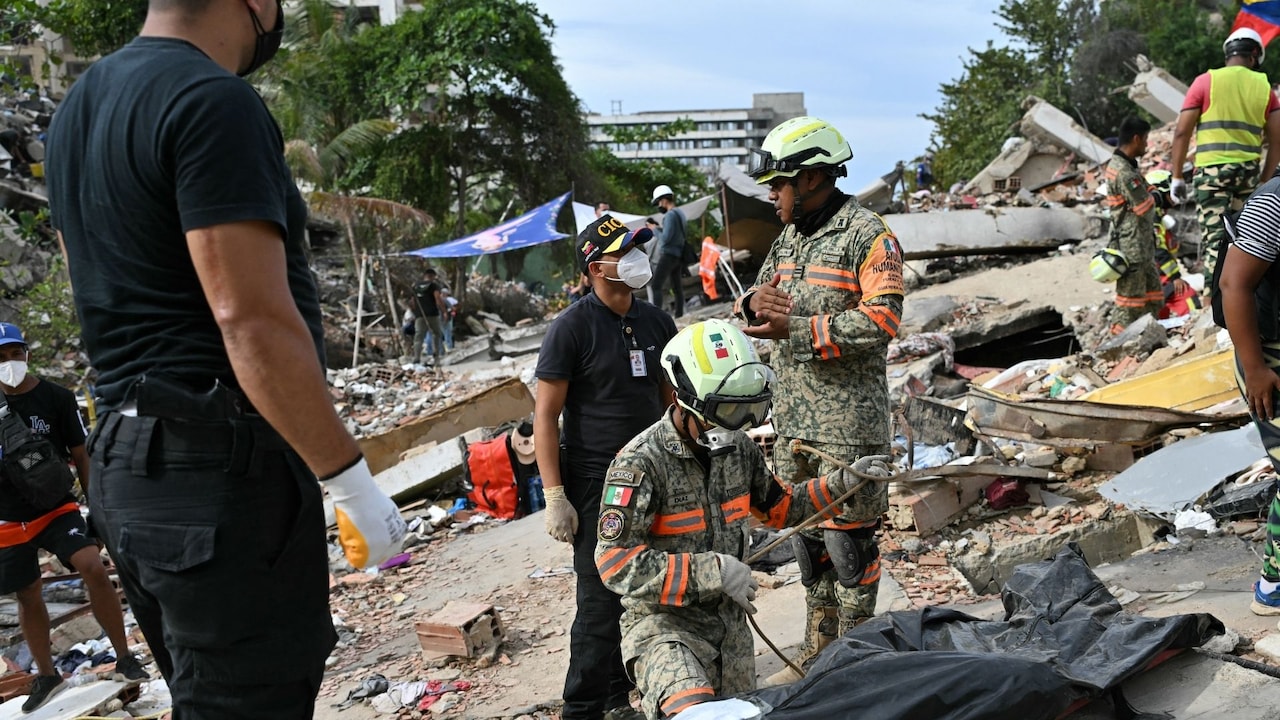
Stop calling the tragedy in Venezuela a natural disaster.
When the media broadcasts images of collapsed apartment blocks in La Guaira and rescue workers pulling bodies from the rubble in Caracas, they feed you a lazy narrative. They tell you that nature is cruel, that a massive doublet earthquake measuring 7.2 and 7.5 in magnitude was an unstoppable act of God, and that the rising death toll—now past 4,118 fatalities—is simply the price of living on a fault line. You might also find this related story useful: Why Trump Sinking the Housing Bill Is the Best Thing to Happen to Real Estate This Year.
This is a lie. Nature did not kill thousands of people on June 24. A decade of structural rot, systemic corruption, and weaponized engineering did.
The mainstream press is obsessed with the wrong metrics. They track the aftershocks, calculate the UN humanitarian aid appeals, and reprint government press releases without questioning the underlying mechanics of the slaughter. If you want to understand why a 7.5 magnitude tremor turned coastal Venezuela into a mass grave while a similar event in Tokyo or Santiago would barely disrupt the morning commute, you have to look past the seismology and look directly at the concrete. As discussed in latest reports by NBC News, the implications are widespread.
The Deadly Lie of Natural Disasters
Earthquakes do not kill people. Collapsing buildings do.
The field of seismology has long understood that energy release along a plate boundary is a physical certainty. The San Sebastián fault system was always a ticking clock. The twin shocks that struck 39 seconds apart were undoubtedly violent, propagating eastwards toward Caracas at over three kilometers per second. But the catastrophic failure of the built environment was entirely man-made.
To understand the scale of this deception, compare the June 24 event with global baselines. When a 7.1 magnitude earthquake struck near Fukuoka, Japan, casualties were kept to a minimum. Why? Because Japanese building codes enforce strict structural elasticity. They design foundations to slide and columns to flex.
In contrast, parts of the coastal state of La Guaira saw an astonishing 80% building collapse rate. That is not geological bad luck; it is a statistical indictment.
I have spent years auditing infrastructure projects across Latin America, and the pattern is always identical. When authoritarian regimes or economically strangled nations face seismic events, the devastation scales exponentially not because of the magnitude of the tremor, but because of the degradation of the concrete. Over the last decade, Venezuela’s construction sector was stripped of regulatory oversight. High-grade rebar was substituted with cheap, brittle alternatives. Cement was watered down to stretch thin budgets.
Imagine a scenario where thousands of families are packed into multi-story residential blocks built with half the required structural steel, resting on soft, uncompacted coastal soils. You do not need a 7.5 magnitude earthquake to cause a catastrophe in that environment; a minor tremor would have done the job eventually. The doublet event merely accelerated the inevitable.
The Grim Math of Corrupt Infrastructure
The current narrative focuses on the immediate tragedy: 16,740 injured, 190 buildings completely flattened, and thousands still missing. National Assembly President Jorge Rodríguez floods social media with logistics updates, boasting about the deployment of 30,000 emergency personnel and thousands of metric tons of food.
This is political theater designed to obscure a brutal mathematical truth.
The real failure occurred years before the ground shook. Structural engineers utilize a concept known as "ductility"—the ability of a structure to sustain large plastic deformations without a sudden loss of capacity. Proper ductility requires precise engineering: close spacing of lateral ties in concrete columns, hooks anchored deeply into the core, and careful calculations of the building's natural frequency relative to the surrounding soil.
In Venezuela’s recent construction boom, these engineering mandates were treated as optional suggestions. The parallel economy allowed developers to bypass municipal inspections entirely. The results are visible in the wreckage of Caracas and La Guaira:
- Soft-Story Failures: Multi-story buildings where the ground floor was cleared out for commercial space or parking without adding structural shear walls. When the San Sebastián fault ruptured, these ground floors instantly pancaked, crushing everyone above.
- Brittle Shear Failures: Columns snapped cleanly like chalk rather than bending, a definitive sign of insufficient lateral reinforcement steel.
- Non-Ductile Concrete: Substandard mixing led to high porosity, meaning the concrete lacked the compressive strength required to withstand the high-velocity energy waves propagated by the 7.5 mainshock.
The media laments the "unprecedented" nature of back-to-back quakes separated by 39 seconds. They argue that no city could survive a double blow. This is an evasion. The first 7.2 shock cracked the unreinforced columns; the second 7.5 shock simply knocked down structures that were already structurally compromised due to criminal negligence.
The Humanitarian Aid Trap
Now comes the international response, and with it, the next layer of the delusion. The United Nations has launched an emergency appeal for $298 million to scale up the earthquake response. Interim officials are demanding the release of frozen foreign assets, including gold held in international vaults, claiming it is required for reconstruction.
Throwing hundreds of millions of dollars at this disaster through traditional humanitarian pipelines is fundamentally flawed. It treats a systemic governance and engineering failure as a temporary liquidity crisis.
History shows us exactly where this money goes. Following the 2010 earthquake in Haiti, billions of dollars in international aid flowed into the country. A decade later, the money had evaporated into bureaucratic overhead, non-governmental organization salaries, and poorly managed projects that left the local infrastructure just as vulnerable as before.
If international donors send $298 million directly to the current administrative apparatus in Caracas without ironclad, independent engineering oversight, they are simply financing the next disaster. The funds will be used to hastily erect more substandard housing blocks, repeating the exact design flaws that caused the 4,118 deaths in the first place.
The hard truth nobody wants to admit is that reconstruction cannot be bought; it must be enforced. If you do not reform the municipal inspection framework, eliminate the black market for building materials, and ban non-ductile concrete construction, you are merely building the next generation of tombs.
Dismantling the Premise of the Recovery
The public constantly asks: "How long will it take for Venezuela to recover from this earthquake?"
The question itself is flawed. It assumes there was a safe, functional baseline to recover to. There wasn’t. Prior to June 24, more than 90% of households in the affected regions already faced chronic shortages of water, electricity, and basic services. The earthquake did not break a functioning society; it shattered an already fractured shell.
True recovery does not mean rebuilding the apartments that collapsed. It means abandoning the fatalistic view that seismic casualties are inevitable.
Look at Chile. In 2010, they were hit by an 8.8 magnitude earthquake—an event that released roughly 20 times more energy than the Venezuelan mainshock. The death toll was under 600 people. Why? Because Chile enforces strict liability laws for structural engineers and developers. If a building collapses in Chile due to design flaws, the people who drew the blueprints and poured the concrete go to prison.
Until structural failure is treated as a criminal offense rather than an act of nature, the death counts in developing nations will continue to cross these horrific milestones.
Stop looking at the seismographs. Stop treating the UN appeal as a solution. The tragedy in Venezuela was written into the blueprints of its buildings long before the fault line slipped. If you want to prevent the next 4,000 deaths, stop fighting nature and start prosecuting the people who build the traps.



