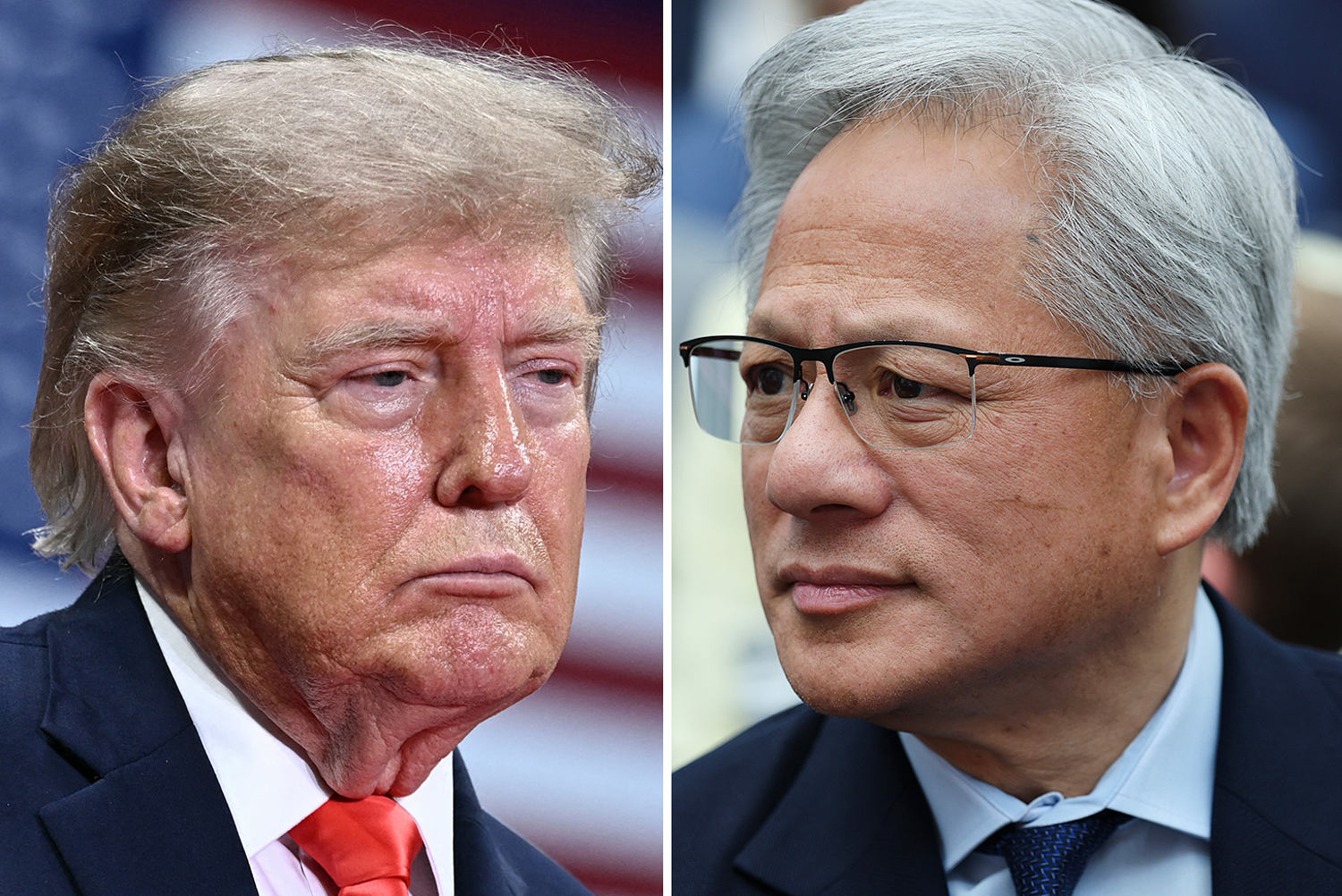
Political commentary regarding corporate leadership frequently creates noise that obscures operational reality, yet the recent remark by Donald Trump suggesting he "would not mind" if Jensen Huang returned as CEO of Nvidia reveals a critical structural disconnect between political rhetoric and corporate governance. Jensen Huang has served continuously as the Chief Executive Officer and President of Nvidia since co-founding the company in April 1993. A statement framing his leadership as a potential "return" operates on a factually false premise, yet the market and policy implications of executive endorsement at the highest levels of government require rigorous deconstruction. Analyzing this intersection requires separating factual corporate status from the strategic mechanics of political signaling, supply chain diplomacy, and semiconductor industrial policy.
The Anatomy of the Premise Error
To evaluate the strategic weight of political statements on technology leadership, analysts must first isolate factual reality from rhetorical framing. The assertion that Jensen Huang could "return" to a post he has never vacated for over three decades demonstrates a common friction point when political discourse intersects with specialized technology sectors. In similar developments, take a look at: Influencer University Is Selling You a Lottery Ticket Disguised as a Degree.
- Continuous Tenure: Jensen Huang co-founded Nvidia in 1993 alongside Chris Malachowsky and Curtis Priem. Unlike other major technology firms that experienced founder exits and subsequent returns—such as Apple with Steve Jobs or Twitter with Jack Dorsey—Nvidia’s executive structure has remained unbroken at the top.
- Board and Governance Structure: Under Delaware corporate law, where Nvidia is incorporated, the appointment and retention of a Chief Executive Officer rest entirely with the Board of Directors, acting as fiduciaries for the shareholders. Executive branch officials hold zero statutory authority over corporate leadership appointments unless a transaction triggers national security intervention under the Committee on Foreign Investment in the United States (CFIUS) or antitrust enforcement.
- The Mechanics of Rhetorical Slippage: In high-velocity political communication, prominent figures frequently conflate distinct corporate narratives. The premise of a "returning" CEO likely stems from cross-contamination with other high-profile corporate restructuring narratives, or a generalized heuristic that equates strong industrial performance with founder-led turnarounds.
This factual discrepancy does not render the statement irrelevant to institutional investors or corporate strategists. In political economy, the literal accuracy of a statement often matters less than the directional sentiment it signals to regulatory agencies, trade negotiators, and capital markets.
The Three Vectors of Political Signaling in Semiconductor Policy
When a political leader expresses approval—even via an understated idiom like "would not mind"—toward the chief executive of a systemic technology monopoly, that signal propagates through three distinct operational channels. The Wall Street Journal has provided coverage on this important topic in great detail.
1. Regulatory and Antitrust Posture
Nvidia commands a dominant share of the discrete graphics processing unit (GPU) and artificial intelligence accelerator markets. This market concentration naturally attracts scrutiny from the Department of Justice (DOJ) and the Federal Trade Commission (FTC) under Section 2 of the Sherman Act, which governs monopolization. A public endorsement of the incumbent chief executive signals a lower probability of aggressive, personality-driven regulatory hostility from an administration, shifting the institutional risk profile from existential structural breakup toward manageable behavioral remedies.
2. Export Control Calibration
Nvidia’s revenue architecture relies heavily on global distribution, creating acute friction with U.S. national security apparatus objectives. The Bureau of Industry and Security (BIS) within the Department of Commerce enforces strict export controls on advanced compute hardware destined for restricted jurisdictions, primarily China.
- The Compliance Bottleneck: Nvidia repeatedly engineers modified, lower-bandwidth chips (such as the A800 and H800, followed by the H20) to comply with evolving compute-density thresholds established by federal regulators.
- The Diplomatic Interface: Executive leadership must maintain continuous dialogue with Washington to prevent export restrictions from permanently ceding foreign market share to domestic competitors like Huawei. Publicly expressed goodwill from top political figures lowers the transactional friction required for a CEO to secure audiences with trade representatives and national security advisors.
3. Capital Allocation and Domestic Industrial Policy
Under the CHIPS and Science Act, the federal government allocates tens of billions of dollars in subsidies and tax credits to incentivize domestic semiconductor fabrication. While Nvidia operates as a fabless semiconductor designer—relying primarily on Taiwan Semiconductor Manufacturing Company (TSMC) for physical fabrication—its purchasing power dictates foundry capacity allocation. Political alignment with Nvidia’s leadership influences how federal incentives are structured to pull advanced packaging (such as CoWoS) and leading-edge node production onto U.S. soil.
The Cost Function of Executive-Political Alignment
Corporate leaders operating at the center of geopolitical competition face a complex optimization problem. Aligning too closely with any political faction introduces asymmetric risks, while maintaining total distance leaves the enterprise vulnerable to unfavorable regulatory shifts. We can model the strategic calculus of a technology CEO navigating political endorsements through a structural cost function:
$$\text{Net Strategic Value} = (R_a + T_f) - (P_b + G_r)$$
Where:
- $R_a$ (Regulatory Access): The increased capacity to shape technical definitions in export controls and AI safety frameworks.
- $T_f$ (Tariff Friction Reduction): The potential mitigation of broad-based import tariffs on hardware components assembled overseas before entering U.S. data centers.
- $P_b$ (Partisan Blowback): The alienation of opposing political coalitions, which can trigger retaliatory congressional subpoenas or state-level regulatory hurdles.
- $G_r$ (Geopolitical Retaliation): The risk that foreign governments view the company as an explicit instrument of U.S. statecraft rather than a neutral commercial vendor, accelerating domestic substitution mandates in foreign markets.
For Jensen Huang, whose operational strategy relies on positioning Nvidia as an essential, neutral infrastructure provider to every sovereign nation building "Sovereign AI" capabilities, managing $G_r$ is critical. A public endorsement from a U.S. political leader increases $R_a$ domestically, but simultaneously forces Nvidia’s international government affairs teams to work harder to reassure foreign ministries in Europe, the Middle East, and Asia of the company's commercial independence.
Operational Reality vs. Political Narrative
The divergence between the narrative of a "returning CEO" and the reality of a thirty-year continuous tenure highlights a fundamental truth in technology management: architectural dominance is built over decades, not election cycles.
Nvidia’s current market position is not the result of recent executive maneuvering, nor could it be replicated by simply installing a charismatic leader. It is the cumulative output of a multi-decade capital allocation bet initiated in 2006 with the introduction of CUDA (Compute Unified Device Architecture). By embedding a proprietary software layer onto parallel processing hardware long before deep learning achieved commercial viability, Huang created a switching-cost moat that competitors cannot easily breach with superior silicon alone.
Political commentary tends to compress complex, multi-year engineering and supply chain dependencies into simplified narratives of individual leadership. While a political figure may view a CEO through the lens of deal-making and personal loyalty, the semiconductor ecosystem operates on rigid physical and economic constraints:
- Lithography Bottlenecks: Leading-edge chip production depends entirely on extreme ultraviolet (EUV) lithography machines supplied solely by ASML in the Netherlands. No domestic political endorsement can accelerate the physics of optical fabrication or bypass global equipment supply chains.
- Packaging Capacity: Modern AI accelerators require advanced 2.5D and 3D packaging techniques to connect logic dies with High Bandwidth Memory (HBM). Supply constraints in HBM—dominated by SK Hynix, Samsung, and Micron—dictate shipment volumes far more than executive rhetoric.
- Energy Infrastructure: The deployment of GPU clusters is increasingly capped by electrical grid capacity and transformer availability rather than chip supply or regulatory approval.
Limitations of Political Endorsements in Tech Valuation
Institutional analysts and corporate strategists must recognize the hard boundaries of political influence when modeling long-term enterprise value for semiconductor firms. Relying on favorable political commentary as a thesis for capital allocation introduces severe analytical blind spots.
- Volatility of Political Sentiment: Political endorsements are non-binding and subject to rapid reversal based on shifting electoral coalitions, trade disputes, or media cycles. A statement of approval does not constitute a formal policy commitment or a durable regulatory safe harbor.
- Statutory Insulation: Independent regulatory bodies and career civil servants within the Department of Commerce and the DOJ operate under established administrative procedures. While executive branch leadership sets broad enforcement priorities, altering specific technical export thresholds requires formal rulemaking processes that cannot be bypassed by off-the-cuff remarks.
- Market Saturation Dynamics: The primary threat to Nvidia’s margin profile is not regulatory intervention, but the internal silicon development programs of its largest customers. Hyperscalers—including Google (TPU), Amazon (Trainium/Inferentia), Microsoft (Maia), and Meta (MTIA)—are actively designing custom Application-Specific Integrated Circuits (ASICs) to reduce their dependency on merchant GPU pricing. Political goodwill in Washington cannot compel private cloud providers to buy merchant silicon if custom architectures offer superior performance-per-watt for specific inference workloads.
Strategic Execution for Corporate Leadership
When high-profile political figures make factually imprecise but directionally supportive statements about an enterprise, the corporate communications and government affairs apparatus must execute a disciplined response protocol. Correcting the factual error publicly—pointing out that the CEO never left—creates unnecessary friction and converts a supportive gesture into a defensive media cycle. Conversely, embracing the endorsement openly compromises the company's political neutrality.
Corporate leadership should deploy a three-part containment and capitalization strategy:
- Bypass the Factual Correction: Allow financial analysts and trade press to note the continuous tenure independently. Corporate communications should maintain strict silence on the premise error to avoid alienating the political principal.
- Anchor Messaging to Industrial Output: Redirect any subsequent media or investor inquiries away from executive personality and toward concrete domestic economic metrics—specifically U.S. research and development headcount, domestic software ecosystem contributions, and supply chain partnerships with U.S.-based cloud and server manufacturers.
- Convert Goodwill into Technical Working Groups: Instruct government affairs teams to utilize the positive political climate to secure seats on technical advisory committees governing AI safety standards and export control definitions. Influence is most durable when embedded in the technical specifications of regulatory frameworks rather than the public rhetoric of political campaigns.