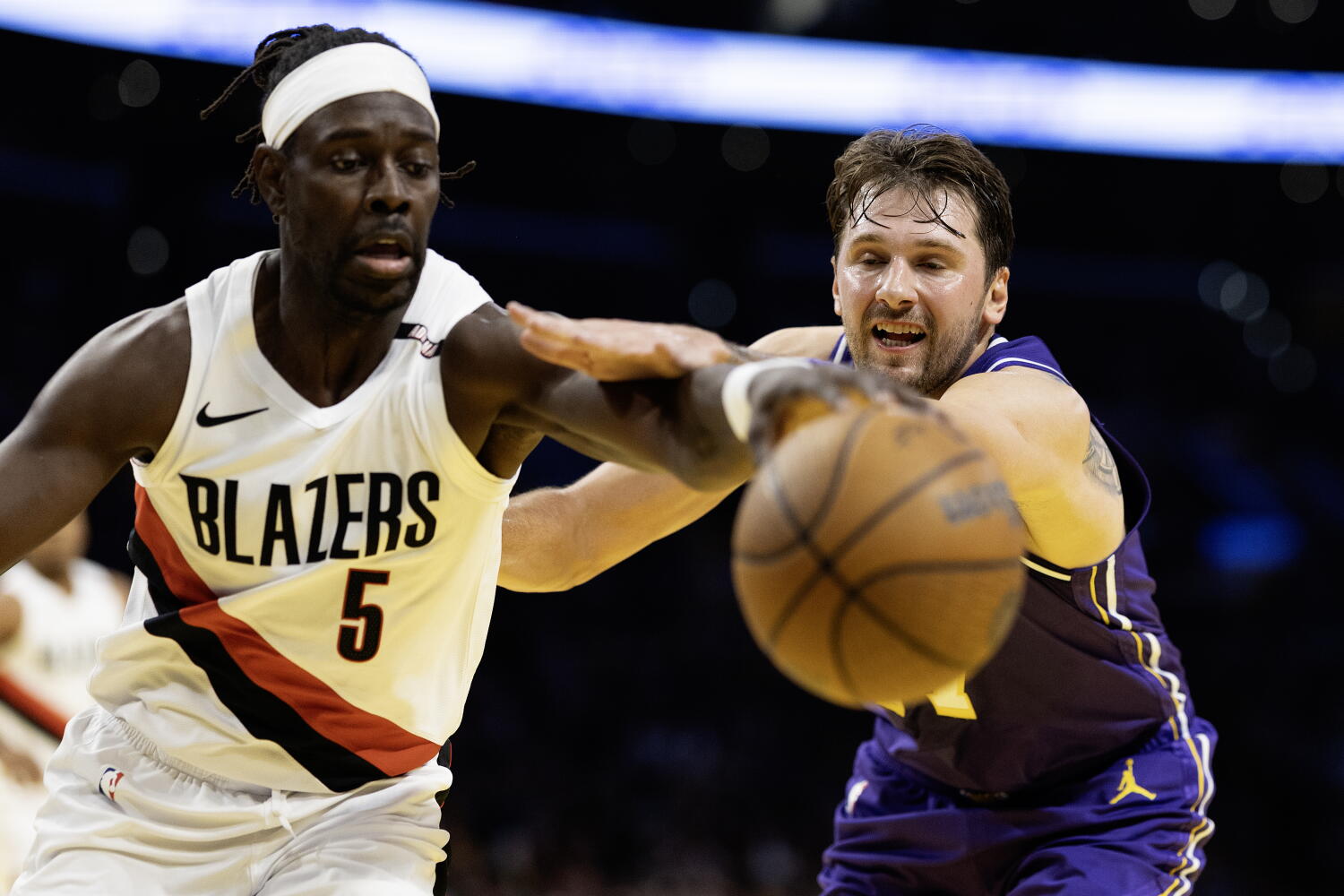
Revenge is a cold dish, sure, but inside a sweating arena smelling of stale beer, floor wax, and cheap nacho cheese, it tastes mostly like copper and bile.
When the final buzzer sounded on the Los Angeles Lakers’ prior meeting with the Portland Trail Blazers, the silence in the visitor’s locker room wasn't the loud, dramatic silence of a Hollywood script. It was dull. It was the sound of sneakers squeaking across wet tile and the low, rhythmic hum of an ice machine. They had lost. Not to a juggernaut, and not in a blaze of glory, but in the sluggish, humiliating way teams lose when their legs feel like bags of wet cement and their pride hasn't quite caught up to the scoreboard.
Days later, the rematch arrived. The box score from that second night will tell you one clean, sterile truth: Luka Doncic scored 53 points, and the Los Angeles Lakers avenged their loss to the Portland Trail Blazers.
Box scores are liars by omission. They tell you what happened, stripped of the pulse, the doubt, and the suffocating weight of wearing purple and gold when the city expects a coronation every Tuesday night. To understand what fifty-three points actually cost—and what they bought—you have to look past the ledger. You have to look at the geometry of exhaustion, the cruelty of memory, and the strange, heavy magic of a man who plays basketball like he is conducting an orchestra in slow motion while everyone else is sprinting on a treadmill.
The Weight of the Jersey
If you have never stood in the tunnel beneath the arena in downtown Los Angeles two hours before tip-off, it is hard to explain the atmospheric pressure.
I remember covering a mid-January game there years ago, leaning against the cinderblock wall near the media workroom. The building was mostly empty, save for the rhythmic thump-thump-thump of a ball boy rebounding for a rookie. Yet even in the quiet, the rafters felt crowded. Banners don't just hang there; they lean over the court. Every missed free throw is measured against Jerry West. Every lazy defensive rotation is an insult to Kobe Bryant’s ghost. Every sluggish loss to a rebuilding squad like Portland feels less like a statistical blip and more like an existential crisis.
When Luka Doncic arrived in Los Angeles, he didn't just inherit a roster. He inherited an expectation that treats anything short of perfection as a personal betrayal.
Consider a hypothetical fan sitting in Section 314—let’s call him Mateo. Mateo works double shifts at a warehouse in Vernon, saves for three months to buy two upper-deck tickets for himself and his ten-year-old son, and sits in forty-five minutes of gridlock on the 110 freeway just to make it by the national anthem. When Mateo watched the Lakers drop that first game to the Trail Blazers, he didn't care about defensive rating or back-to-back travel schedules. He saw a team that looked beat before the fourth quarter even began. He saw hesitation.
And Luka felt it. You could see it in the way he chewed on his jersey during dead balls in the first quarter of the rematch. Great scorers have a specific kind of vanity; it isn't the shallow vanity of mirrors, but the fierce, protective vanity of craftsmen who refuse to let their worst work stand as the final draft. That loss to Portland was an ugly draft. Doncic came out on the floor determined to burn the manuscript.
The Illusion of Slowness
To watch Luka Doncic dismantle an NBA defense is to witness a sustained violation of common sense.
In a league obsessed with vertical leap, forty-inch verticals, and blur-fast first steps, Doncic moves like a man carrying groceries up a flight of stairs. He lacks the explosive twitch of a young Russell Westbrook or the effortless, gliding grace of Kevin Durant. If you froze a frame of him driving into the lane, you would swear he was stuck in mud.
Yet nobody can stop him. Why?
Think of a chess grandmaster playing blitz against a street hustler. The hustler moves his pieces so fast his hands blur, slapping the clock with theatrical aggression. The grandmaster barely shifts in his chair. He takes a sip of water, nudges a pawn two squares forward, and suddenly the hustler realizes his queen has been trapped for six moves.
That is Doncic’s relationship with space and time. Basketball isn't actually a game of speed; it is a game of deceleration. Anyone can run fast in a straight line. Almost no one can go from sixty miles per hour to a dead stop in six inches without their knees buckling, all while keeping a defender pinned squarely on their hip like a backpack.
Against Portland in the rematch, that deceleration became a torture device.
Early in the second quarter, with the Trail Blazers clinging to a narrow lead and playing with the reckless, house-money confidence of a young team that already stole one game, Doncic isolated at the top of the key. Portland sent a long, wiry wing defender to crowd his airspace—the exact strategy that had disrupted the Lakers' rhythm in their previous loss.
Doncic didn't try to blow past him. He dribbled once, low and heavy. He leaned his left shoulder into the defender’s chest, creating a tiny, violent pocket of space. Then he stopped. His defender kept sliding backward, betrayed by his own momentum, expecting a drive that never came. Doncic rose up, off-balance by textbook standards, completely serene by his own, and drained a twenty-six-foot three-pointer.
Splash.
The crowd exhaled. You could feel the temperature in the arena shift by five degrees.
Anatomy of an Explosion
Scoring fifty points in a modern NBA game is no longer the mythological rarity it was in the nineteen-nineties, when defenses clutched, grabbed, and turned the paint into a bar fight. Today, pace is faster, the three-point line is an addiction, and offensive ratings sit at historic highs. Knowing that context matters; pretending otherwise would be dishonest.
Still, there is a vast canyon between an empty fifty—chucked up in garbage time of a blowout—and a necessary fifty.
This was the latter. Portland did not roll over. The Trail Blazers, fueled by young guards who view marquee matchups in Los Angeles as career-making auditions, punched back repeatedly. Every time the Lakers threatened to stretch the lead to double digits, Portland found a corner three or a backdoor cut to slice it back to four. The ghosts of the first loss lingered in the corners of the court, whispering that it might happen again.
In the third quarter, the game turned into a street fight masquerading as a sporting event.
Doncic absorbed contact on nearly every possession. A forearm to the ribs on a baseline drive. A rake across the wrists on a step-back jumper. By the midway point of the third, his left elbow was bleeding slightly, a thin crimson line smeared across his pale skin, and his face had turned that familiar shade of beet-red that signals he has entered the furnace.
People often mistake Doncic’s constant dialogue with referees for whining. Sometimes it is. But more often, it is theater—a way of keeping his own competitive rage simmering at an exact boil. He needs the friction. Without an adversary, without a perceived slight, he can drift into boredom. The loss to Portland gave him the grievance; the physicality of the rematch kept the fire fed.
By the end of the third quarter, he had thirty-nine points. The Lakers led by six. Nothing was safe.
The Crucial Pivot
Here is where lesser stars fracture, and where historical figures separate themselves from mere All-Stars.
When a player has nearly forty points through three quarters, the fourth quarter becomes a psychological trap. The defense sells out completely, throwing double-teams as soon as the ball crosses half-court. The crowd screams for fifty, seducing the scorer into taking terrible, contested shots to chase the milestone. Meanwhile, teammates stand around like spectators who forgot to buy tickets, watching their best player dribble the air out of the ball while the lead evaporates.
That exact script is how the Lakers lost the first game. They became predictable, static, and desperate.
In the fourth quarter of the rematch, Portland immediately trapped Doncic thirty feet from the basket. Two defenders lunged at him, arms outstretched like wings, daring him to force a pass through traffic or hoist a prayer.
Doncic didn't blink. He didn't force it. He simply looked over the top of the trap, snapped a one-handed bounce pass between a defender's ankles to a cutting teammate in the dunker spot, and stood still as the layup dropped in.
Two possessions later, the trap came again. Again, Doncic surrendered the ball immediately, triggering a crisp swing-swing rotation that ended in a wide-open corner three.
Portland panicked. If they doubled him, the Lakers scored layups and open threes. If they played him straight up, he backed his man down to the painted area, pivoted twice, and lofted soft, rainbow fadeaways that kissed the glass and fell through without touching the rim.
Suddenly, the game wasn't a tug-of-war anymore. It was an avalanche.
With three minutes left, isolated once more on the left wing, Doncic waved off a screen. He wanted the matchup. He dribbled through his legs once, twice, lulled his defender into a flat-footed stance, and stepped back behind the arc. The shot had so much height it seemed to brush the bottom of the scoreboard before dropping cleanly through the net.
Fifty-one.
Two free throws moments later pushed the tally to fifty-three. Portland called timeout, their shoulders slumped, the young guards staring at the hardwood as if trying to figure out where the floor had gone.
What the Numbers Hide
I will admit something that sports writers rarely like to confess: sometimes, even when you are watching greatness unfold right in front of you, it feels confusing. You look at the stat sheet afterward—53 points, 11 rebounds, 8 assists, shooting north of fifty percent from the field—and your brain struggles to reconcile the quiet, unhurried reality of what you just saw with the violent explosion those numbers represent.
There were no windmill dunks. There were no chest-thumping sprints down the sideline. Mostly, there was just a big guard walking up the court, calling out a coverage, taking what the defense gave him, and slowly squeezing the oxygen out of an entire opposing roster.
For Mateo, sitting up in Section 314 with his ten-year-old son, the ride home on the 110 freeway would feel entirely different tonight. The traffic would be just as miserable. The double shift at the warehouse the next morning would be just as grueling. Nothing about his actual life had changed because a Slovenian basketball player put a leather sphere through an iron hoop twenty-some times.
Yet something had changed. That is the irrational, stubborn bargain of sports. We invest our fragile, everyday pride in strangers wearing matching uniforms because we want proof that bad nights don't have to define us. We want to see someone get knocked down, look foolish, swallow their pride, and come back forty-eight hours later to rewrite the story on their own terms.
The Lakers walked off the court with their vengeance secured, the standings nudged slightly back into order, and the noise in Los Angeles quieted—at least until the next tip-off.
Down in the tunnel, long after the confetti of applause had died down and the arena crew began stacking chairs, Luka Doncic walked toward the locker room with an ice bag wrapped tightly around his right knee and a fresh strip of white athletic tape covering the scrape on his elbow. He wasn't smiling. He didn't look triumphant. He just looked tired, already calculating the distance to the next game, leaving fifty-three points behind him on the floor like spent shell casings in the dark.