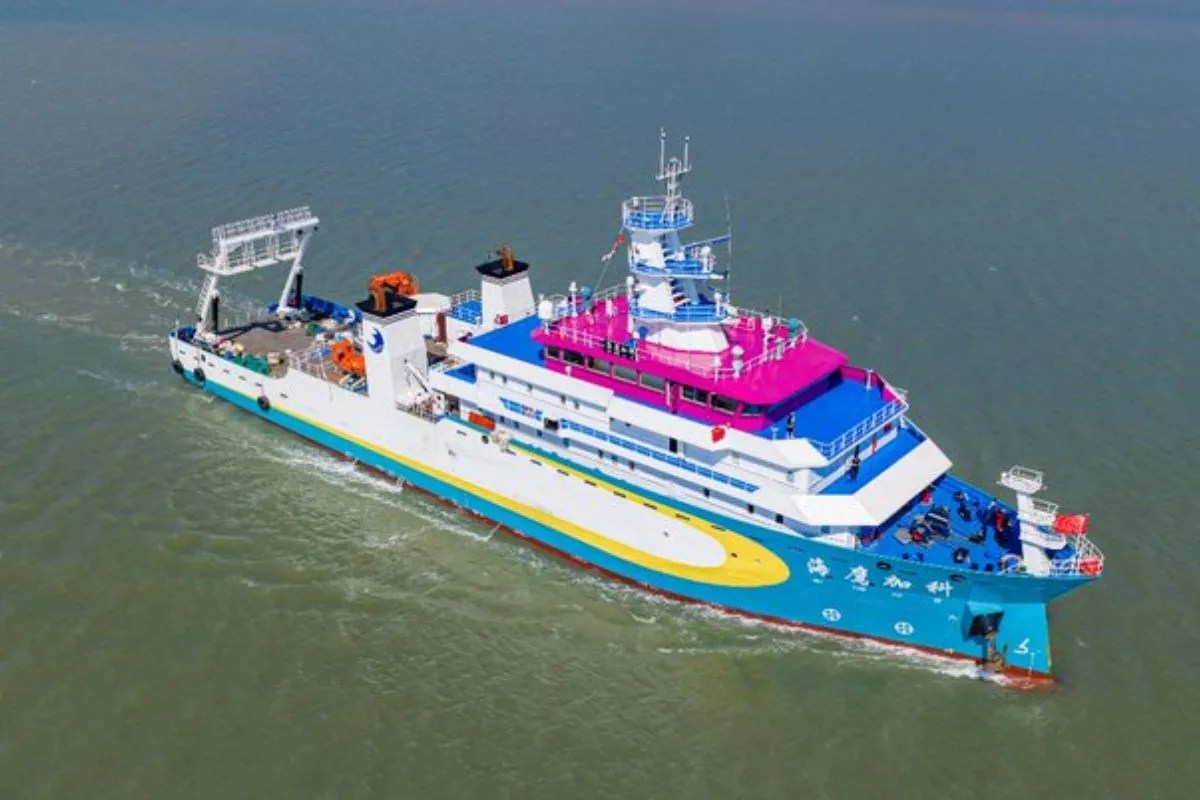
For decades, oceanographic exploration remained the exclusive domain of state treasuries and military command centers. Building a high-end research ship required massive national budgets, bureaucratic clearance, and institutional backing. That rigid framework shattered along the docks of Wenling in eastern China's Zhejiang province. Thirty-seven private investors, many rooted in commercial fishing, pooled one hundred fifty million yuan to construct the Haiying Jiake. This 3,500-ton ocean-going research vessel represents a profound shift in maritime finance. It answers a quiet question about who truly holds the purse strings for future oceanic expansion. When state shipyards and traditional institutional budgets face constraints or shifting priorities, private capital steps directly into the breach, buying sovereign-grade capabilities with commercial money.
Breaking the State Monopoly on the Deep Sea
Dive into the historical backdrop of China's marine research and the operational bottlenecks that forced a change. Traditionally, vessels operated under the Chinese Academy of Sciences, the Ministry of Natural Resources, or naval auxiliary units. These ships mapped abyssal plains, tracked ocean currents, and surveyed exclusive economic zones under strict governmental mandates. Yet, demand for ocean data has exploded beyond government capacity. Offshore wind farms, submarine cable routing, marine biotechnology prospecting, and deep-sea mineral exploration require an unprecedented volume of survey hours. For a different perspective, read: this related article.
State fleets hit operational bottlenecks. Shipyard queues grew longer, and private entrepreneurs recognized a lucrative service gap. By organizing a syndicate of thirty-seven private stakeholders, the initiative bypassed institutional red tape entirely. Capital flowed directly from private enterprise into heavy maritime engineering. The financing model relied on collective pooling rather than corporate debt or government subsidies, proving that private actors could assemble complex scientific assets independently.
The Mechanics Behind the Hull
Examine the physical vessel and its industrial pedigree. Built by Zhejiang Tenglong Shipbuilding—a regional yard historically known for bulk carriers, dredgers, and long-range fishing boats—the Haiying Jiake marks a major industrial milestone. A shipyard that once focused on commercial cargo carriers successfully delivered a sophisticated multi-mission research platform. The vessel displaces 3,500 tons and is equipped for geological surveying, geophysical prospecting, seabed mapping, remotely operated vehicle operations, and support functions for offshore oil fields. Similar insight on this trend has been provided by NPR.
These technical parameters position the ship at a unique commercial crossroads. It can execute high-precision seabed profiling that was previously restricted to state-owned flagships. Sea trials tested its acoustic systems, dynamic positioning, and propulsion stability. The economics of operating a private research asset allow for flexible chartering models, serving energy conglomerates, academic institutions, and commercial developers without waiting for state budget allocations. The shipyard itself gained invaluable experience in transition engineering, moving from low-margin bulk construction to high-specification scientific vessel manufacturing.
Dual Use Realities in Eastern Waters
Maritime analysts often examine how private commercial assets interact with state strategy in East Asia. Ports like Wenling and Quanzhou harbor deep traditions of seafaring where commercial enterprise and coastal defense historically overlapped. While the Haiying Jiake is registered as a civilian scientific vessel, its operational portfolio carries profound dual-use implications. High-resolution bathymetric mapping and geophysical data collection are vital for both civilian marine resource extraction and naval submarine navigation.
When private money finances oceanographic platforms with military-grade mapping capabilities, the boundary between private enterprise and national projection blurs. International observers track these developments closely, noting that private funding mechanisms provide an efficient workaround for expanding operational footprints across contested maritime spaces without direct government outlays. Commercial fishing fleets in Zhejiang and Fujian have long maintained close operational ties with maritime infrastructure networks, turning local investments into instruments of broader national reach.
Capital Flows and Strategic Horizons
Explore the broader financial model driving this transformation. Crowdfunding or syndicating capital among private citizens for heavy industrial infrastructure is rare, but Zhejiang's private economy has long thrived on collective investment models. Small-scale manufacturing bosses, shipping operators, and commercial fishing magnates pooled resources because they foresee direct utility in ocean data. As coastal waters face depletion, commercial actors are forced further offshore.
Finding viable offshore wind sites, securing deep-sea mining leases, or laying telecommunication cables requires proprietary bathymetric intelligence. Owning the research vessel guarantees priority access to critical survey data. This private funding model introduces a new competitive dynamic. If thirty-seven individuals can commission a 3,500-ton floating laboratory, other coastal provinces and private consortia will follow suit. The privatization of oceanography is no longer a theoretical concept. It floats quietly on the East China Sea, anchored by private ledgers and driven by an insatiable appetite for marine resources