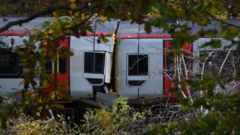
The immediate aftermath of a fatal train crash always follows the exact same script. The headlines scream about how the tragedy "could have been avoided." Politicians demand immediate, sweeping investigations. Pundits call for the systemic overhaul of rail infrastructure, insisting that if we just spend enough billions, implement enough automatic braking tech, and enforce enough regulations, we can achieve the holy grail of transit: zero risk.
It is a comforting narrative. It is also entirely wrong.
When a train collision kills one passenger and injures others, the lazy consensus is to treat the incident as a structural moral failure. The public demands an absolute guarantee of safety. But here is the brutal reality of risk architecture that transport journalists completely miss: chasing absolute safety in rail systems creates a deadlier society.
When you over-regulate and over-engineer rail to eliminate the final fraction of a percent of operational risk, you drive up compliance costs and trigger massive service delays. Rail networks respond by raising ticket prices and cutting routes. Passengers do not stop traveling; they simply migrate to the highways. By making trains prohibitively expensive or inconvenient through an obsession with zero-risk engineering, we push people into passenger vehicles.Statistically, driving a car is vastly more dangerous than riding a train per passenger mile.
By demanding absolute perfection from rail, we inadvertently kill more people on the roads.
The Fallacy of the Preventable Accident
Every accident is preventable in hindsight. If the train had stayed in the depot, the crash would not have happened. If the speed limit across the entire national network was reduced to five miles per hour, fatalities would drop to zero.
But infrastructure does not exist in a vacuum. It exists to balance throughput, economic viability, and safety.
I have spent years analyzing capital allocation in heavy transit infrastructure. I have watched boards burn through millions of dollars trying to solve edge-case anomalies that happen once every two decades, while ignoring systemic maintenance backlogs that cause daily operational headaches. This is the product of fear-based engineering.
When a regulatory body demands that a rail line install the most advanced iteration of Positive Train Control (PTC) or European Train Control System (ETCS) Level 3 on a low-density rural track to prevent a one-in-a-million collision, they are misallocating capital.
Let us break down the actual mechanics of transit risk. Risk is calculated using a straightforward formula:
$$\text{Risk} = \text{Probability of Occurrence} \times \text{Severity of Impact}$$
In rail transport, the severity of impact can be incredibly high when a failure occurs. This is why the industry uses Safety Integrity Levels (SIL), ranging from SIL 1 to SIL 4, to classify the reliability requirements of safety functions.
$$\text{SIL 4} \rightarrow \text{Probability of Failure per Hour} = 10^{-9} \text{ to } 10^{-8}$$
Achieving a SIL 4 rating requires extreme redundancy, rigorous software verification, and astronomically expensive hardware. When you force a rail operator to implement SIL 4 systems across every single mile of track to satisfy a political knee-jerk reaction to a recent crash, you run into the law of diminishing returns.
The cost curve for safety is exponential, not linear. Moving from 99% safety to 99.9% safety might cost a few million dollars. Moving from 99.99% to 99.999% can bankrupt an operator.
When costs skyrocket, the money has to come from somewhere. It comes from deferred maintenance on track geometry, reduced service frequencies, or outright line closures.
People Also Ask: The Wrong Questions About Rail Safety
If you look at public forums or search trends after a major rail incident, the questions asked by the public betray a fundamental misunderstanding of engineering trade-offs.
Why can't trains just stop automatically if there is an obstacle?
The public assumes that modern sensors and automated braking systems can magically violate the laws of physics. A fully loaded freight train or a high-speed passenger convoy can require more than a mile of braking distance due to the incredibly low coefficient of friction between steel wheels and steel rails.
$$\mu_{\text{steel-on-steel}} \approx 0.15 \text{ to } 0.20$$
Compare this to a rubber tire on dry asphalt, where the coefficient of friction is much higher:
$$\mu_{\text{rubber-on-asphalt}} \approx 0.70 \text{ to } 0.80$$
Because of this physical limitation, automatic braking systems cannot simply react to an obstacle visible in the immediate line of sight. They rely on predictive signaling blocks. If an anomaly occurs inside a signaling block due to an unpredictable event—such as a sudden flash flood washing out ballast or an unmapped vehicle clearing a crossing incorrectly—no amount of automated technology can stop the train in time. Automation is not a magic shield against the laws of momentum.
Why don't we just build grade separations for every single intersection?
Eliminating level crossings by building bridges or underpasses for every road intersection would drastically reduce accidents. But the cost is staggering. Building a single grade-separated crossing can cost anywhere from five million to fifty million dollars depending on urban density and geological constraints.
If a transit authority has a limited budget of one hundred million dollars, spending it all to eliminate two level crossings might save one life over ten years. If they spent that same one hundred million dollars on upgrading basic track switching infrastructure or improving regional bus-to-rail integration, they could take thousands of cars off the road, saving dozens of lives over the same period.
The obsession with localized rail incidents blinds the public to macro-level safety optimization.
The Danger of Regulatory Creep
The real villain in the wake of a high-profile train crash is regulatory creep. Regulatory bodies feel immense pressure to show they are taking action. They draft sweeping mandates that require immediate implementation of unproven or overly complex technologies.
Consider the deployment of early-stage train control systems. When regulators rushed these mandates through in various jurisdictions over the last two decades, the result was a cascade of software glitches, systemic delays, and billions of dollars in cost overruns. Operators had to divert funds away from basic, unglamorous safety measures—like clearing vegetation from signal lines and replacing worn wooden ties—just to comply with the digital mandate.
Furthermore, over-engineering creates a false sense of security among human operators. When a system becomes hyper-automated, human crews experience a phenomenon known as automation complacency. They assume the machine will catch every error. When the machine inevitably encounters a edge-case scenario that its programming did not anticipate, the human operator is too disengaged to react quickly enough to mitigate the damage.
The Hard Truth of Infrastructure Management
Amateurs talk about absolute safety. Professionals talk about risk tolerance and capital efficiency.
If we truly want to minimize transport-related deaths, we must accept that rail accidents will occasionally happen. We must resist the urge to over-engineer the rail network to the point of economic paralysis.
The downside to this contrarian approach is obvious and uncomfortable: it means accepting that, on rare occasions, people will die in train accidents that theoretically could have been prevented if we spent an infinite amount of money. It means standing up to grieving families and angry voters and telling them that an infinite safety budget is an economic crime against the rest of the population.
But the alternative is worse. The alternative is a pristine, hyper-regulated, incredibly expensive rail network that carries fewer passengers every year while the highways clog up with commuters who are forty times more likely to die on their way to work.
Stop demanding that rail systems be completely flawless. Every time you scream for zero-risk train networks, you are signing death warrants for drivers on the highway. Turn down the emotional volume, stop chasing engineering utopias, and look at the broader transport system.