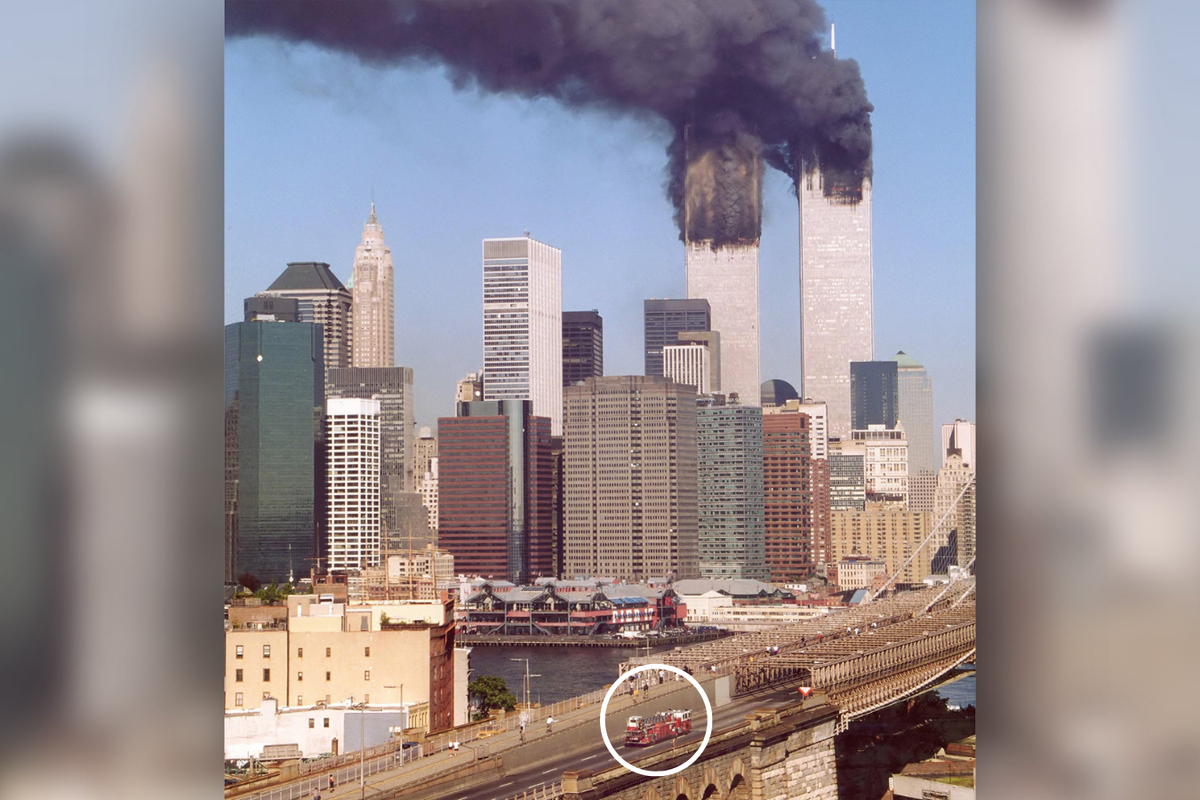
On the morning of September 11, 2001, twenty-year-old Aaron McLamb stood on the top floor of a ten-story Brooklyn factory, holding a Canon Rebel 2000. Below him, the world was fracturing. The North Tower of the World Trade Center was already burning, a vertical wound bleeding black smoke across the East River. When the second plane struck the South Tower, McLamb did not drop his equipment or run for the stairwell. He tracked the unmistakable red flash of a tiller truck leaving a Brooklyn quarters, watched it thread its way toward the Brooklyn Bridge, and pressed the shutter.
That single frame—capturing Ladder 118 speeding toward lower Manhattan with the twin plumes of smoke rising in the background—became an accidental monument. None of the six men aboard that rig survived the collapse of the South Tower. Yet long before the image graced the front page of the New York Daily News or entered the collective visual archive of a scarred nation, it existed simply as an act of compulsive observation by a young man who happened to love fire apparatus.
We talk endlessly about iconic photography as if it is summoned by design. Photojournalism textbooks love to preach about composition, decisive moments, and professional detachment. But the archive of twentieth and twenty-first-century tragedy is littered with an uncomfortable truth: the most enduring documents of human catastrophe are frequently captured by amateurs who had no business being in the right place at the right time, armed with consumer-grade gear and zero editorial oversight.
McLamb was not accredited. He was a volunteer worker printing religious texts in a Brooklyn facility, possessing an amateur's fascination with emergency vehicles. When the sirens began to stack on top of one another—that eerie, mechanical chorus echoing across the East River canyons—he recognized a specific rhythm. He knew the local apparatus. He tracked Ladder 118 not because he possessed prophetic foresight of their doom, but because heavy iron moving toward danger was the only logical motion in a city suddenly unhinged.
The mechanical reality of that morning deserves closer scrutiny. In 2001, digital photography was in its clunky infancy; high-end newsrooms relied on early digital backs or trusted the brutal reliability of 35mm film. McLamb shot on film. He had to wind, frame, and commit light to silver halide without the luxury of an LCD screen confirmation. He could not zoom in to check focus or re-shoot a bracketed exposure. When the dust cloud from the collapse of the towers swept across the river, it acted as a physical shutter, ending his vantage point and forcing the factory workers to seal every window against the toxic grey fog.
Only days later did the film make its way to the Middagh Street firehouse in Brooklyn Heights. Surviving firefighters, moving in the dazed, hollow silence of men who had lost half their shift, peered through a magnifying glass at the developed prints. They did not need a caption. They recognized the sweep of the tiller trailer, the specific placement of the equipment boxes, the ghostly geometry of a rig they had scrubbed and checked just hours prior.
The weight of documentary photography in a crisis lies in its cruel irony. The better the picture, the more terrible the backstory. We consume these frames as art or history, yet they are fundamentally receipts of loss. Every viewer who looks at McLamb’s photograph of Ladder 118 is cursed with retroactive omniscience. We see the smoke, we see the bridge, we see the engine moving with high-stakes urgency, and our brains instantly supply the catastrophic punchline that the photographer could not possibly have known.
This creates a peculiar ethical burden for the amateur archivist. Professional photographers are trained to metabolize trauma, to hide behind the lens as a psychological shield against reality. Amateurs stumble into the frame raw. McLamb went back to his life, walked through inches of alkaline ash on the Brooklyn pavement, and sat in his apartment watching the endless loop of tower collapses on television. The ownership of the image felt almost improper to him—a heavy artifact handed over to a newspaper because keeping it locked in a drawer felt like withholding public property from a grieving city.
Decades later, the digital ecosystem treats these artifacts differently. They are scanned, metadata-tagged, compressed, and re-uploaded into infinite feeds where context is routinely stripped away for quick emotional consumption. A picture meant to honor a specific, devastating Tuesday morning in Brooklyn and Manhattan risks becoming flattened into stock symbolism.
We must resist the urge to sanitize these moments into myth. The six men on that truck—Peter Vega, Ronald Bucca, Joseph Agnello, Vernon Cherry, Leon Smith, Robert Regan—were not cinematic archetypes when they crossed that span. They were municipal workers responding to an alarm, carrying tools up the stairs of the Marriott Hotel because that was the protocol, the duty, and the instinct.
The camera simply caught them mid-stride. A twenty-year-old kid with a stock lens clicked the shutter because a red truck caught his eye, unaware that he was freezing the exact second ordinary life evaporated into legend. The negative remained hidden in a drawer until veterans of the house squinted at a strip of film and whispered names they would no longer say at roll call.
The duty board at the Middagh Street firehouse remains frozen in chalk. The names are still there, written next to assignments that time rendered absolute. And somewhere in the vast ether of digital memory, the amateur's frame continues to travel—a permanent warning shot from a morning that refuses to stay in the past.