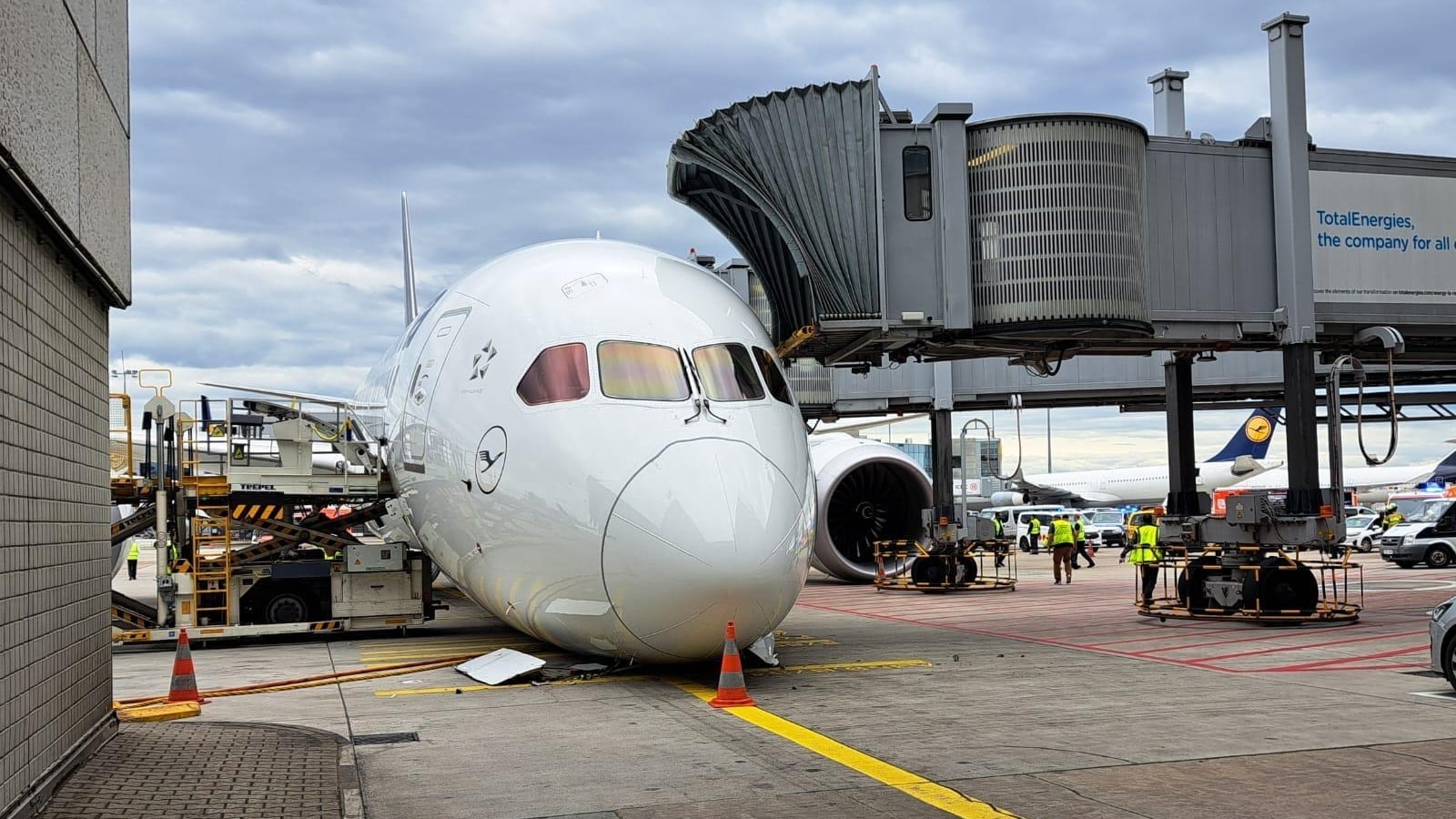
The headlines practically wrote themselves. A Boeing 787 Dreamliner, sitting passively at a Frankfurt Airport gate, suffers a nose gear collapse. Lufthansa ground crew members are injured. Cue the immediate, predictable internet meltdown. Social media feeds light up with recycled panic about manufacturing flaws, corporate negligence, and the apparent existential dread of stepping onto a modern widebody aircraft.
It is a masterclass in lazy journalism. It satisfies a cheap appetite for sensationalism while completely missing the structural reality of how modern aviation actually operates.
When a nose gear retracts on the tarmac, the knee-jerk reaction is to blame the airframe builder. It is an easy narrative. But anyone who has spent decades analyzing line maintenance operations, turnaround protocols, and line-replaceable unit (LRU) failure modes knows that airplanes do not just decide to fold their legs while parked.
The mainstream press looks at a collapsed nose gear and sees a terrifying design flaw. They are asking the wrong question. They want to know what is wrong with the metal. The real question is far more uncomfortable: why are human maintenance interfaces still designed to allow catastrophic operational errors during a standard turnaround?
The Illusion of the Autonomously Failing Gear
Let us dismantle the physics of a parked commercial airliner. A nose landing gear assembly is not a fragile stick of aluminum. It is a massive, heavily engineered column designed to withstand crabbed landings in crosswinds and violent structural impacts on touchdown.
When an aircraft is on the ground, multiple redundant mechanical and hydraulic systems prevent the landing gear from retracting.
- The Weight-on-Wheels (WoW) System: Mechanical proximity sensors detect the physical compression of the landing gear struts. When compressed, these sensors send electronic signals to the flight control computers, physically locking the gear selector lever in the down position and isolating the hydraulic lines responsible for retraction.
- The Ground Locking Pins: Heavy, physical steel pins with bright red "Remove Before Flight" streamers are manually inserted directly into the gear geometric lock links by ground crews. These pins provide a brute-force mechanical block. Even if the hydraulics receive a full pressure command to retract, the physical geometry of the link cannot move.
For a nose gear to collapse on the ground, a specific sequence of barriers must fail simultaneously. The laws of probability and modern aerospace engineering mean that spontaneous mechanical failure of a locked gear link while static is functionally zero.
When a gear collapses at the gate, it is almost never an engineering flaw. It is an operational intervention.
I have seen operations teams throw millions of dollars at investigating hypothetical structural fatigue when the actual culprit was a technician pulling a maintenance bypass pin out of sequence or cycling hydraulic systems while a mechanical lock was omitted. Aviation media treats a gate incident like a mid-air structural failure. In reality, it is usually closer to someone accidentally knocking the jacks out from under a car in a repair shop.
Dismantling the Ground Safety Panic
The public looks at an incident like the Frankfurt collapse and asks a fundamentally flawed question: Is it safe to fly on this aircraft model?
The Google "People Also Ask" algorithm populates with queries driven by pure anxiety: Why do landing gears fail? Which planes are safest?
Let us answer that with brutal honesty. The premise that a ground incident dictates flight safety is mathematically illiterate.
+------------------------------------+------------------------------------+
| The Sensationalist Narrative       | The Hard Operational Reality       |
+------------------------------------+------------------------------------+
| A parked aircraft collapsed,       | Human-machine interface errors     |
| proving that the airframe design   | during high-pressure turnarounds  |
| is inherently unstable.            | create isolated ground incidents.  |
+------------------------------------+------------------------------------+
| Ground crew injuries mean the      | Gate operations carry industrial   |
| entire fleet poses an immediate    | hazards completely detached from   |
| risk to passengers mid-flight.     | aerodynamic airworthiness.         |
+------------------------------------+------------------------------------+
An aircraft undergoing pre-flight preparation is not an active flight environment. It is an industrial construction zone. Heavy machinery is moving. High-pressure hydraulic lines are being pressurized and bled. Fuel trucks are pumping thousands of gallons of volatile liquid. Catering trucks are hoisting tons of cargo to cabin level.
When a ground crew member is injured because a nose gear drops, it is an industrial workplace accident. It is tragic, it requires rigorous OSHA-level investigation, and it demands better ground handling protocols. But treating it as a sign that the sky is falling is a deliberate distortion of risk metrics.
The true vulnerability in modern aviation is not the integrity of the titanium forge. It is the punishingly tight turnaround window imposed by legacy carriers trying to sweat their capital assets. When an airline demands that a widebody twin-aisle jet cross an ocean, land, discharge hundreds of passengers, undergo deep maintenance checks, restock, refuel, and push back within ninety minutes, they are running a high-stakes race against the clock.
Under that kind of operational pressure, human beings skip steps. They pull the lock pin five minutes too early because the tug driver is gesturing wildly. They misinterpret a cockpit light because they have been working a double shift at a freezing hub airport.
The Downside of True Objectivity
Taking a hard, data-driven stance on aviation incidents comes with an uncomfortable truth. The contrarian view forces us to acknowledge that human error remains our greatest systemic vulnerability.
It is comforting to blame a massive, faceless corporation for a hardware defect. If a corporation made a bad part, they can fix it with a recall. We can all sit back, wait for the airworthiness directive, and feel safe again.
It is far more terrifying to admit that our safety relies on underpaid, exhausted ground crews strictly following a 400-step checklist at three o'clock in the morning in driving rain. If the system relies on perfect human execution in a high-stress environment, the system is fundamentally fragile.
Consider the mechanics of the nose gear lock system. The safety pin is a low-tech solution to a high-tech problem. It is a piece of metal on a cord. If the ground crew forgets to insert it, or inserts it into the wrong guide hole—a mistake that has happened on almost every major commercial airframe type over the last fifty years—the safety net vanishes.
Imagine a scenario where a technician needs to test the nose wheel steering system. To do this, they may need to deactivate certain interlocks or pressurize the utility hydraulic system. If the mechanical lock pin is missing, that hydraulic pressure does not just turn the wheels; it can inadvertently actuate the retraction cylinder. The plane tries to park on its face.
This is not a Boeing problem. This is not a Lufthansa problem. This is a human-machine interface problem that spans across Airbus, Embraer, and every major military transport division on earth.
The Fix is Not Better Steel
The aviation industry does not need to redesign landing gear cylinders. It needs to redesign the psychological environment of the turnaround.
If you want to stop nose gear collapses, stop looking at the wreckage. Look at the digital logs and the shift schedules.
- Automate the Geometric Lock: We must phase out manual steel ground pins entirely. A modern widebody aircraft should feature an internal, electronically actuated, mechanically default-closed ground lock that physically prevents retraction whenever the weight-on-wheels sensor registers a load, requiring a deliberate, two-factor physical key override outside the cockpit.
- Decouple Maintenance from Turnaround Times: Airlines must stop penalizing line maintenance crews for delays caused by safety double-checks. If a crew needs to verify a lock status, the clock must stop. The financial penalty for a missed departure slot is currently so high that it acts as a direct psychological counter-incentive to meticulous safety compliance.
- Standardize the Interface: Ground handling gear vary wildly across airport hubs. A ground handler at Frankfurt might be hooking up a tow bar to a 787 in the morning and a different tractor to an A350 in the afternoon. The variance in safety pin locations and bypass switch configurations across manufacturers is an open invitation to cognitive slip.
Stop reading the breathless reporting from analysts who have never held a torque wrench. The Frankfurt incident was not an aviation catastrophe. It was a loud, expensive reminder that when you rush the people who maintain the machines, the laws of gravity will eventually penalize your impatience.
Turn off the news tracking fleet groundings. Look at the schedule pressure of the airline you are booking. That is where the real risk hides.