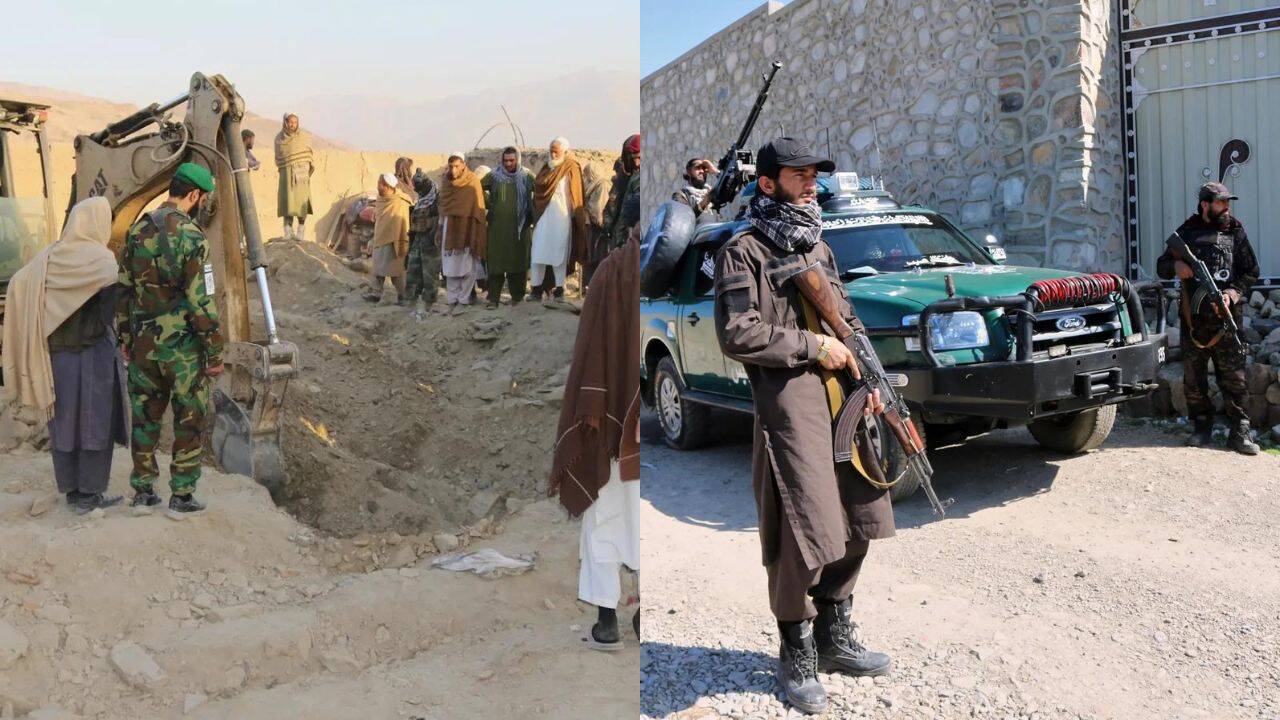
The operational matrix governing relations between the Islamic Emirate of Afghanistan and the Islamic Republic of Pakistan shifted fundamentally on June 18, 2026. Kabul’s formal declaration of airstrikes targeting alleged Islamic State Khorasan Province (ISIS-K) sanctuaries inside the Pakistani provinces of Balochistan and Khyber Pakhtunkhwa represents an unprecedented reversal of historical cross-border dynamics. For decades, the structural directionality of kinetic cross-border intervention ran almost exclusively from Islamabad into Afghan territory. By executing and publicizing asymmetric cross-border actions, the Taliban regime is attempting to establish tactical parity, shifting from defensive diplomacy to an offensive containment strategy along the contested 2,640-kilometer Durand Line.
To understand this escalation, analysts must look beyond immediate political rhetoric and examine the specific military mechanisms, structural asymmetries, and economic calculations driving both states toward an increasingly unmanageable border war. Meanwhile, you can find similar events here: Germany and the Brutal Reality of Its Missing Army.
The Strategic Triad: Cross-Border Sanctuaries and Proxy Dynamics
The conflict between Kabul and Islamabad operates within a closed system of mutual security dilemmas. Each state projects internal security failures across the border, creating a self-reinforcing loop of kinetic retaliation. This dynamic is governed by three primary structural pillars.
The Asymmetric Sanctuary Loop
Both nations exploit or tolerate insurgent sanctuaries to project leverage or insulate themselves from internal blowback. To understand the complete picture, check out the excellent analysis by Reuters.
- The Western Vector: Pakistan isolates the Tehreek-i-Taliban Pakistan (TTP) as its primary external threat. Islamabad argues that the TTP utilizes eastern Afghan provinces (Khost, Paktika, Kunar) as strategic depth, executing attacks against Pakistani security personnel before retreating into sovereign Afghan territory.
- The Eastern Vector: Afghanistan identifies ISIS-K and anti-Taliban resistance elements as its core existential threats. Kabul asserts that these groups exploit structural governance deficits in Pakistan’s federal tribal enclaves and Balochistan to plan operations targeting the Taliban leadership.
The Deterrence Failure Equation
The breakdown of bilateral deterrence stems from an imbalance between state capacity and local enforcement. The Taliban administration lacks the conventional air superiority or heavy armor required to seal the border, while Pakistan's military apparatus faces deep institutional constraints, including sustained low-intensity insurgencies in Balochistan and volatile political friction domestically. Because neither state can effectively police its side of the frontier, kinetic cross-border strikes have become the default tool to demonstrate internal resolve, despite yielding marginal strategic returns.
The Failure of Trilateral Mediation
Diplomatic mechanisms designed to stabilize the frontier have hit an institutional bottleneck. Multilateral engagement frameworks spearheaded by regional powers—specifically the China-mediated talks in Urumqi—have consistently prioritized economic stability and infrastructure expansion over addressing the core security architecture. Because these mediation frameworks lack independent verification mechanisms to monitor border movements or audit militant camps, agreements consistently dissolve into mutual recrimination whenever a high-casualty bombing occurs on either side.
Technical Auditing of the June 18 Kinetic Claims
The Afghan Ministry of Defense claims its air force conducted targeted strikes against hardened ISIS-K positions on Thursday night. Analyzing the logistical reality of the Afghan Air Force (AAF) requires balancing these state assertions against independent capability assessments.
Data compiled by the London-based International Institute for Strategic Studies indicates the AAF operates with severe material constraints. The fleet lacks conventional, manned fixed-wing strike fighters. The active inventory consists of approximately six light fixed-wing utility aircraft and 23 rotary-wing platforms, primarily aging Mi-17 transport and MD-530 light scout helicopters left behind or recovered after the August 2021 Western withdrawal.
Given these material parameters, the strategic mechanism for an airborne operation inside Pakistani airspace relies on one of two operational hypotheses:
- Hypothesis A: Asymmetric Unmanned Aerial Systems (UAS). The Taliban have successfully engineered or procured low-cost, long-endurance loitering munitions and reconnaissance drones. These systems have a small radar cross-section, allowing them to exploit gaps in regional low-altitude radar coverage along mountainous terrain. This aligns with Pakistan's official information ministry counter-claim, which asserted that no manned strikes occurred and that a solitary drone was intercepted after crossing the frontier.
- Hypothesis B: Stand-off Rotary Infiltration. Afghan rotary assets may have utilized terrain-masking techniques through the deep valleys of Khyber Pakhtunkhwa to execute low-altitude, short-range rocket or mortar delivery against border-adjacent targets, immediately retrograding before Pakistani air defense networks could formalize a target lock.
The Economic and Geopolitical Cost Functions
The transition from localized border skirmishes into a semi-formal air campaign introduces severe cost penalties that threaten the economic survival of both regimes.
[Border Kinetic Escalation]
       │
       ▼
[Frequent Border Closures]
       │
       ▼
[Supply Chain Disruption & Revenue Collapse]
       │
       ▼
[Domestic Inflationary Surges]
The Trade-Tariff Bottleneck
The immediate casualty of cross-border escalation is bilateral trade. Key border crossings—most notably Torkham and Chaman—serve as economic lungs for landlocked Afghanistan and vital markets for Pakistani manufactured goods. When military exchanges intensify, these ports of entry close.
This disruption acts as an economic shock wave. It halts customs revenue collections, strands perishable agricultural exports, and causes immediate domestic inflationary spikes. For Kabul, the loss of daily customs transit fees directly undermines its fragile self-funding model. For Islamabad, a closed western border cuts off direct overland access to Central Asian energy and consumer markets, aggravating its ongoing foreign exchange crisis.
Regional Infrastructure Paralysis
The escalation places structural roadblocks in front of long-term regional integration initiatives. The viability of the Turkmenistan-Afghanistan-Pakistan-India (TAPI) gas pipeline and the Central Asia-South Asia power project (CASA-1000) depends entirely on a stable security landscape along the Durand Line. As long as the border remains an active combat zone, international consortiums will refuse to deploy the capital or personnel required to construct these transit corridors, locking both nations out of critical transit revenue.
Structural Constraints of Border Management
The fundamental vulnerability governing this conflict is the physical and historical reality of the border itself. The Durand Line remains an artificial demarcation line that bisects close-knit Pashtun tribal geographies.
The multi-billion-dollar border fencing initiative launched by Pakistan in 2017 has failed to deliver total security isolation. Topographical realities make absolute sealing impossible. Deep ravines, subterranean cave complexes, and dense mountain forests defy continuous physical barriers.
Furthermore, any attempt by either military apparatus to enforce strict passport and visa regimes fractures centuries-old local micro-economies. This creates deep resentment among border communities, turning local populations into passive or active facilitators for cross-border smuggling and insurgent transit. The border cannot be managed purely as a military problem; it is an economic ecosystem that resists rigid state institutionalization.
Tactical Realignments and Future Scenarios
The traditional paradigm where Pakistan maintained absolute escalatory dominance along the frontier has dissolved. By executing retaliatory actions, the Taliban have signaled that future Pakistani strikes inside Afghanistan will face immediate, asymmetric blowback on Pakistani soil.
The most probable trajectory indicates a move toward a highly localized war of attrition. Neither state possesses the fiscal reserves or domestic political stability to sustain a full-scale conventional ground invasion. Instead, operations will likely crystallize around cyclical, low-yield drone deployments, cross-border artillery duels, and targeted proxy assassinations.
The primary danger rests on the potential for catastrophic miscalculation. If an uncoordinated Afghan drone strike or an uncalibrated Pakistani artillery shell hits a high-value civilian or command center deep within either country, political pressure will force a rapid escalatory response. This risk is heightened by the absence of functional, direct military-to-military hotlines between Kabul and Islamabad, meaning that any misinterpretation of radar data or border movements could quickly spiral into a wider regional conflict.
Taliban Cross-Border Strikes Into Pakistan's Terror Camps provides a detailed broadcast assessment of these unfolding cross-border operations and the escalating defense postures of both neighboring countries.