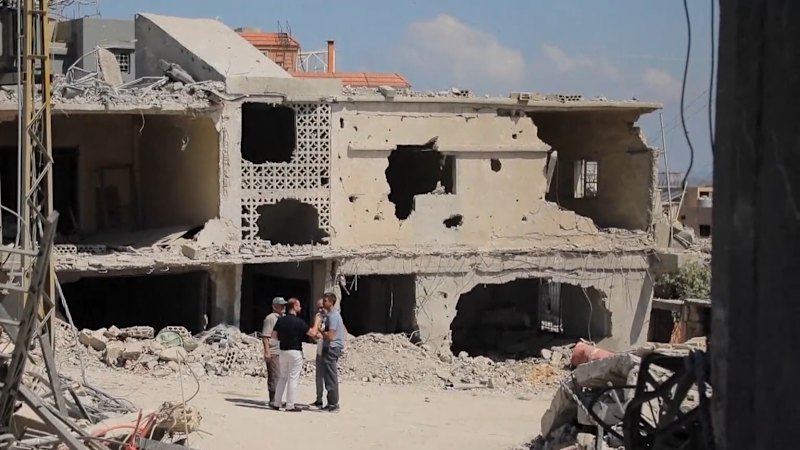
National security strategies often rely on a foundational spatial design flaw: the belief that holding physical territory inside a sovereign competitor’s border guarantees domestic security. The joint declaration issued by Prime Minister Benjamin Netanyahu, Defense Minister Israel Katz, and IDF Chief of Staff Lt. Gen. Eyal Zamir reasserting a commitment to maintain a 10-kilometer deep security zone inside southern Lebanon reveals a classic operational paradox. While intended to isolate domestic populations from short-range tactical kinetic threats, the open-ended occupation of sub-Litani territory introduces structural friction that undercuts broader macro-diplomatic stabilization frameworks.
The immediate friction manifests in the direct collision between Jerusalem's tactical mandate and the broader US-Iran multilateral diplomatic framework negotiated in Switzerland. The framework seeks an immediate, permanent cessation of military operations across all regional fronts. By anchoring troops inside Lebanese territory up to the outskirts of Nabatieh and the Ali Taher ridge, the state introduces a permanent operational friction point.
Understanding why this architecture fails to achieve its stated goals requires breaking down the strategic cost functions, target-hardening dynamics, and structural misalignment inherent in unilateral border enforcement.
The Tri-Border Friction Model
The persistence of an un-negotiated military presence inside an adversarial state can be modeled through three distinct dimensions: tactical value, diplomatic leverage, and organizational risk. When a military body expands its perimeter to create a physical buffer, it shifts the operational equilibrium across all three fields.
1. Tactical Demolition vs. Friction Generation
The physical destruction of subterranean structures, launch nodes, and storage facilities along the Ali Taher ridge provides an immediate, verifiable drop in local short-range threat vectors. This is the primary driver of the defense establishment’s current stance. However, holding this terrain shifts the adversary's tactical playbook.
Instead of cross-border raiding, the adversary moves toward asymmetric attrition, focusing on localized ambushes, improvised explosive devices, and anti-tank guided missile strikes targeting fixed observation posts. The buffer zone does not erase risk; it shifts the geographic target from domestic civilians to forward-deployed military personnel.
2. The Diplomatic Asymmetry
The presence of forward units complicates sovereign state-to-state negotiations. While the United States attempts to stand up direct negotiation channels in Washington between the ambassadors of Israel and Lebanon to establish permanent peace, the physical reality on the ground undercuts Beirut's sovereign executive authority.
When foreign troops occupy a 10-kilometer strip of sovereign territory, the local government’s ability to rein in non-state armed groups decreases. The domestic political cost for the Lebanese Armed Forces to coordinate border security rises, as internal actors can label any cooperation as capitulation to foreign occupation. This strengthens the political narrative of non-state actors like Hezbollah, who frame their existence around national territorial defense rather than regional proxy interests.
3. The Multi-Theater Escalation Loop
The third vulnerability is the decoupling of localized truces from regional agreements. Senior security planners note that maintaining a physical presence in southern Lebanon provides third-party actors—specifically Tehran—with a low-cost mechanism to disrupt broader diplomatic engagements.
If a regional patron wishes to stall or dismantle an international agreement, such as the US-Iran memorandum of understanding, it can command local proxies to execute low-intensity violations against the forward buffer zone. The predictable, high-threshold retaliation from the occupying force then creates friction between Washington and Jerusalem, effectively allowing an adversary to dictate the timing and pacing of international diplomatic crises.
The Operational Cost Function of Border Enforcement
A core limitation of the buffer architecture is its high marginal maintenance cost compared to its defensive yields. The economic and strategic cost function of maintaining a forward military zone inside foreign territory can be expressed by analyzing three key variables: logistical line vulnerability, force degradation, and intelligence dilution.
The first vulnerability is the logistical corridor. Supplying forward deployment positions up to 10 kilometers deep requires securing predictable lines of communication through hostile or semi-hostile terrain. Every supply convoy demands dedicated armor, electronic warfare assets to counter local unmanned aerial vehicles, and active combat engineering support to scan for improvised mines. The resource allocation required to protect the logistical tail reduces the total combat power available for proactive reconnaissance and threat neutralizing.
The second variable is force degradation. A prolonged, open-ended defensive deployment creates an operational bottleneck. Units held in static defensive postures inside a security zone undergo training degradation, as their mission profiles shift from high-mobility combined arms maneuvers to garrison defense and patrol operations. This run-rate consumption of elite personnel and equipment strains reserve components and drives up long-term defense expenditures without delivering a decisive end-state.
The third variable is intelligence dilution. While forward positioning allows for direct ground-based electronic collection and visual observation, it simultaneously creates a target-rich environment for the adversary’s intelligence apparatus. Fixed structures can be mapped, patrol schedules analyzed, and tactical reaction times quantified. The operational signature of a static occupying force provides the adversary with the precise parameters required to design effective asymmetric counters.
Strategic Realignment and the Sovereign State Channel
To break the escalation loop inherent in open-ended territorial occupations, defensive doctrine must pivot from geographical containment to sovereign accountability. Real security along highly contested borders is not achieved through the perpetual deployment of forward infantry divisions, but through the hard integration of international legal frameworks, sovereign state enforcement, and technical deterrence.
The primary play requires leveraging current diplomatic channels to shift the burden of security directly onto the sovereign state of Lebanon. President Joseph Aoun's explicit push to decouple Lebanon's state negotiations from wider regional proxy narratives provides a critical, time-sensitive window. Jerusalem should conditioned territorial withdrawal entirely on the verified deployment of the Lebanese Armed Forces along the international boundary, backed by international monitoring mechanisms separate from historical, non-enforcing bodies.
By linking the physical retrocession of territory to the physical occupation of that space by sovereign Lebanese state troops, the international community forces Beirut to assume legal and operational accountability for any subsequent cross-border violations.
Simultaneously, the defensive strategy must transition to an off-border, high-technology containment architecture. Rather than exposing personnel to localized attrition inside a 10-kilometer foreign zone, investments should be redirected toward automating deep-reconnaissance capabilities, enhancing real-time satellite and airborne tracking, and building out hyper-responsive, remote-kinetic strike capabilities positioned within sovereign borders.
This approach preserves full tactical freedom of action to neutralize emerging threats while stripping the adversary of its primary political narrative and local tactical targets. The final strategic objective is to transform the border from an active theater of asymmetric friction into a strictly monitored, sovereign state boundary where any violation triggers clear, state-level consequences rather than an endless cycle of proxy skirmishes.