A humid breeze carries the scent of salt and diesel across Victoria Harbour, but in the sterile, high-ceilinged corridors of Government House, the air is perfectly still. It is a stillness born of absolute clarity. For decades, the political machinery of Hong Kong was described as a delicate balancing act—a chaotic, often loud tug-of-war between a powerful executive branch and a stubborn, vocal legislature.
That noise has faded.
To understand what "executive-led government" truly means in the modern context of this city, you have to look past the legal jargon and the constitutional debates. You have to look at the desk of a mid-level civil servant or the boardroom of a logistics firm in Kwun Tong. The old friction that defined the city—the constant stalling of bills, the filibusters, the public shouting matches—has been replaced by a smooth, high-speed rail of policy implementation.
Efficiency has a price.
The Weight of the Unchecked Pen
Consider a hypothetical architect named Lam. Under the old system, if Lam wanted to work on a massive public housing project, that project might sit in the Finance Committee of the Legislative Council (LegCo) for eighteen months. It would be picked apart by opposition lawmakers, debated in the press, and perhaps scaled back to satisfy a dozen different interest groups. Lam would spend more time preparing testimonies than drawing blueprints.
Today, the pen moves differently.
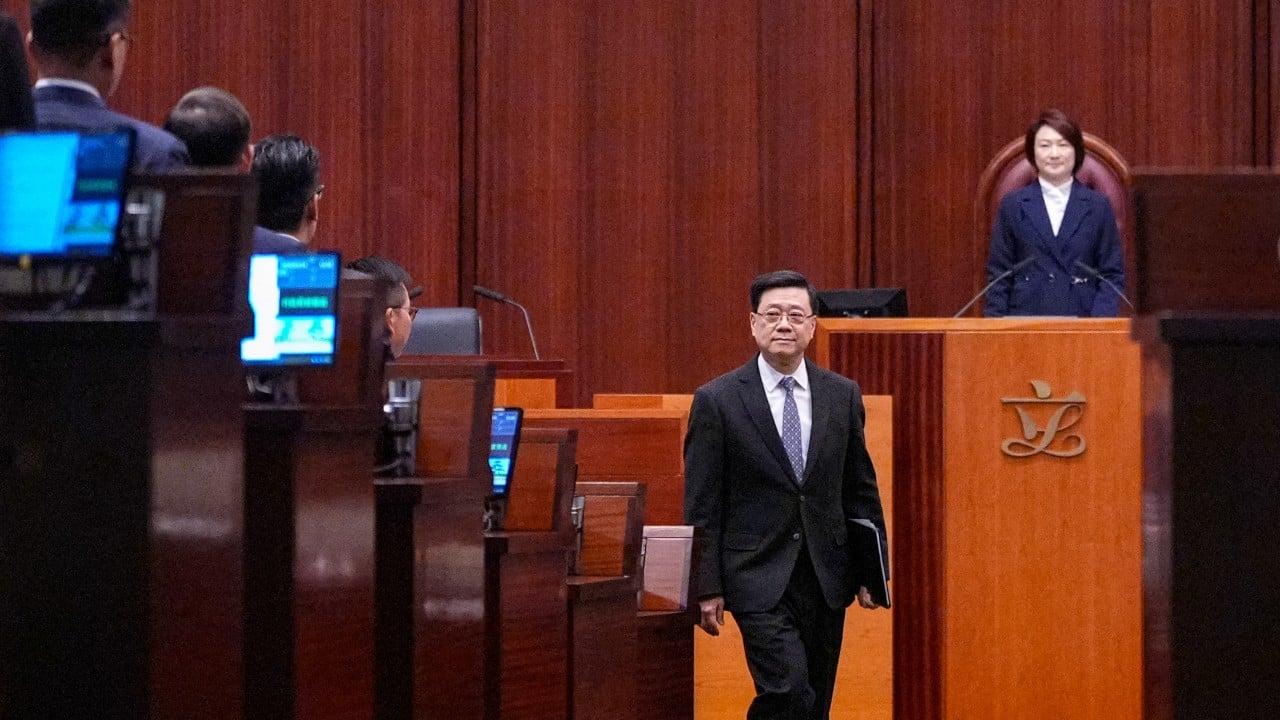
The executive-led model essentially places the Chief Executive at the undisputed center of the solar system. The legislature, once a site of resistance, now functions more like a planetary body held in a tight, predictable orbit. When the government proposes a law, it passes. Often with striking speed.
This is not merely a change in tone; it is a structural overhaul of how power flows through the streets. The Basic Law always intended for the executive to be the primary engine of the city, but for years, the gears were jammed with the grit of political dissent. Now, the grit is gone. The engine is roaring. But the people in the back of the car are beginning to wonder if anyone is checking the brakes.
The Vanishing Middleman
In the past, the Legislative Council acted as a shock absorber. It was a messy, imperfect filter where public grievances were aired, often theatrically. While this slowed down progress, it also provided a sense of "buy-in." Even if you disagreed with a policy, you saw it being debated. You saw your representative—however loud or disruptive—demanding answers.
Now, the "executive-led" reality means that the consultation process happens behind closed doors before a bill ever reaches the floor. By the time the public hears about a new regulation, the momentum is already terminal.
The impact on the business sector is profound and paradoxical. On one hand, CEOs love predictability. If the government promises a new tech hub or a bridge to the mainland, businesses can bank on it happening. There are no more political "black swans" that can kill a project mid-stream.
But on the other hand, the absence of a robust opposition means there is no "early warning system" for bad ideas. If a policy is flawed, if it hurts a specific niche of the economy or misses a vital social nuance, there is no one left with the power to shout "Stop."
Silence is not always a sign of agreement. Sometimes, it is just the sound of a room where no one is allowed to disagree.
The Civil Service Transition
Hong Kong’s civil service was long regarded as the "Gold Standard"—an impartial, bureaucratic elite that kept the city running while politicians bickered. They were the keepers of the rules.
Under an intensified executive-led mandate, the role of these professionals has shifted from "advisors" to "implementers." There is a subtle, pervasive pressure to deliver results that align with the Chief Executive’s vision. The "Can-Do" spirit that built the city’s skyline is now being applied to governance with a singular focus.
Suppose a senior official has concerns about the environmental impact of a massive land reclamation project. In the old world, those concerns would eventually leak to a legislator, who would then force a public inquiry. Today, that official is more likely to keep those concerns in a private memo. Why risk the friction? The path of least resistance is to ensure the executive’s goal is met on time and under budget.
This creates a feedback loop. The executive branch receives less critical data, leading to bolder decisions, which requires even more "alignment" from the departments below.
The Invisible Stakes for the Average Citizen
For the person riding the MTR to work in Central, the "executive-led" government might seem like an abstract concept discussed in dry editorials. But it manifests in the most tangible ways. It is in the way the city handles a public health crisis. It is in the way rent controls are—or are not—enforced. It is in the curriculum taught in the schools their children attend.
When power is concentrated, the government can move with the agility of a startup. It can pivot. It can mobilize resources in a weekend that would take a democratic bureaucracy a year to authorize. We saw this in the rapid rollout of infrastructure and the swift implementation of security laws.
The trade-off is the loss of the "public square."
In a city where the executive leads and the legislature follows, the burden of accountability shifts entirely onto the shoulders of the leader. There is no one else to blame when things go wrong. No opposition to point to. No legislative gridlock to hide behind. It is a high-wire act performed without a net.
The Corporate Echo Chamber
International investors are currently watching this experiment with a mixture of relief and anxiety. They appreciate the lack of strikes and the streamlined tax codes. But they also worry about the "echo chamber" effect.
In any healthy ecosystem—biological or financial—you need diversity of input to survive. A forest with only one type of tree is vulnerable to a single disease. A government that only hears its own voice is vulnerable to a single, catastrophic error in judgment.
The current administration argues that this is the only way to solve Hong Kong’s deep-seated problems, like the housing crisis and economic integration with the Greater Bay Area. They argue that "too much politics" was the poison that almost killed the city. They are offering a bargain: Give up the noise, and we will give you stability and prosperity.
The Long Shadow of the Gavel
The gavel in the Legislative Council used to be a symbol of a process. It marked the end of a debate, the conclusion of a hard-fought compromise. Now, the gavel feels more like a punctuation mark on a sentence that was written long before the session began.
Walking through the streets of Mong Kok at night, you still see the neon, the crowds, and the relentless energy that defines Hong Kong. The city is not dead. Far from it. It is transforming into something sleeker, faster, and more unified.
But as the executive-led government cements its hold, a quiet question lingers in the humid air between the skyscrapers. In the rush toward efficiency, in the pursuit of a frictionless society, what happens to the people who don't fit into the machine?
The ghost of consensus still haunts the hallways of power. It is the memory of a time when the city's future was a conversation, not a directive. Whether this new, streamlined Hong Kong can maintain its soul without that conversation is the great, unanswered question of the decade.
The pen is moving. The ink is drying. The city waits to see what the next page holds, knowing that this time, there is no one left to edit the script.