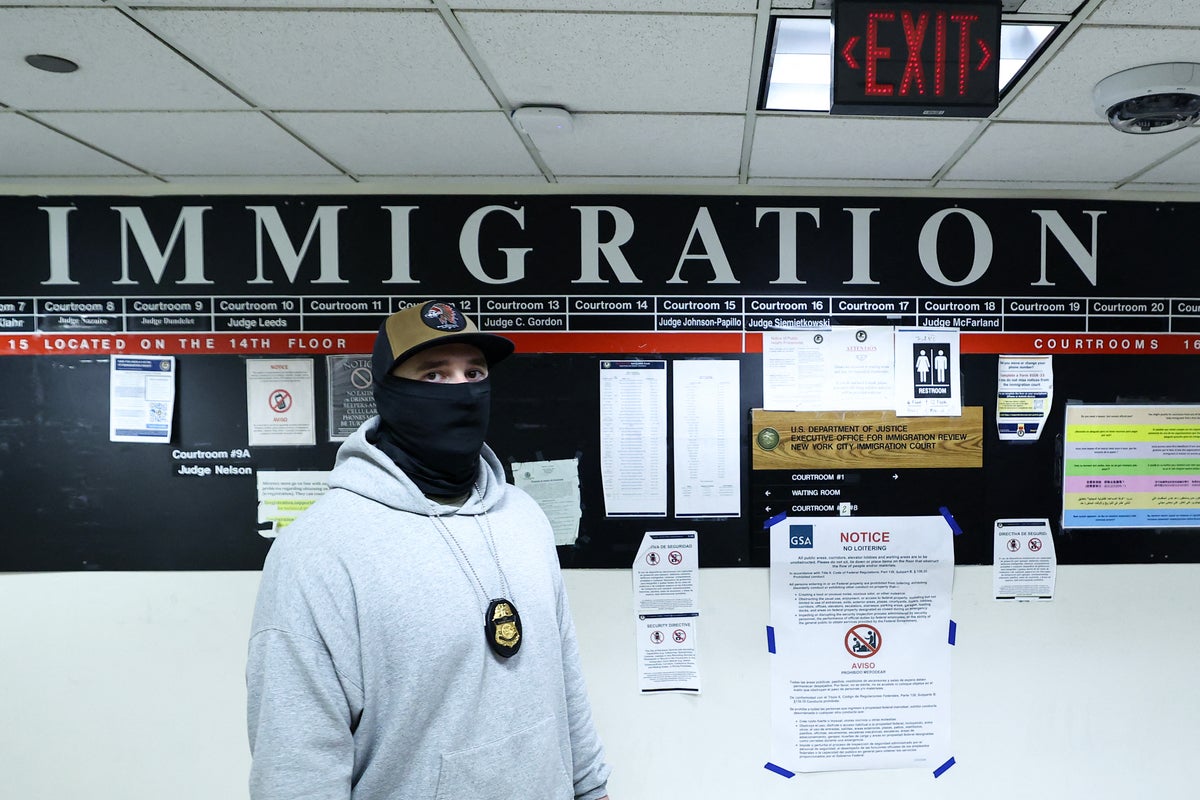
The fluorescent lights of a federal courtroom do not offer comfort. They hum with a flat, clinical vibration, casting a cold glare over the polished mahogany benches, the heavy seals of state, and the American flag standing stiffly in the corner. For decades, this was the room where Judge Ilana Rovner expected to spend her days. It was a place defined by the steady, predictable rhythms of the law—the rustle of legal briefs, the sharp rap of a gavel, the quiet murmur of a translator helping a terrified family understand their fate.
Then came the letter.
It arrived with the bureaucratic coldness that only a government agency can muster. No phone call. No face-to-face meeting to honor her years of service. Just a piece of paper from Donald Trump’s Department of Justice, effectively stripping her of her robes.
To the casual observer scanning a news feed, it was just another headline in a relentless cycle of political maneuvering: a fired immigration judge suing the government over allegations of discrimination. A standard employment dispute wrapped in the flag of Washington politics. But if you look closer, past the dense legal jargon of the lawsuit, you find something far more fragile. You find the systematic dismantling of a system that was supposed to represent everyone, quietly replaced by a machine designed to look like only one segment of America.
The Weight of the Robe
To understand what was lost, you have to understand what it takes to sit on that bench.
Immigration judges are not political operatives. They are, by design, the final line of defense between human beings and the terrifying machinery of deportation. On any given Tuesday, a judge might decide whether a political dissident is sent back to a regime that will execute him, or whether a mother is separated permanently from her children. The mental toll is staggering. The burnout rate is notoriously high.
Judge Rovner, whose name has now been entered into the public record via her civil rights lawsuit, was part of a deliberate effort to ensure the bench reflected the diverse kaleidoscope of the people walking through the courtroom doors. She wasn't alone. For years, the Department of Justice had made slow, agonizing progress toward diversifying the immigration court system. Women, Black lawyers, Hispanic advocates, and immigrants themselves brought a crucial element to the bench: lived experience.
They understood nuance. They knew that a trembling witness isn't necessarily lying; sometimes, they are just traumatized.
But the lawsuit paints a dark picture of a sudden, calculated reversal. According to the legal filings, the Department of Justice under the Trump administration initiated a quiet purge. It wasn't a loud, public firing squad. Instead, it was a subtle shifting of the gears. Veteran judges, particularly women and minorities, suddenly found themselves facing hyper-scrutiny. Minor administrative errors that were once dismissed with a nod became firing offenses.
The goal, the lawsuit alleges, was remarkably simple: clear out the existing bench to make room for a specific archetype. White. Male. Frequently from a military or prosecutorial background.
The Assembly Line of Justice
Imagine a factory where the product being manufactured is a human destiny.
When a court is stripped of its diversity, the entire nature of its deliberations changes. It is a psychological truth that we are all bound by our blind spots. A homogenous bench creates a dangerous echo chamber. When every judge in a building has the exact same background, the law ceases to be a living, breathing mechanism of justice. It becomes an assembly line.
Consider the hypothetical story of a young woman named Maria. She fled violence in Central America, arriving at the border with nothing but a bruised shoulder and a child in her arms. In a balanced court, her case is evaluated by someone who understands the geopolitical realities of her homeland, or perhaps by someone who recognizes the cultural barriers that make it difficult for a woman to speak openly about abuse to a male authority figure.
Now, change the judge. Place her case in front of someone whose entire career has been spent prosecuting crimes or enforcing rigid military hierarchies. The nuances disappear. The trauma is misread as evasiveness. The assembly line moves forward, the stamp descends, and Maria is sent back.
This isn't just about the judges who lost their jobs, though their personal financial and emotional devastation is immense. It is about the systemic starvation of empathy.
The numbers backing up the lawsuit point to a stark reality. During the period in question, the percentage of white male appointments skyrocketed, while the appointment of women and minority judges plummeted to historic lows. The Department of Justice defended these shifts as standard operational adjustments, aiming for efficiency and a tougher stance on immigration backlog.
But efficiency is a terrifying word when applied to human rights.
The Hidden Cost of Uniformity
The real danger of this ideological push is that it erodes the one thing a legal system cannot survive without: legitimacy.
When a community looks at a court and sees only an overwhelming sea of faces that look nothing like them, trust evaporates. If the system feels rigged from the outset, the entire illusion of a fair trial collapses. The immigration courts were already struggling under immense pressure, facing backlogs that stretched into the hundreds of thousands of cases. Introducing a discriminatory hiring and firing practice didn't fix the backlog; it merely weaponized it.
The lawsuit filed by the terminated judges isn't just an act of retaliation. It is an act of exposure. It forces the public to look behind the heavy curtains of the Department of Justice and witness the deliberate engineering of bias.
We often like to believe that the law is an objective, unyielding entity, operating above the messy fray of human prejudice. We want to believe the blindfold on Lady Justice is real. But the law is only as fair as the human being holding the gavel. When that human being is selected not for their legal acumen or their capacity for balance, but because they fit a specific demographic and political profile, the blindfold is ripped away.
The legal battle will drag on for years. There will be motions, counter-motions, appeals, and settlement conferences held in closed rooms far away from the public eye. The dry facts of the case will be filed into gray archives, forgotten by the 24-hour news networks.
But the courtroom remains. Somewhere right now, under those same humming fluorescent lights, a family is waiting for a door to open. They are waiting to see who walks out of the back room, climbs the steps to the bench, and looks down at them. They are waiting to see if they will be met with the cold stare of an ideological machine, or the eyes of someone who remembers what justice actually feels like.