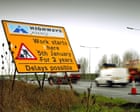
Drivers bypassing active roadwork closures to circumvent transit queues are not merely exhibiting individual impatience; they are executing a predictable failure mode of urban mobility governance. When motorists breach physical and administrative barriers to re-enter closed corridors, they expose a structural vulnerability where private temporal optimization directly conflicts with collective system stability. Understanding this phenomenon requires moving past moralizing narratives of reckless behavior and examining the underlying incentive structures, information asymmetries, and game-theoretic dynamics that drive roadwork noncompliance.
Modern transportation networks operate under fragile equilibrium conditions. Arterial capacity is calculated based on standardized flow rates, predictable friction coefficients, and strict compliance with traffic control devices. When maintenance or construction mandates a temporary capacity reduction, the network experiences a localized bottleneck. The traditional traffic management model assumes that motorists act as compliant agents within a centrally planned system. However, individual drivers frequently evaluate the cost of compliance—measured in extended transit delay—against the expected cost of noncompliance.
This calculus creates a severe divergence between systemic optimization and individual utility maximization. The compliant driver absorbs a definitive, immediate cost in lost time to preserve long-term safety and infrastructure integrity. Conversely, the noncompliant driver attempts to capture a localized temporal arbitrage by exploiting the temporary absence of physical enforcement or the perceived slack in construction zones. This behavioral asymmetry introduces cascading disruptions into the corridor.
The decision to ignore roadwork closures relies on a predictable failure of risk assessment and information distribution. Drivers routinely miscalculate the physical hazards present in an active work zone, treating safety barriers as negotiable suggestions rather than boundary conditions of a high-risk industrial environment. This miscalculation is exacerbated by insufficient real-time feedback loops. When a motorist breaches a closure and navigates past parked machinery, uneven milled surfaces, or active crews without encountering an immediate catastrophic event, their cognitive bias reinforces the behavior. They update their internal risk model to treat future closures as low-consequence obstacles.
Furthermore, the physical infrastructure of traffic control often communicates weakness rather than prohibition. Cones, plastic barrels, and lightweight signage signal a mutable boundary. Without hard physical hardening—such as concrete Jersey barriers paired with active monitoring—roadwork closures rely on voluntary adherence. In system design, any critical safety mechanism that depends entirely on voluntary compliance in the face of acute personal friction is fundamentally misengineered.
The economic and operational fallout of this noncompliance manifests as a localized tragedy of the commons. Every vehicle that breaches a closed corridor introduces unpredictable friction into an already constrained environment. Construction zones are dynamic, high-entropy workspaces. Heavy equipment movements, blind spots, and altered geometry require a sterile operational envelope. Unscheduled vehicular traffic forces construction personnel to transition from productive labor to reactive hazard mitigation, halting work cycles and compounding project delays.
These delays translate directly into extended economic friction. Every additional day a major arterial remains constrained due to interrupted workflow multiplies the aggregate lost productivity for thousands of surrounding commuters. The driver who skips a queue saves ten minutes of personal transit time while imposing collective hours of delay on the broader economic network, alongside an unacceptable escalation of kinetic risk to roadside workers.
Addressing this structural failure requires an immediate transition from reactive enforcement to systemic deterrence and physical hardening. Traffic management agencies must treat closure integrity as an engineering problem rather than an administrative one.
The first tactical shift involves upgrading the physical threshold of exclusion. Soft barriers must be replaced with modular, heavy-duty physical blockades that make unauthorized entry mechanically impossible for standard passenger vehicles, while maintaining emergency egress pathways controlled by on-site personnel. Relying on psychological deterrence in high-stress transit environments is an obsolete strategy.
The second shift requires restructuring the feedback loop governing enforcement. Traditional police patrols are too resource-intensive to provide continuous deterrence across every active maintenance site. Automated optical surveillance integrated directly into work zone perimeters can reliably capture license plate data for any vehicle breaching established boundaries. By pairing automated capture with mandatory, high-impact administrative penalties—such as immediate license suspension and steep civil liability multipliers—the expected cost of noncompliance eclipses any potential temporal gain.
Mobility networks cannot function sustainably when individual actors can unilaterally rewrite the operational rules of the system for marginal personal gain. Securing roadwork corridors is not merely about protecting asphalt; it is about preserving the fundamental reliability and safety of shared civic infrastructure against the erosion of individual self-interest.