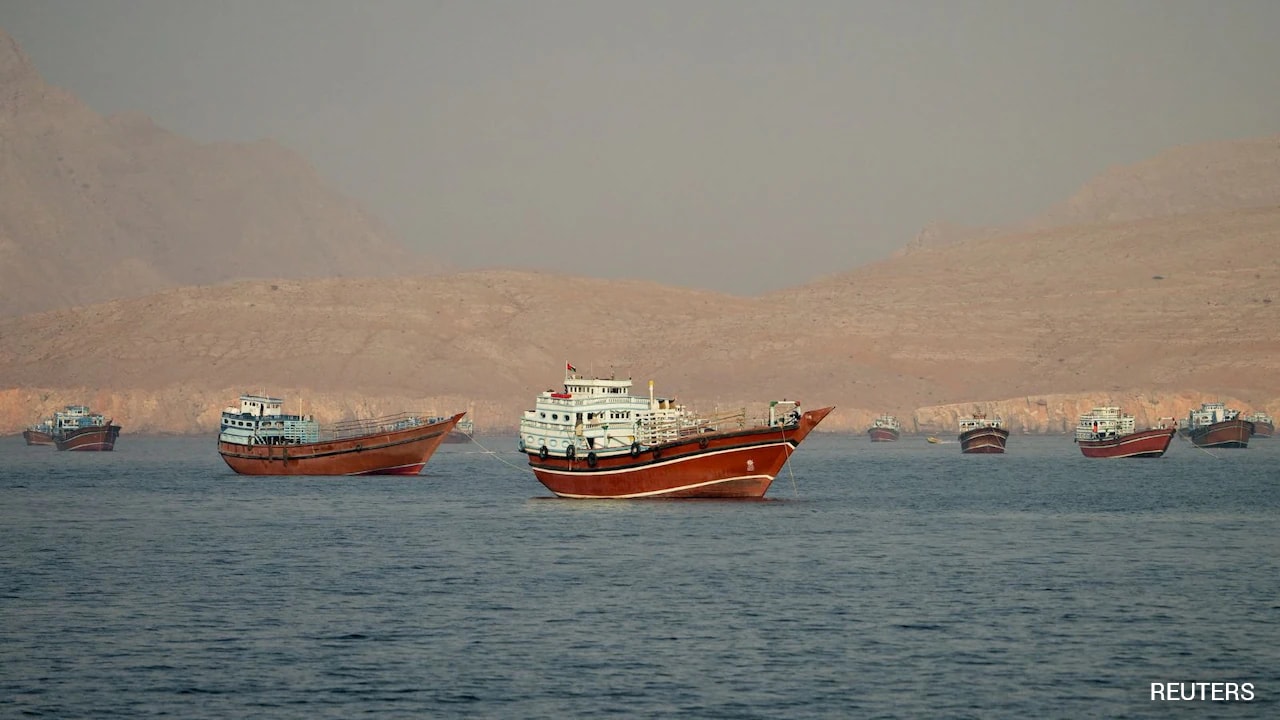
On June 20, 2026, the ঘোষণা of a total closure of the Strait of Hormuz by Iran’s Khatam al-Anbiya Central Headquarters exposed the deep friction between legal jurisdiction, kinetic reality, and economic coercion. Within hours of Tehran’s declaration, United States Central Command countered with operational data: 55 merchant vessels successfully transited the waterway, moving over 17 million barrels of oil without impediment. This divergence reveals a fundamental misunderstanding in maritime strategic analysis: the conflation of nominal sovereignty with functional denial. The escalating standoff surrounding the US-Iran memorandum of understanding is not a binary state of war or peace, but a highly calculated exercise in competitive risk management.
To understand the durability of global energy supply chains under geopolitical duress, analysts must isolate the underlying mechanisms of chokepoint dynamics. The current friction is defined by three distinct operational layers.
The Asymmetry of Declaration versus Operational Enforcement
Iran's military apparatus, specifically the Islamic Revolutionary Guard Corps Navy, utilizes public declarations as psychological market interventions rather than immediate kinetic blockades. The declaration of a closure serves a dual diplomatic purpose: it signals domestic resolve to the axis of resistance while attempting to artificially inflate global insurance premiums to force Western compliance.
The functional reality of the Strait remains governed by naval physics and international law. A physical blockade requires continuous maritime presence and the explicit willingness to engage commercial hulls with kinetic force. Because US Central Command maintains a persistent surface and aerial monitoring architecture, Iran cannot enforce a legal or physical barrier without directly triggering the defensive rules of engagement protecting commercial traffic.
The transit of three Indian-flagged crude tankers—the Desh Vaibhav, Desh Vibhor, and Sanmar Herald—carrying 860,000 metric tons of cargo on the exact day of the announced closure demonstrates that commercial operators evaluate risk based on local defense posture rather than rhetorical signaling. The strategic bottleneck is not the geographic narrowness of the shipping lanes, but the structural credibility of the deterrent forces flanking them.
The Cost Function of Multi-Front Linkage
Tehran’s explicit justification for the renewed escalation links the maritime status of the Strait to Israeli military actions in southern Lebanon. This cross-theater linkage introduces a complex variable into the 14-point memorandum of understanding signed by Washington and Tehran.
The diplomatic framework operates on an implicit multi-front ceasefire. By treating Israeli engagements against Hezbollah as a material breach of the bilateral US-Iran understanding, Iran attempts to weaponize global energy security to enforce localized territorial concessions in the Levant. This introduces a structural instability into the agreement:
- Front-End Asymmetry: The United States cannot fully dictate the tactical targeting choices of the Israel Defense Forces in Lebanon.
- Back-End Vulnerability: Iran can easily control the operational posture of its naval forces within its territorial waters.
This structural mismatch creates an escalation loop. Every kinetic strike in Nabatiyeh or southern Lebanon translates directly into a technical or regulatory impediment in the Persian Gulf. The strategic flaw in the initial agreement was the assumption that a regional cessation of hostilities could be managed through a centralized bilateral mechanism without formal cross-guarantees from localized state and non-state actors.
Non-Kinetic Chokepoint Mechanics: Insurance and Administrative Friction
The focus on anti-ship cruise missiles, fast attack craft, and naval mines often obscures the far more effective tools of gray-zone maritime denial: administrative and financial barriers. Prior to the outright closure announcement, Iran implemented a mandatory insurance requirement on all vessels transiting its recognized sector of the Strait.
This regulatory maneuver operates as a micro-tariff on global energy. By forcing international shipping lines to comply with Iranian insurance mandates, Tehran accomplishes several strategic objectives simultaneously:
- De Facto Recognition: It compels commercial entities to recognize Iranian legal authority over international transit corridors.
- Information Collection: It provides Iranian authorities with granular, real-time data regarding cargo manifests, ownership structures, and final destinations.
- Risk Escalation: It creates an immediate legal conflict with Western hull and machinery insurers, who frequently invalidate policies for vessels complying with unsanctioned regulatory regimes.
Vice President J.D. Vance pointed out a second critical administrative variable: the 30-day mine-clearing window embedded within the memorandum of understanding. The presence of legacy naval mines requires meticulous operational clearance. Iran can exploit this technical clause to divert commercial traffic away from designated deep-water channels under the guise of safety management. This tactical diversion slows transit velocities, effectively lowering the daily throughput of the Strait without firing a single shot.
The Burgenstock Technical Negotiations
As technical delegations from the United States, Iran, Qatar, and Pakistan assemble in Burgenstock, Switzerland, the immediate hurdle is resolving the sequencing of concessions. The IRGC-affiliated media apparatus has demanded the absolute release of 12 billion dollars in frozen assets and the immediate implementation of comprehensive oil sanctions waivers before any reversal of the maritime restrictions can occur.
The United States faces a delicate balancing act. Validating Iran's tactics by fast-tracking financial relief undermines the credibility of US maritime security guarantees. Conversely, insisting on a total cessation of Iranian naval signaling while hostilities continue in Lebanon risks collapsing the 60-day diplomatic window entirely.
The most probable strategic trajectory over the next 72 hours will involve a transactional compromise centered on asset liquidity. Washington will likely permit the initial release of 6 billion dollars in escrowed funds via Qatari financial institutions, explicitly tied to the formal suspension of the Iranian maritime insurance mandate. Commercial traffic will continue to navigate the Strait under heightened alert, shielded by the reality of US naval positioning, while the underlying conflict in Lebanon remains the primary volatile variable capable of fracturing the broader regional settlement.