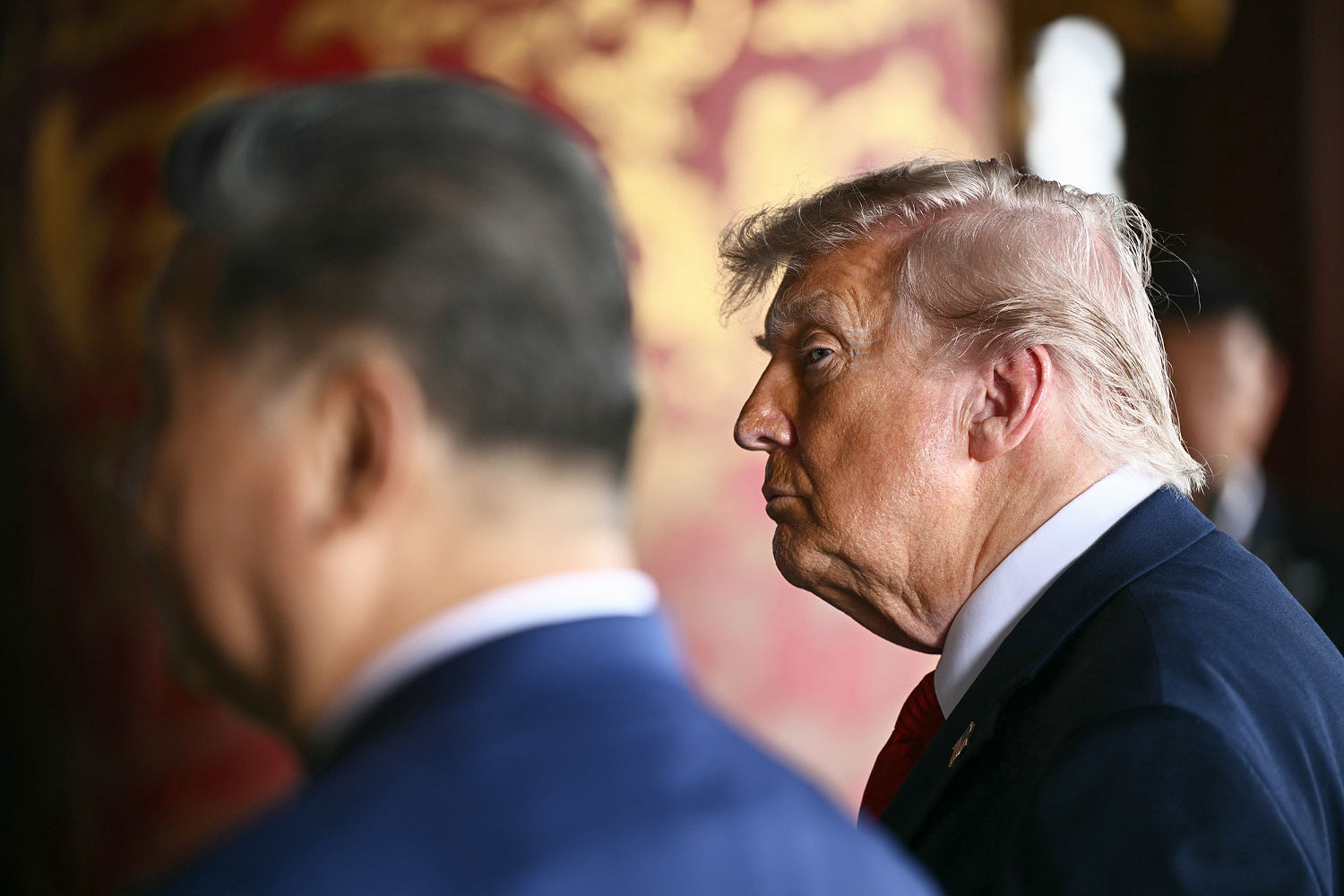
The narrative surrounding the May 2026 bilateral summit between US President Donald Trump and Chinese President Xi Jinping in Beijing has focused heavily on diplomatic theater and ambiguous communiqués. Mainstream commentary frames the event as a series of unresolved contradictions. This perspective misinterprets the strategic mechanics at play. Bilateral diplomacy between the world’s two largest economies does not operate on a binary scale of absolute consensus or failure. Instead, it functions as a highly transactional optimization problem, where both states seek to maximize domestic political leverage while mitigating systemic economic and military risks.
Deconstructing this summit requires moving past the superficial optics of the Zhongnanhai leadership compound and analyzing the cold structural trade-offs across four interconnected verticals: energy-commodity flows, military deterrence in the Taiwan Strait, trilateral nuclear arms control, and the resolution of Middle Eastern maritime bottlenecks. When evaluated through these frameworks, the summit did not produce ambiguity. It established a calculated, conditional roadmap designed to sustain a fragile equilibrium for the remainder of the current US presidential term.
The Commodity Leverage Function: Commercial Concessions vs. Structural Dependence
The visible commercial deliverables of the summit—commitments by Beijing to purchase US agricultural products, energy, and Boeing aircraft—are frequently analyzed as isolated trade victories. In reality, these deals represent a calculated economic trade-off. For the US administration, securing high-profile purchasing agreements serves a direct domestic political function, reinforcing an America First economic mandate. For Beijing, these commitments act as a tactical concession mechanism designed to avert immediate tariff escalations while securing critical industrial inputs.
The commercial commitments scale across specific, quantified vectors:
- Aerospace Capital Goods: An initial commitment by China to purchase 200 Boeing commercial aircraft powered by General Electric Aerospace engines. The administration indicated this baseline could scale to 750 airframes conditional upon performance metrics and execution timelines. This serves as an immediate capital injection into the US manufacturing base while addressing China’s domestic civil aviation modernization requirements.
- Agricultural Flows: An agreement to purchase US agricultural goods, specifically soybeans and beef, valued in the double-digit billions annually over a rolling three-year horizon.
- Energy Arbitrage: A framework allowing Chinese state-owned enterprises to source crude oil and liquefied natural gas (LNG) directly from infrastructure in Texas, Louisiana, and Alaska.
The systemic consequence of this energy framework extends far beyond a reduction in the bilateral trade deficit. China is currently the primary consumer of sanctioned Iranian crude oil. By establishing a formal logistical pipeline for US hydrocarbon exports to China—symbolized by the projected deployment of Chinese maritime tankers to Gulf Coast ports—the US is attempting to structurally substitute Iranian oil within China's energy mix.
The structural limitation of this strategy lies in price elasticity and infrastructure constraints. China will not completely dismantle its energy ties to Tehran so long as Iranian crude trades at a significant, sanctions-induced discount. Consequently, the US energy push serves as a partial hedging mechanism rather than an absolute replacement of illicit oil flows.
The Taiwan Strait Deterrence Model: Strategic Ambiguity vs. Transactional Leverage
The structural core of US-China friction remains the status of Taiwan. During private sessions, President Xi communicated a strict warning: mismanagement of the Taiwan issue could act as a direct catalyst for kinetic clash or systemic conflict. The subsequent US rhetorical positioning illustrates a deliberate preservation of strategic ambiguity, repurposed as a tool for transactional leverage.
The operational friction point centers on two authorized but unexecuted US arms packages to Taipei: an $11 billion weapons system package authorized in December, and a subsequent $14 billion defensive hardware sale approved by lawmakers in January that awaits formal transmission to Congress. Upon departing Beijing, the US executive branch explicitly stated that a final determination on whether these sales will proceed has not been reached.
This non-committal stance is not an analytical oversight. It is an intentional application of a conditional deterrence model. The mechanics of this model operate on a clear quid pro quo logic:
                  [ US Formally Approves Taiwan Arms Packages ]
                                       │
                     Is China cooperative on global issues?
                     (e.g., Iran, Trade, Fentanyl Precursors)
                                       │
                     ┌─────────────────┴─────────────────┐
                    YES                                 NO
                     │                                   │
                     ▼                                   ▼
       [ Delay / Phase Delivery ]            [ Accelerate Transfers ]
       * Preserves diplomatic buffer         * Signals hard deterrence
       * Avoids immediate escalation         * Imposes immediate strategic cost
By keeping the arms transfers in a state of administrative suspension, Washington retains a powerful lever to enforce Chinese compliance on secondary strategic priorities, such as restricting the export of precursor chemicals used in illicit fentanyl manufacturing.
The vulnerability of this approach is its misreading of Beijing’s core security hierarchy. For the Chinese Communist Party, sovereignty over Taiwan is an existential priority that cannot be structurally traded for commercial concessions or relaxed energy sanctions. The US strategy assumes a level of fungibility between trade policy and cross-strait security that does not exist in Beijing's ideological framework.
Trilateral Nuclear Arithmetic and the Limits of Parity
A notable strategic pivot during the summit was the US proposal for a trilateral nuclear arms control pact encompassing the United States, the Russian Federation, and the People's Republic of China. The stated objective is to establish a hard cap on the number of operational nuclear warheads within each nation's arsenal, attempting to construct a successor framework to the New START treaty, which expired without a replacement structure.
The structural impediment to this initiative is a stark asymmetry in arsenal size. Current Pentagon intelligence estimates place China’s operational nuclear stockpile at over 600 warheads. While this represents a rapid modernization trajectory, it remains an order of magnitude below the strategic deployments of the United States and Russia, which each maintain arsenals exceeding 5,000 warheads.
United States: ════════════════════════════════════════ 5,000+ Warheads
Russia:        ════════════════════════════════════════ 5,000+ Warheads
China:         ══════ 600+ Warheads
From an analytical standpoint, Beijing view demands for caps at current levels as an attempt by Washington to lock in a permanent state of strategic inferiority. A viable arms control framework requires a shared baseline of parity or a mutually accepted formula for strategic stability. The US claim of a "positive response" from Xi regarding the preliminary discussions should be interpreted as diplomatic politeness rather than a structural shift in China’s nuclear doctrine. Beijing will not sign a treaty that codifies a ten-to-one numerical disadvantage unless it is paired with sweeping concessions in conventional military posture across the Indo-Pacific theatre.
The Middle Eastern Conflict: Shared Chokepoints and Divergent Leverage
The ongoing kinetic conflict involving Iran and the resulting disruption of maritime transit through the Strait of Hormuz represents a shared macroeconomic vulnerability for both Washington and Beijing. The summit readouts indicate a superficial alignment: both leaders agree that the Strait of Hormuz must be reopened to international shipping and that Tehran must not acquire a military nuclear capability.
The divergence emerges in the execution mechanism. The US administration’s strategy relies on outsourcing the diplomatic pressure campaign to Beijing, leveraging China’s position as Iran's primary economic lifeline. While President Xi explicitly stated that China would withhold the transfer of direct military equipment to Tehran, Beijing has refused to unilaterally halt its purchases of Iranian petroleum products or enforce secondary US sanctions against its domestic independent refiners.
This posture reflects a calculating strategy by China. A protracted, localized conflict in the Middle East consumes US naval assets, drains western logistical reserves, and diverts Washington's strategic focus away from the Indo-Pacific. Simultaneously, the conflict grants Beijing access to deeply discounted energy inputs while positionally elevating China as an indispensable diplomatic mediator. The US expectation that China will expend its own political and economic capital to pull Washington out of a Middle Eastern security dilemma miscalculates Beijing’s broader geopolitical cost function.
The Strategic Path Forward
The Beijing summit achieved its primary unstated objective: the codification of a temporary framework of "strategic stability" projected to govern the bilateral relationship for the next three years. This framework replaces aggressive decoupling rhetoric with a model of managed competition within predefined commercial boundaries.
The immediate operational playbook for corporate and geopolitical strategists requires executing along three specific vectors:
- Supply Chain Arbitrage: Do not assume a permanent de-escalation of trade friction. Treat the Boeing and agricultural purchase agreements as temporary diplomatic buffers. Maintain parallel supply chain diversification strategies outside the Chinese mainland, as the unresolved Taiwan arms package issue remains a high-probability catalyst for sudden regulatory or tariff disruptions.
- Energy Flow Monitoring: Track the velocity of Chinese maritime assets routing toward US Gulf Coast infrastructure. If Chinese purchases of US crude scale effectively, it will signal a tactical reduction in illicit Iranian flows, providing a highly reliable leading indicator of temporary stabilization in US-China trade enforcement.
- Technology Guardrails: Anticipate a hardening of technological barriers. Despite discussions to initiate secondary bilateral talks regarding artificial intelligence governance, the underlying structural race for semiconductor supremacy and algorithmic dominance remains zero-sum. Expect continued tightening of export controls on dual-use technologies, independent of any progress made in conventional commodity trading.