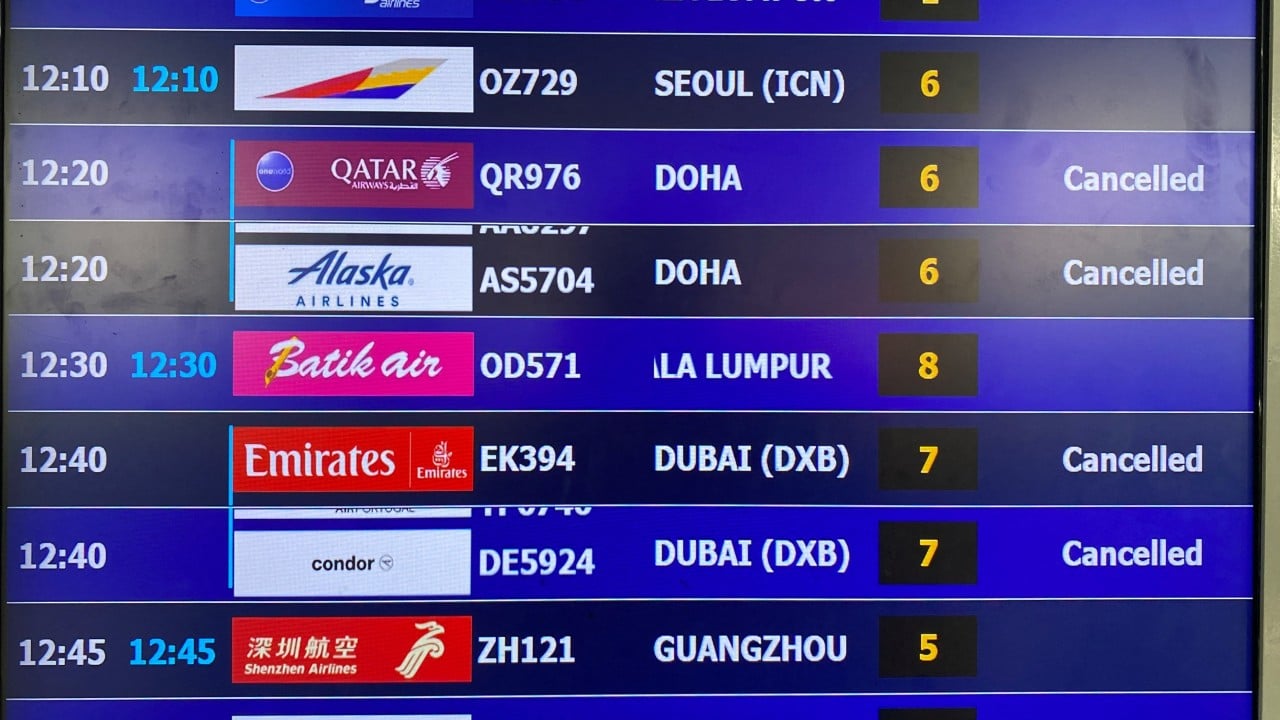
The stability of Asia’s travel recovery is currently tethered to a fragile corridor of Middle Eastern airspace. When Iran-Israel tensions escalate into direct kinetic engagement, the resulting shockwaves do not merely disrupt flight paths; they trigger a multi-point failure across the Asian travel value chain. This "domino effect" is not a vague metaphor but a quantifiable sequence of operational constraints, cost escalations, and psychological deterrents that threaten the thin margins of the post-pandemic rebound. Understanding this vulnerability requires a clinical breakdown of how airspace closures, fuel volatility, and risk-adjusted consumer behavior intersect to create a systemic bottleneck.
The Geopolitical Chokepoint Airspace and the Geometry of Efficiency
The primary mechanism of disruption is the physical narrowing of the Eurasian air bridge. Airlines operating between Asia and Europe have historically relied on a finite number of high-efficiency corridors. The closure of Iranian and Israeli airspace forces a radical reconfiguration of these routes, primarily diverting traffic into Turkish, Egyptian, or Saudi Arabian sectors.
This reconfiguration is governed by the Principle of Path Deviation. When a straight-line flight path is obstructed, the resulting "dog-leg" maneuver adds significant nautical mileage.
- Operational Burn Rate: For a standard long-haul wide-body aircraft (e.g., Boeing 787 or Airbus A350), every additional 30 minutes of flight time consumes between 2,500 to 4,000 kilograms of extra fuel.
- The Crew Duty Bottleneck: Aviation regulations strictly limit the number of hours a flight crew can remain on duty. A detour that pushes an 11-hour flight to 13 hours can cross the "Duty Period" threshold, necessitating an extra crew set or a technical stop. This removes the "seamless" nature of long-haul connectivity and introduces a massive variable cost that cannot be mitigated through software optimization.
- Fleet Utilization Decay: Longer flight times mean aircraft spend more time in the air for the same number of revenue-generating trips. This effectively shrinks an airline's capacity without a single plane leaving the fleet, leading to fewer available seats and higher ticket prices across the board.
The Tri-Factor Cost Function of Fuel, Insurance, and Risk
The financial impact of Middle Eastern instability on Asian travel is not limited to the price of Brent crude. It is a three-pronged cost escalation that attacks the balance sheet from different angles.
1. The Fuel Surcharge Lag
While global oil prices react instantly to missile launches, the actual cost to the airline is mediated by hedging strategies. However, for many low-cost carriers (LCCs) in Asia that do not hedge aggressively, the "spot price" spike is a direct hit to the operating margin. Even for full-service carriers, the increased fuel burn from rerouting compounds the price-per-barrel increase.
2. War Risk Insurance Premiums
Aviation insurance is bifurcated into standard hull/liability and "War Risk" coverage. As soon as a region is designated a high-risk zone, premiums for flights overflying or landing in adjacent territories (such as Jordan, Iraq, or Lebanon) skyrocket. These costs are often passed directly to the consumer via "War Risk Surcharges," a move that immediately dampens demand in price-sensitive markets like Southeast Asia.
3. The Currency Depreciation Feedback Loop
Geopolitical instability typically triggers a "flight to safety," strengthening the US Dollar against Asian currencies (e.g., the Japanese Yen, Thai Baht, and Indian Rupee). Because aircraft leases and fuel are priced in USD, while revenue is earned in local currency, Asian airlines face a "double squeeze": their costs go up in dollar terms while their customers' purchasing power in dollar terms goes down.
Mapping the Psychological Domino Effect
The "domino effect" frequently cited in news reports is often misunderstood as a purely economic phenomenon. In reality, it is a Psychological Contagion that follows a predictable decay curve in travel intent.
The first domino is the Proximity Fallacy. Travelers in North America or Europe often view "The Middle East" and "Asia" as adjacent or overlapping zones. An attack in Isfahan creates a general perception of "Eastern instability," leading to cancellations not just for Israel or Jordan, but for destinations like Turkey, Egypt, and even India.
The second domino is the Business Travel Freeze. Corporate travel departments operate on a "duty of care" principle. When a region enters a heightened state of alert, internal risk assessments often trigger an automatic "Non-Essential Travel Ban." Unlike leisure travelers who might wait for a refund, corporate travelers cancel immediately, stripping airlines of their highest-margin passengers.
The third domino is the Group Tour Liquidity Crisis. Much of Asia’s outbound tourism (especially from China and South Korea) relies on large-scale group bookings. These operators work on razor-thin margins and high volume. A 15% cancellation rate can turn a profitable tour into a net loss, forcing the operator to cancel the entire departure. This creates a "shadow" capacity reduction that doesn't show up on flight schedules but is felt acutely by hotels and ground operators.
Structural Vulnerabilities in Asian Hubs
Singapore, Bangkok, and Hong Kong serve as the "lungs" of the Asian travel economy. Their dependence on long-haul transit makes them uniquely vulnerable to Middle Eastern disruptions.
- Changi and the Europe-Australia Kangaroo Route: A significant portion of Singapore’s transit traffic involves the Europe-to-Australia corridor. If rerouting makes this trip 20 hours instead of 17, the "Ultra Long Haul" (ULH) economics break down. Passengers may opt for one-stop flights via North America or simply defer travel.
- Bangkok’s Tourism Dependency: Thailand’s economy is disproportionately reliant on European arrivals during the winter "peak season." If flight costs rise by 20% due to fuel and rerouting, the "value-for-money" proposition that drives Thai tourism is eroded.
The Strategic Pivot for Asian Operators
To survive this period of high-frequency geopolitical shocks, the strategy must shift from growth maximization to Resilience Engineering. This involves three tactical moves:
- Route Diversification and the Polar Option: For Northeast Asian carriers (Japan, Korea), the "Polar Route" over Canada and the North Pole becomes a strategic hedge against Middle Eastern instability, despite its own regulatory and environmental complexities.
- Capacity Re-allocation to Intra-Asia: Airlines must develop the agility to pivot "locked" long-haul capacity into regional "bubbles" (e.g., Tokyo-Seoul-Bangkok) where the geopolitical risk is decoupled from the Middle East.
- Dynamic Pricing for Risk: Rather than static seasonal pricing, airlines are moving toward AI-driven models that price in "Real-time Risk Surcharges." This allows for the immediate recovery of rerouting costs without the need for manual fare filings.
The current crisis is not a temporary blip but a stress test for the "New Normal" of global aviation. The winners will not be the airlines with the most planes, but those with the most adaptable flight paths and the deepest understanding of the cost-per-minute of geopolitical friction.
Focus resources on securing fuel-efficient wide-body fleets and diversifying transit hubs away from singular geographical dependencies. The ability to bypass troubled airspace is no longer a luxury; it is the fundamental requirement for solvency in the 2020s.


