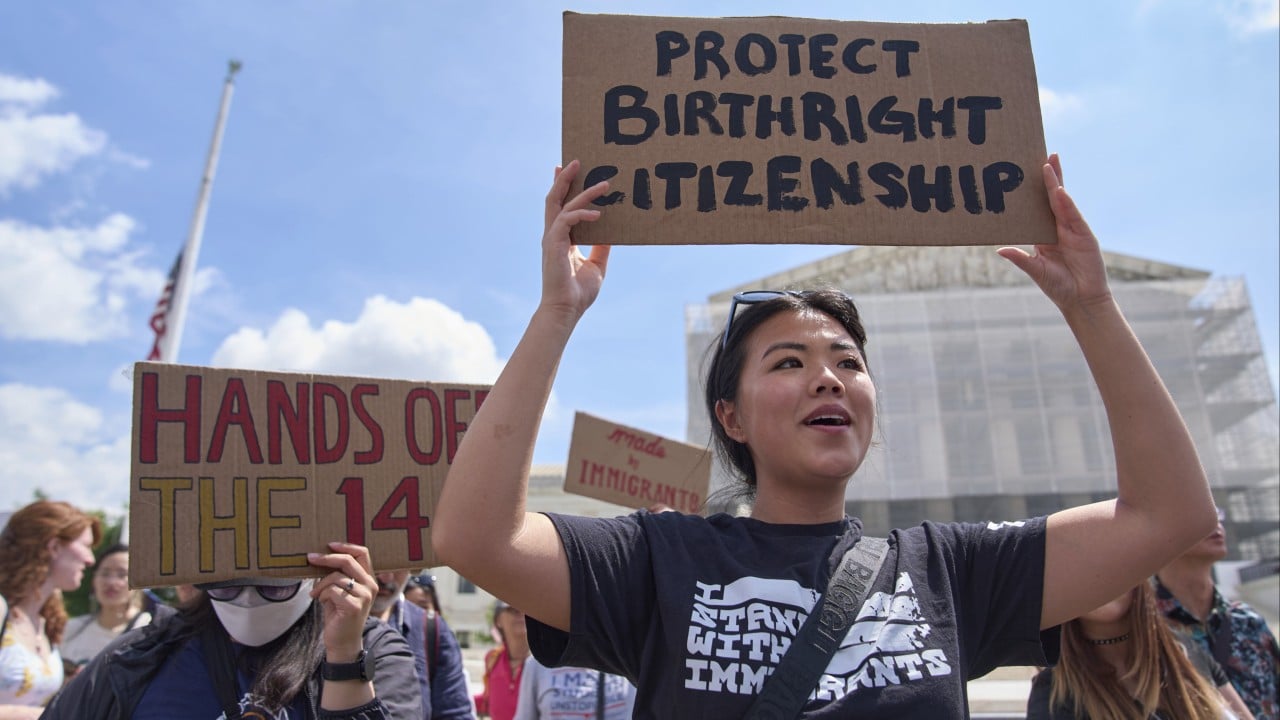
The proposed executive and legislative assault on birthright citizenship—specifically targeting "birth tourism" and strategic migration from China—is not merely a legal dispute; it is an attempt to recalibrate the American social contract by shifting from a territorial (jus soli) to a bloodline or consent-based (jus sanguinis) model. This shift creates a structural bottleneck for the "birth tourism" industry, an informal but high-value economy that functions as a bridge for capital flight and long-term strategic hedging by foreign nationals. To understand the impact of this policy shift, one must analyze the intersection of constitutional durability, the logistics of enforcement, and the specific economic incentives driving Chinese participation in the U.S. birthright system.
The Triad of Incentives Driving Birth Tourism
Birth tourism persists because it offers a high Return on Investment (ROI) across three distinct vectors. For the affluent Chinese middle and upper classes, a U.S. passport for a child is an insurance policy against domestic political volatility and a mechanism for future capital preservation.
- The Hedging Vector: A child with U.S. citizenship provides a family with a "foothold" for future immigration under family reunification categories. This serves as a long-term exit strategy that bypasses the high-stakes competition of EB-5 investor visas or H-1B lottery systems.
- The Educational Arbitrage: Citizens qualify for domestic tuition rates at state universities and have access to federal grants and loans restricted to nationals. The cost savings over a four-year degree often exceed the initial $50,000 to $100,000 investment in the birth tourism process.
- Capital Mobility: U.S. citizenship facilitates the movement of assets into the Western financial system. It provides a legal identity that is not subject to the same scrutiny or capital controls as a non-resident alien.
The competitor narrative often frames this as a simple matter of border security. In reality, it is a conflict between the Constitutional floor (the 14th Amendment) and the Administrative ceiling (the ability of the State Department and DHS to filter intent at the border).
The Constitutional Conflict: Textualism vs. Intent
The legal debate hinges on the phrase "subject to the jurisdiction thereof" within the 14th Amendment. Strict constructionists argue that this clause was intended to exclude those who owe primary allegiance to a foreign power, such as diplomats or invading forces. The prevailing legal consensus, established in United States v. Wong Kim Ark (1898), maintains that any person born on U.S. soil, regardless of parental status (excluding diplomats), is a citizen.
A move to end birthright citizenship via executive order introduces a high probability of "Legal Latency." The time between the order's signing and a Supreme Court resolution would create a period of systemic "statelessness-in-waiting" for thousands of infants. This uncertainty would likely suppress the birth tourism market in the short term, not through law, but through the introduction of prohibitive risk. The cost of the "insurance policy" (the birth) remains high, while the "payout" (the citizenship) becomes speculative.
The Mechanics of Targeting China
China is the primary target of these policy discussions due to the organized nature of its birth tourism infrastructure. Unlike seasonal or opportunistic migration, Chinese birth tourism is often a "concierge" service involving:
- Birth Centers (Maternity Hotels): Concentrated in Southern California, these operations provide lodging, medical coordination, and legal assistance for visa applications.
- Intent Concealment: Applicants are coached to misrepresent their travel purpose during B-1/B-2 visa interviews, characterizing medical tourism as simple recreation.
- Dual-Nationality Friction: China does not recognize dual citizenship. This creates a unique diplomatic friction point where the U.S. treats these individuals as Americans, while Beijing treats them as Chinese nationals who have "violated" the nationality law.
The proposed policy shift aims to transform birth from a passive event into a qualified act. If the U.S. moves to a model where at least one parent must be a citizen or permanent resident, it effectively decapitates the business model of these concierge services.
Enforcement Bottlenecks and Data Gaps
A significant hurdle in the data-driven analysis of this issue is the "Reporting Gap." The U.S. government does not specifically track "birth tourism" as a distinct statistical category. Estimates are derived by cross-referencing temporary visa entries with birth certificates in specific zip codes (e.g., San Bernardino or Orange County).
The administrative burden of verifying parental status for every birth in the United States—approximately 3.6 million annually—would necessitate a new national registry or a fundamental change to how birth certificates are issued. This creates a massive unfunded mandate for state-level health departments.
The enforcement mechanism would likely rely on a Negative Presumption Model:
- Births to non-residents are flagged at the point of issuance.
- The burden of proof shifts to the parents to demonstrate "lawful permanent residence."
- Failure to meet this threshold results in a "Certificate of Birth" that does not confer the rights of citizenship.
This transition from a "Notification-based" system to a "Verification-based" system represents a significant expansion of the federal administrative state into what has traditionally been a state-governed function.
Strategic Risks to American Human Capital
While the rhetoric focuses on "stopping" foreign influence, a rigid restriction on birthright citizenship carries a risk of "Brain Drain" or "Incentive Misalignment." The United States has historically benefited from its ability to attract and integrate global talent.
- Loss of High-Skilled Progeny: Many children born to non-resident workers (on H-1B or O-1 visas) go on to become high-contributing members of the U.S. economy. Removing their birthright status may discourage the world’s most mobile and skilled professionals from choosing the U.S. as a primary base of operations.
- Diplomatic Reciprocity: Any move to restrict citizenship based on parentage could trigger reciprocal restrictions from other nations, complicating the lives of American expats and their families abroad.
- The "Underground" Birth Risk: Ending birthright citizenship does not necessarily stop the births; it merely stops the documentation. This creates a permanent underclass of individuals who are physically present but legally invisible, increasing the long-term social and economic costs associated with an undocumented population.
The Infrastructure of Exclusion
The actual implementation of a birthright ban would require a "Technological Wall" rather than a physical one. This would involve:
- Real-time Interoperability: Linking hospital birth records directly to DHS/ICE databases to verify the legal status of parents in real-time.
- Biometric Linkage: Associating the infant's biometric data with parental visa records to prevent "identity swaps" or document fraud.
- Automated Denial Systems: AI-driven systems that flag visa applicants with a high "maternity risk score" based on age, financial status, and travel patterns.
These tools represent a shift toward "Algorithmic Borders," where entry is denied not based on past actions, but on predicted intent.
The Strategic Path Forward
Policy makers must choose between a Constitutional Amendment—which is politically improbable—and Administrative Attrition. The latter is the more likely path. By increasing the regulatory hurdles for medical visas, aggressively prosecuting the operators of maternity hotels, and requiring stricter proof of "non-immigrant intent" for women of child-bearing age from specific regions, the government can achieve the desired reduction in birth tourism without a direct Supreme Court confrontation.
The most effective lever is not the removal of the 14th Amendment, but the systematic dismantling of the Economic Bridge. If the U.S. Treasury and the IRS were to implement strict reporting requirements on the assets of "accidental citizens" (those born in the U.S. but living abroad), the tax burden and FATCA compliance costs would eventually outweigh the benefits of the passport. For the Chinese elite, the risk of having their global assets subject to U.S. taxation and disclosure would be a more potent deterrent than a change in immigration law.
The strategic play is to transform the U.S. passport from a low-cost insurance policy into a high-maintenance financial liability. This targets the primary motivation of the Chinese birth tourist—capital preservation—without the systemic shock of a constitutional crisis. Focusing on the "Financial Friction" of citizenship will yield a higher success rate in curbing birth tourism than attempting to redefine the foundational principles of American territory.