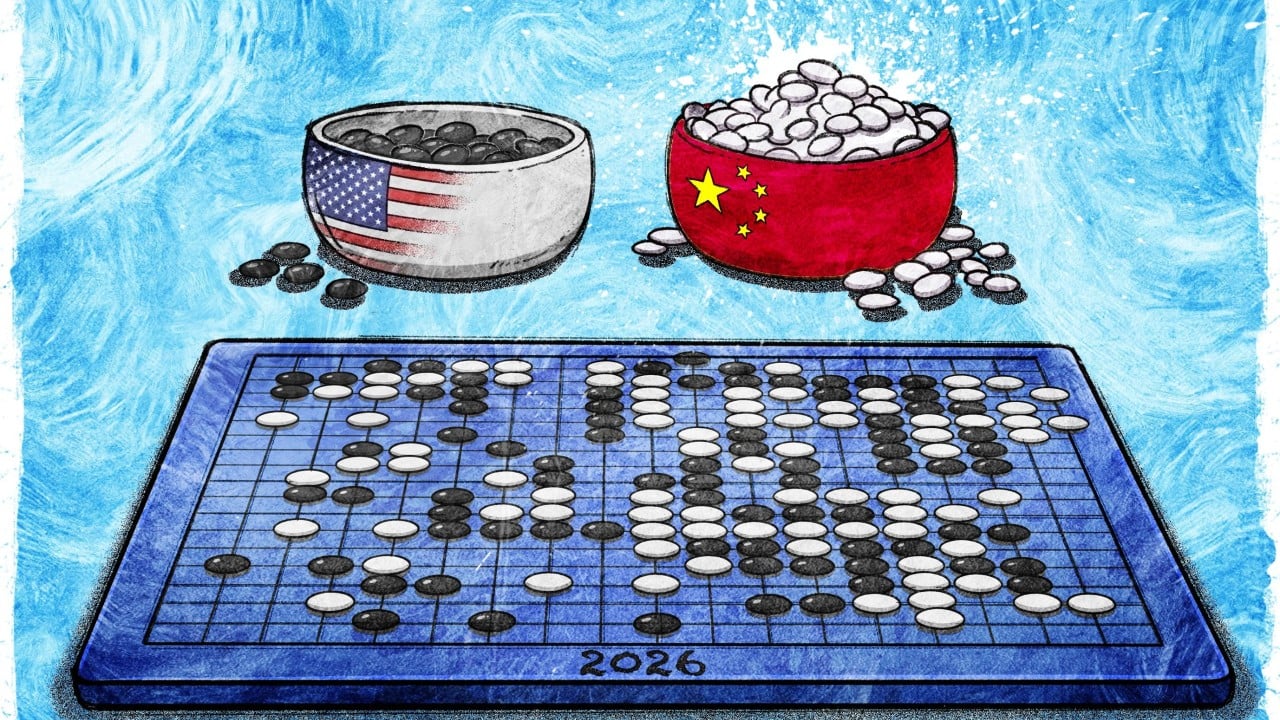
The strategic environment Donald Trump enters in 2025 bears no structural resemblance to the one he exited in 2021, let alone the one he encountered in 2017. While the first term focused on trade deficits as a primary metric of friction, the current friction is rooted in a fundamental divergence of industrial and security architectures. China has transitioned from a defensive posture of "reform and opening up" to a consolidated "Fortress Economy" model. This shift renders the previous playbook—bilateral trade deals and tariff-induced negotiation—insufficient. Success in this new era requires a granular understanding of three specific structural shifts: the exhaustion of the "Chimerica" symbiotic model, the securitization of the global supply chain, and the emergence of non-dollar financial liquidity.
The Triad of Chinese Strategic Consolidation
The logic of the 2017-2020 trade war assumed that China remained dependent on external demand to sustain internal social stability. This assumption has been systematically dismantled by the Chinese Communist Party (CCP) through the "Dual Circulation" strategy. This framework prioritizes "internal circulation"—domestic consumption and indigenous technological development—while treating "external circulation" as a secondary, albeit necessary, support mechanism.
1. The Technological Autarky Mandate
In 2017, the U.S. held significant leverage over Chinese telecommunications and semiconductor firms via Export Administration Regulations (EAR). Today, that leverage has catalyzed a massive capital reallocation toward domestic lithography and logic chip production. The 2025 reality is a China that has internalized the risk of "chokepoint" technologies.
The primary variable is no longer just the volume of trade, but the Criticality Index of the components traded. If the U.S. increases pressure on legacy nodes (mature semiconductors), China now possesses the scale to flood global markets with low-cost alternatives, creating a "low-end capture" that makes Western hardware manufacturers structurally dependent on Chinese silicon for basic consumer goods.
2. The Securitized State Infrastructure
The China of 2025 is governed by a radically expanded National Security Law and Anti-Espionage Law. For a U.S. administration, this means the traditional channels of corporate diplomacy are effectively severed. U.S. CEOs can no longer serve as informal intermediaries because the cost of "dual loyalty" in Beijing has become prohibitive. This creates an information vacuum. Strategic calculations must now account for the "Black Box" effect: the inability to gauge internal Chinese economic stressors accurately due to the suppression of financial data and the criminalization of due diligence.
3. The BRICS+ Liquidity Shift
The weaponization of the SWIFT system following the invasion of Ukraine served as a proof-of-concept for Beijing. The 2025 administration faces a world where a significant portion of China's energy and commodity trades are settled in RMB or through the Cross-Border Interbank Payment System (CIPS). This reduces the efficacy of traditional U.S. financial sanctions. The U.S. dollar’s role as the sole arbiter of trade has been diluted by a pragmatic, albeit fragmented, multipolar financial reality.
Quantifying the Tariff Elasticity Gap
A central pillar of the Trump strategy involves the imposition of universal baseline tariffs, potentially exceeding 60% on Chinese goods. To analyze the efficacy of this, one must calculate the Tariff Elasticity of Substitution (TES). In 2018, many U.S. firms could shift production to Vietnam or Mexico. By 2025, Chinese firms have anticipated this by "offshoring" themselves.
The "China Plus One" strategy, initially a Western corporate hedging tool, has been co-opted. Much of the "Mexican" or "Vietnamese" exports to the U.S. are now assembled in Chinese-owned factories using Chinese intermediate components. Consequently, a blanket tariff on China may inadvertently damage U.S. allies or fail to decouple the actual value chain. The strategy consultant’s view identifies a Value Chain Loophole:
- Point of Origin vs. Point of Value: Tariffs are applied at the point of origin. Value, however, is captured by the owner of the IP and the primary capital equipment.
- Capital Export: China is no longer just exporting goods; it is exporting the capital and the machinery required to make those goods elsewhere.
This creates a scenario where the U.S. collects revenue from tariffs, but the strategic goal—reshoring industrial capacity—remains unachieved because the underlying cost structure of domestic U.S. manufacturing (energy, labor, regulation) has not been addressed in tandem.
The Battery and EV Hegemony: A New Energy Realpolitik
The most significant sector-specific shift is the total vertical integration of the "New Three" (lithium-ion batteries, electric vehicles, and solar products) within China. In 2017, the U.S. was debating the merits of the Paris Agreement. In 2025, the U.S. is facing a reality where the transition to any future energy model—regardless of political preference—is mediated by Chinese supply chains.
The cost function of a standard EV battery in China is roughly 30% lower than in the U.S., driven by subsidized electricity, proximity to refining, and massive economies of scale. Any U.S. administration attempting to "win" in this space faces a paradox:
- Option A: Impose high tariffs to protect nascent U.S. EV industries, resulting in higher costs for American consumers and a slower technological refresh cycle.
- Option B: Allow imports, which decimates the domestic automotive labor force and deepens strategic dependence on a geopolitical rival.
This is not a trade problem; it is an industrial policy bottleneck. The 2025 strategy must move beyond punitive measures and toward a Subsidization Counter-Cycle, where the U.S. matches the scale of Chinese state-directed investment in raw material processing, not just the final assembly of "green" goods.
The Asymmetry of Political Time Horizons
A critical failure in Western analysis is the tendency to view trade negotiations through the lens of the U.S. electoral cycle. Beijing operates on a "Centenary Goal" timeline. The 2025 administration must contend with a Chinese leadership that has already priced in four years of volatility.
This leads to the Strategic Patience Imbalance:
- The U.S. Objective: Fast, high-visibility wins (reduced trade deficits, purchase agreements) to satisfy domestic political stakeholders.
- The Chinese Objective: Long-term structural resilience and the gradual displacement of U.S. influence in the Global South.
When these two timelines collide, the party with the longer horizon usually wins by offering short-term concessions that do not alter the long-term trajectory. For example, China may agree to buy more American agricultural products (a 2019-style win) while simultaneously accelerating the development of RISC-V open-source chip architecture to bypass U.S. semiconductor dominance (a long-term strategic loss for the U.S.).
The Risk of Accidental Escalation: The Kinetic-Economic Linkage
The boundary between economic competition and kinetic conflict has blurred. The "Taiwan Dilemma" is no longer just about sovereignty; it is about the Global Silicon Surcharge. A blockade or conflict in the Taiwan Strait would represent a 10% hit to global GDP almost instantaneously.
The 2025 administration faces a China that has significantly modernized its A2/AD (Anti-Access/Area Denial) capabilities. Economic leverage is only effective if it is backed by a credible deterrent that does not rely on a "suicide pact" economic model. If the U.S. economy is too deeply integrated with China’s, the "Nuclear Option" of total financial decoupling becomes a hollow threat because the "Mutual Assured Economic Destruction" (MAED) is too high.
Operationalizing the "Clean Network" 2.0
To move beyond the limitations of the previous term, the strategy must pivot toward Selective Interdependence. This requires a tiered classification of trade:
- Tier 1: Non-Critical Consumer Goods: (Toys, furniture, textiles). Maintain standard trade relations with moderate tariffs for revenue.
- Tier 2: Dual-Use Technology and Infrastructure: (Telecom, energy storage, biotech). Implement a "Zero-Trust" policy, mandating total supply chain visibility and domestic or "friend-shored" alternatives.
- Tier 3: Foundational IP and Data: (AI models, genomic data, financial rails). Complete decoupling to prevent systemic vulnerabilities.
This tiered approach replaces the "Blunt Force" tariff model with a "Surgical Resection" of critical dependencies.
Strategic Recommendation: The Resilience Pivot
The 2025 administration must abandon the pursuit of a "Grand Bargain" with Beijing. The structural incentives for both nations have diverged too far for a return to the pre-2016 status quo. Instead, the U.S. strategy should focus on Internal Margin Expansion. This involves:
- De-risking through Aggregation: Forming a "Buyer's Club" with the G7 and select Indo-Pacific partners to collectively negotiate access to critical minerals, preventing China from playing individual nations against each other.
- Regulatory Reciprocity: Applying the same restrictions on Chinese investment in U.S. land, data, and infrastructure that China applies to U.S. firms within its borders. This is not "protectionism"; it is the elimination of an asymmetric disadvantage.
- Energy Dominance as Leverage: Utilizing the U.S. advantage in LNG and oil production to offer energy security to Asian and European partners, thereby reducing their economic reliance on Chinese-brokered trade routes.
The final play is not to "change" China, but to build a U.S.-led economic ecosystem that is so efficient and secure that China’s state-capitalist model is forced into a position of reactive adjustment rather than proactive disruption. The 2025 administration must treat the relationship not as a deal to be closed, but as a permanent state of high-stakes competition where the metric of success is the preservation of American optionality.