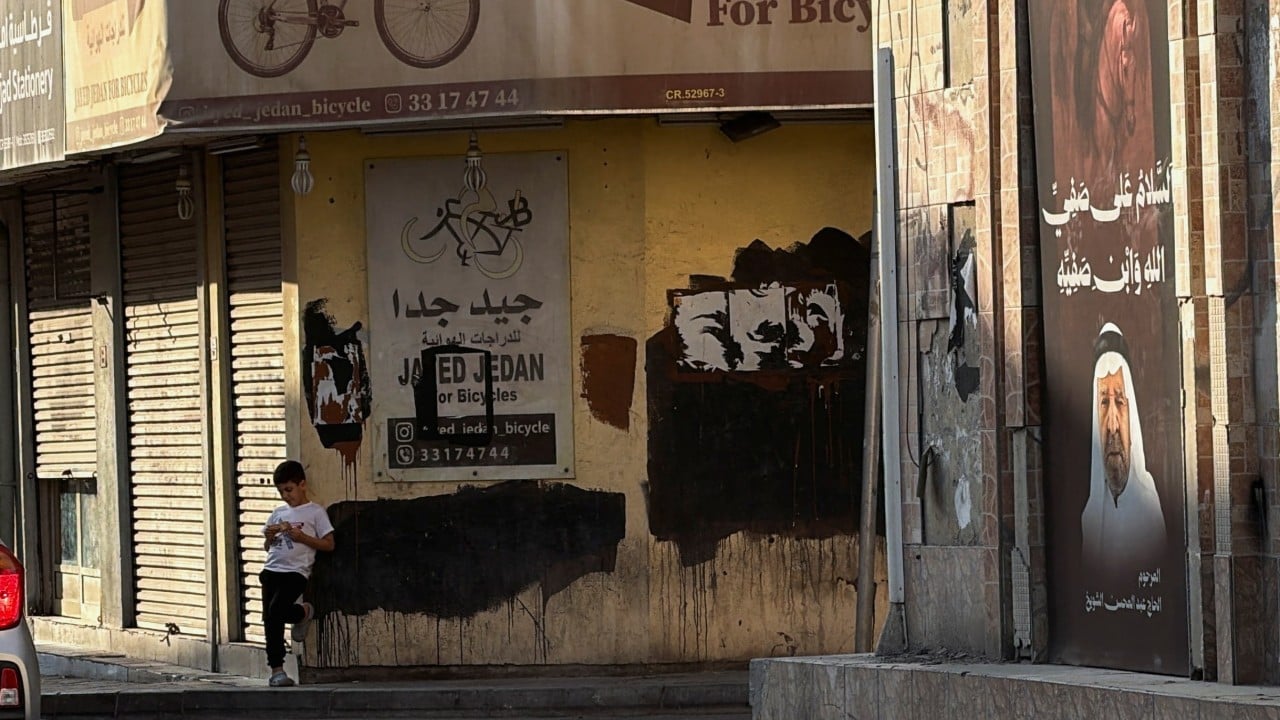
External military escalation in the Persian Gulf directly alters the domestic security calculus of Bahrain, converting regional kinetic conflict into internal political polarization. Because Bahrain operates with a minority Sunni ruling establishment governing a majority Shiite population—a demographic structure unique among Gulf Cooperation Council states—external warfare involving the Islamic Republic of Iran immediately activates dormant domestic fault lines. Analyzing this dynamic requires stripping away reductive sectarian narratives to examine the structural feedback loops connecting regional warfare, sovereign risk premiums, state security apparatuses, and domestic civil mobilization.
The Structural Vulnerability of Asymmetric Governance
To understand why regional conflict destabilizes Bahrain faster than its neighbors, analysts must isolate the country’s core demographic and institutional asymmetry. Unlike Saudi Arabia, where the Shiite population is geographically concentrated in the Eastern Province, or Kuwait, where political integration and parliamentary mechanisms historically absorbed sectarian friction, Bahrain’s demographic majority resides across the entire archipelago while remaining largely excluded from senior security, defense, and executive decision-making structures. If you liked this post, you might want to check out: this related article.
This governance model relies on an implicit security-for-stability equilibrium during periods of regional peace. When the Persian Gulf remains below the threshold of open interstate warfare, the state manages domestic dissent through targeted economic subsidies, localized policing, and controlled political channels. Regional war destroys this equilibrium through three distinct mechanisms:
- Securitization of Identity: Interstate conflict between Iran and Western-allied Gulf states forces the Bahraini state to view domestic Shiite political demands through the prism of national security rather than civil governance.
- Erosion of Moderate Mediation: During high-intensity regional crises, moderate opposition figures advocating for incremental constitutional reform lose political capital to hardline factions, while state pragmatists lose influence to hardline security officials.
- Information Warfare Amplification: Cross-border media ecosystems rapidly frame local grievances—such as unemployment, housing shortages, or judicial sentencing—as frontlines in a broader regional struggle, accelerating mobilization cycles.
The Three-Stage Escalation Mechanism
When an external conflict involving Iran intensifies, internal instability in Bahrain does not manifest instantaneously. It follows a predictable three-stage operational sequence driven by state preemptive measures and opposition reactions. For another look on this development, refer to the latest coverage from BBC News.
Stage One Preemptive Containment and Security Hardening
Before organized domestic protests materialize, the state security apparatus executes preemptive containment. Recognizing that Bahrain hosts critical Western naval infrastructure—specifically the headquarters of the U.S. Navy’s Fifth Fleet—Manama prioritizes physical security around strategic maritime chokepoints, energy infrastructure, and diplomatic facilities.
This phase involves expanded surveillance, restrictions on public assembly, and heightened scrutiny of religious gatherings. While operationally designed to deter sabotage or foreign intelligence infiltration, preemptive containment inevitably sweeps up non-violent domestic activists. The unintended second-order effect is the validation of opposition narratives regarding state repression, lowering the threshold for grassroots grievance mobilization.
Stage Two Symbolic Mobilization and Digital Dissent
Because heavy security deployments prevent large-scale urban demonstrations comparable to the 2011 Pearl Roundabout protests, domestic dissent shifts toward decentralized, low-cost, high-visibility actions. These include localized neighborhood marches, commercial strikes, and coordinated digital campaigns targeting international human rights monitors and foreign capital markets.
During a regional war, opposition actors capitalize on the state's divided attention. With military and intelligence resources oriented outward toward maritime defense and missile interception, domestic policing units face bandwidth constraints. Protesters exploit these operational seams to signal persistent domestic resistance without triggering immediate overwhelming force, forcing the state into a reactive posture.
Stage Three The Economic Contagion Loop
The third stage transitions the crisis from a policing challenge to a macroeconomic threat. Bahrain possesses the smallest hydrocarbon reserves in the Gulf Cooperation Council and carries a high debt-to-GDP ratio relative to its wealthier neighbors. Its economic survival depends on financial services, tourism, and sovereign debt issuance—all of which require an image of uninterrupted domestic stability.
Internal unrest during a regional war compounds geopolitical risk premiums. Credit rating agencies and institutional investors evaluate Bahrain not merely on its fiscal balance sheet, but on the probability of domestic disruption affecting regional banking hubs. As capital costs rise, the state’s fiscal capacity to fund public sector wages and social subsidies shrinks, directly feeding the economic grievances driving the protests.
Distinguishing Indigenous Grievances from External Proxy Dynamics
A persistent analytical failure in regional reporting is the conflation of indigenous Bahraini Shiite political grievances with Iranian statecraft. Accurate risk assessment requires separating organic domestic drivers from external exploitation.
Known Factual Baselines:
- Bahrain’s domestic opposition movements historically rooted their demands in constitutional monarchy, electoral district reform, equitable public sector employment, and judicial accountability—issues predating the 1979 Iranian Revolution.
- Following the 2011 uprising and the subsequent dissolution of major opposition societies such as Al-Wefaq, formal institutional channels for political representation contracted sharply.
- Iranian state media and regional proxy networks consistently amplify Bahraini domestic unrest to impose reputational costs on Manama and its Western allies, portraying the Bahraini government as illegitimate.
Analytical Hypotheses vs. Direct Evidence:
While security services have periodically interdicted weapons shipments and dismantled militant cells with alleged links to the Islamic Revolutionary Guard Corps, attributing all domestic mobilization to Tehran misdiagnoses the threat environment. In operational reality, Iran does not need to manufacture dissent in Bahrain; it merely exploits existing structural fractures. When the Bahraini state treats organic civil unrest identically to foreign-directed espionage, it inadvertently drives alienated youth toward radicalized underground networks that are receptive to external material support.
The Strategic Dilemma of External Security Guarantees
Bahrain’s security architecture relies heavily on two external pillars: the United States security umbrella and financial-military backing from Saudi Arabia and the United Arab Emirates. During an active regional war involving Iran, both pillars introduce complex operational trade-offs for Manama.
First, hosting the U.S. Fifth Fleet acts as a strategic deterrent against direct Iranian conventional invasion, yet it simultaneously makes Bahrain a primary target for asymmetric retaliation, including drone and ballistic missile strikes, as well as domestic protests against Western military presence. Domestic opposition groups frequently leverage anti-war sentiment to broaden their appeal, framing protests not purely in sectarian terms, but as opposition to Bahrain’s territory being used as a staging ground for regional conflict.
Second, reliance on Gulf Cooperation Council financial bailouts—most notably the multi-billion-dollar fiscal stabilization packages structured by Riyadh, Abu Dhabi, and Kuwait—binds Manama’s domestic policy autonomy to the threat perceptions of its larger neighbors. During a regional war, Saudi and Emirati policymakers prioritize absolute internal security across the Arabian Peninsula to prevent any breach in the collective defense perimeter. This external pressure limits Manama’s room to offer unilateral domestic political concessions, even if local pragmatists calculate that targeted reforms would de-escalate internal pressure.
Operational Limitations of Purely Kinetic Stabilization
History demonstrates that relying exclusively on coercive state capacity to suppress domestic conflict during external crises yields diminishing returns. While tactical policing and emergency legal frameworks successfully clear streets and disrupt organized leadership networks in the short term, they fail to resolve the underlying structural drivers of instability.
Three operational bottlenecks emerge when a state over-indexes on kinetic stabilization:
- Intelligence Degradation: Mass arrests and the criminalization of moderate civil society leaders eliminate credible interlocutors. Without recognized community leaders capable of negotiating de-escalation, state intelligence loses visibility into hyper-local grassroots sentiment, increasing the risk of sudden, uncoordinated flashpoints.
- Institutional Hollowing: Continual expansion of security budgets diverts capital from infrastructure maintenance, education, and private-sector diversification, deepening the structural unemployment that fuels youth radicalization.
- Diplomatic Friction: Severe domestic crackdowns complicate military and intelligence cooperation with Western partners, whose legislatures regularly scrutinize arms sales and defense agreements based on human rights metrics.
Strategic Forecast and Policy Imperative
As long as interstate warfare persists in the Persian Gulf, Bahrain’s domestic stability will remain hostage to external escalation cycles. The state cannot eliminate its demographic reality, nor can it decouple its geography from the strategic waterways of the Strait of Hormuz and the central Gulf. Consequently, attempting to achieve absolute domestic quietude through maximum security pressure during a regional war is a losing strategic posture that accelerates fiscal exhaustion and hardens generational alienation.
To break the feedback loop between external war and internal revolt, Manama must execute a dual-track containment strategy that separates regional defense from domestic governance. While maintaining strict maritime and critical infrastructure security against external kinetic threats, the state must simultaneously reopen localized, non-ideological channels for economic and municipal grievance resolution. Reinstating targeted economic empowerment programs, decoupling municipal service delivery from security clearances, and allowing controlled civil society mediation will not eliminate ideological opposition, but these measures will strip external adversaries of the domestic fuel required to turn a regional war into an internal regime crisis.