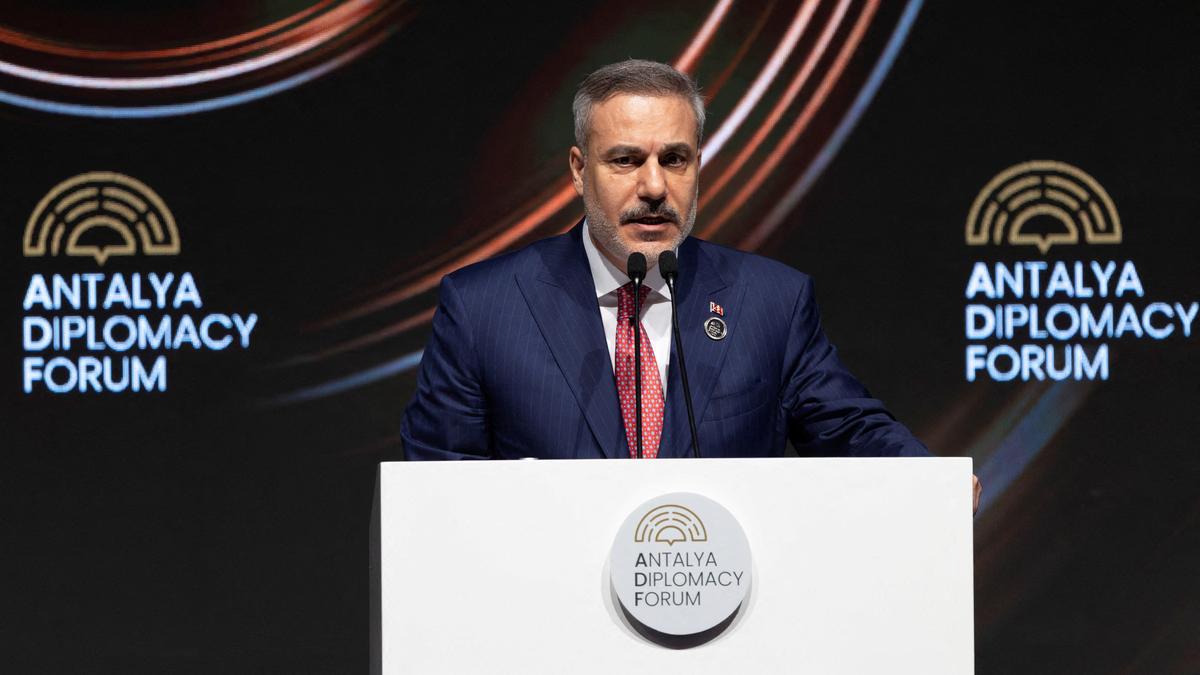
Turkiye’s recent accusations that Israel is using "security" as a mere smokescreen for territorial expansion isn’t just a diplomatic jab. It is a fundamental misreading of how modern warfare and geography actually function in 2026. While Ankara plays to a gallery of regional sentiment, they are ignoring the cold, hard reality of the Security-Space Paradox. In the old world, you held land to protect your borders. In the new world, land is a liability unless it functions as a sensor-fused buffer.
The "lazy consensus" among international observers is that this is a simple 19th-century land grab. It isn't. We are witnessing the total collapse of the "Strategic Depth" doctrine that defined the late 20th century. When Ankara points the finger at "pretexts," they are using a rhetorical framework that died the moment low-cost loitering munitions and hypersonic kinetic penetrators became standard kit for non-state actors.
The Myth of the Land Grab
Critics argue that seizing territory under the guise of security is a transparent relic of colonial expansion. They are wrong. If you wanted to build a profitable, modern ethno-state today, the last thing you would do is acquire more hostile territory. Land is expensive. Occupation is a fiscal black hole.
From a purely cold-blooded logistical standpoint, holding land inhabited by a population that hates you is a strategic nightmare. It drains the GDP, shreds international credit ratings, and creates a permanent insurgency that modern AI-driven surveillance can suppress but never fully eliminate. The idea that Israel—a nation built on high-tech exports and venture capital—is "greedy" for more rocks and sand ignores the massive economic drag of every square kilometer added to its footprint.
The truth is far more uncomfortable: Israel is trapped in a geographic cage that has been rendered obsolete by technology. When rockets have a flight time measured in seconds, "security" isn't a pretext; it is a frantic, often clumsy attempt to push the launch point further back than the enemy’s newest engine can travel.
Why Turkiye’s Narrative is Pure Projection
Ankara’s critique is a masterpiece of psychological projection. I’ve watched regional powers play this game for decades. Turkiye itself has spent years establishing "buffer zones" in Northern Syria and Iraq, citing the exact same security concerns regarding the PKK and YPG.
The difference? Turkiye calls it "Cross-Border Counter-Terrorism Operations." When Israel does it, Ankara calls it "Expansionism." This isn't a debate about international law; it’s a debate about who gets to define the word sovereignty.
- Logic Check: If security is a pretext, then every nation-state with a border wall is a colonizer in waiting.
- Data Point: Look at the cost-to-benefit ratio. Israel’s military spending as a percentage of GDP remains one of the highest in the OECD. You don't spend that much on "pretexts." You spend it because your margin for error is zero.
The Death of Strategic Depth
In 1991, Professor Ahmet Davutoğlu (who later became Turkiye’s Prime Minister) popularized the concept of Strategic Depth. The idea was simple: a nation's power is derived from its historical and geographical reach.
That theory is now a corpse. In 2026, depth is digital, not physical.
Imagine a scenario where a state controls 500 miles of desert. In 1940, that’s a fortress. In 2026, a swarm of $500 drones equipped with thermal imaging and shaped charges makes that desert a graveyard for the occupier.
Israel knows this. Their "land acquisition" isn't about farming or settlement; it’s about topographic dominance. If you don't hold the high ground, your Iron Dome interceptors have a shorter detection window.
$$T_d = \frac{D}{V_m} - T_p$$
Where $T_d$ is the decision time, $D$ is the distance from the launch point, $V_m$ is the missile velocity, and $T_p$ is the processing lag of the radar array. When $D$ approaches zero, $T_d$ becomes negative. You are dead before your computer knows you are under attack.
This is the math that Turkiye ignores because math doesn't win elections in Istanbul or Ankara. Pushing the border out isn't about "more land." It’s about buying three seconds of $T_d$.
The Intelligence-Industrial Complex
I have seen the internal reports from defense contractors who thrive on this instability. They don't want "more land" for their clients; they want more interfaced territory.
We are moving toward the era of the Automated Frontier. The "pretext" of security is actually a transition phase toward the total mechanization of borders. The land being contested today is being prepared for a permanent grid of autonomous turrets, seismic sensors, and subterranean acoustic monitors.
People ask: "Why can't they just use tech instead of boots on the ground?"
The answer is brutal: The tech needs a place to stand.
You cannot maintain a high-frequency sensor array in a territory you do not physically control. If you don't own the dirt, the enemy cuts the fiber-optic cables. If you don't own the ridge, the enemy jams the line-of-sight microwave links.
Dismantling the "Peace through Withdrawal" Fallacy
The international community loves to suggest that returning to 1967 borders would solve the security crisis. This is a nostalgic fantasy.
The 1967 borders were drawn before the advent of:
- Commercialized GPS-guided munitions.
- Tunnel-boring machines capable of moving 10 meters a day.
- Social media-driven radicalization that turns a civilian kitchen into a bomb factory in 24 hours.
To ask a state to return to "legacy" borders in a "hyper-tech" era is like asking a bank to switch from blockchain encryption back to a physical ledger and a heavy door. It’s not just risky; it’s a form of strategic suicide that no sane cabinet would ever approve.
The Economic Reality No One Mentions
The real tragedy isn't the acquisition of land, but the devaluation of land.
The territory Turkiye and Israel are arguing over is increasingly worthless in a globalized economy. The most valuable "land" on earth today exists in data centers in Northern Virginia and the chip fabs of Taiwan. The Levant is fighting a 20th-century war over soil while the rest of the world has moved on to the war over silicon.
Israel’s internal conflict is between its "Start-up Nation" identity—which wants to ignore the borders and live in the cloud—and its "Fortress Nation" reality—which is stuck in the mud. Turkiye’s rhetoric helps the Fortress Nation wing. Every time Erdogan shouts about expansionism, he reinforces the siege mentality that makes the "security pretext" a self-fulfilling prophecy.
The Actionable Truth
If you are looking for a solution that involves "land for peace," you are looking at a 1990s map. It’s over. The only way forward is Transparency through Technology.
- Stop obsessing over where the fence is.
- Start obsessing over who controls the electromagnetic spectrum over that fence.
The "pretext" will remain as long as the geography remains a threat. If Turkiye actually wanted to stop Israeli expansion, they wouldn't give speeches at the UN. They would offer a joint-security architecture that renders the "need" for buffer zones obsolete through shared satellite intelligence. But they won't. Because a solved problem is a political disaster for a populist leader.
The status quo isn't a failure of diplomacy. It’s a success of political branding. Both sides are getting exactly what they want: a permanent state of friction that justifies increased military spending and internal consolidation of power.
Security isn't the pretext for land. Land is the pretext for an eternal, profitable, and politically convenient state of war.
Stop looking at the map. Start looking at the balance sheets.