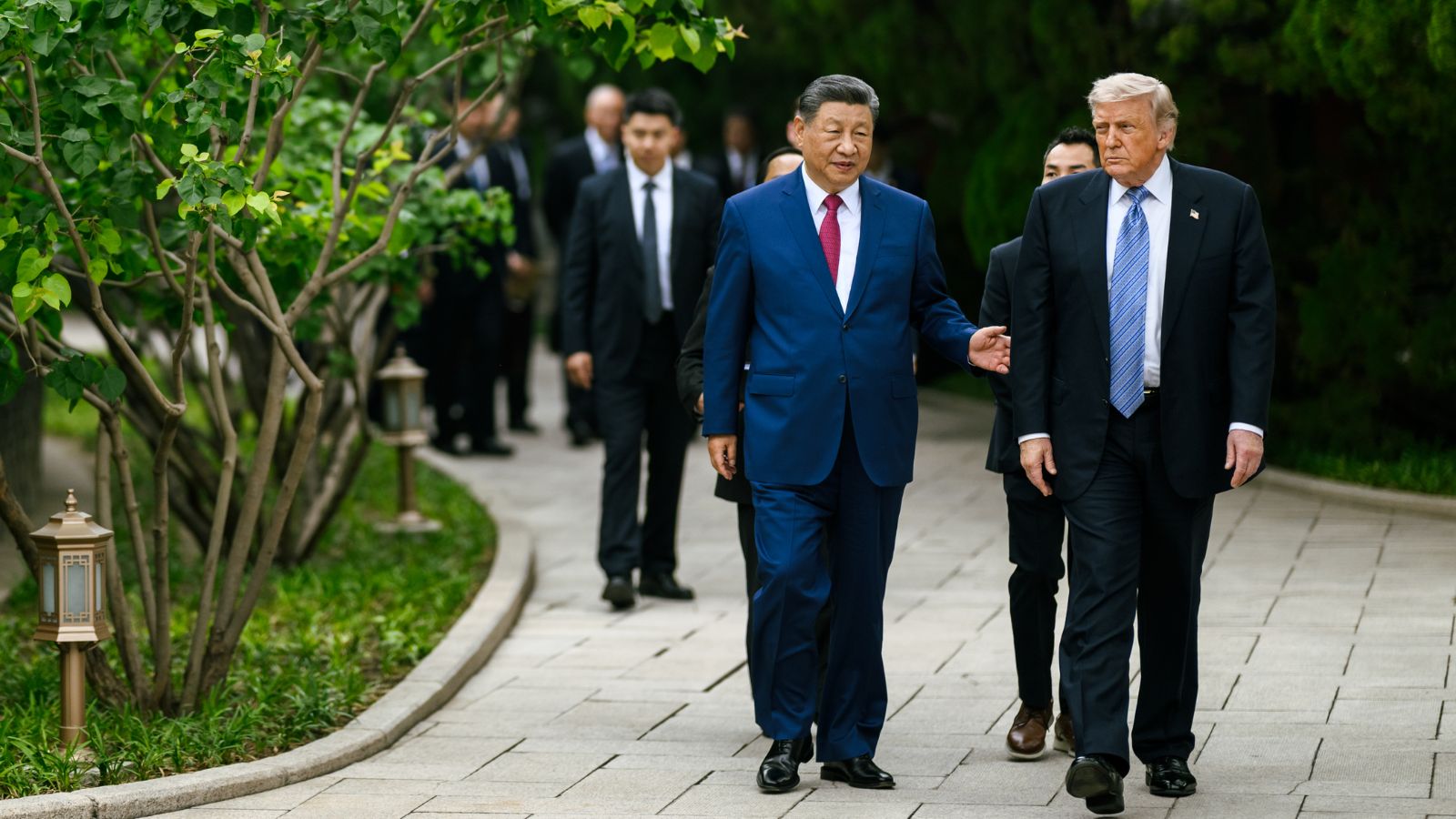
The utilization of ancient biological markers as instruments of statecraft represents a deliberate shift from immediate transactional diplomacy to long-term psychological positioning. When Chinese leadership presents centuries-old flora to an American counterpart, the interaction transcends simple horticulture; it serves as a non-verbal projection of temporal dominance and institutional continuity. This tactic exploits the asymmetry between the American political cycle, characterized by four-to-eight-year volatility, and the Chinese strategic horizon, which benchmarks success in centuries.
The Architecture of Temporal Authority
The presentation of ancient trees functions as a physical manifestation of the "Century of Humiliation" counter-narrative. By highlighting organisms that predated the United States as a sovereign entity, the host establishes a hierarchy of endurance. This diplomatic maneuver relies on three specific psychological levers: Meanwhile, you can read other stories here: The Taiwan Strait Noise Machine Why Seven Chinese Warships Are Not an Invasion.
- The Continuity Coefficient: The trees serve as living proof that the current political structure is merely the latest iteration of a civilization that has survived multiple systemic collapses.
- Scale Relativity: By forcing a head of state to contemplate a 500-year-old living entity, the host diminishes the significance of contemporary quarterly reports or election cycles.
- The Stewardship Mandate: The health of these ancient specimens signals to the observer that the state possesses the administrative stability required for multi-generational preservation.
The reaction of a foreign leader to these displays—often characterized by genuine surprise—reveals a fundamental disconnect in how different powers calculate value over time. While the Western leader focuses on the novelty of the age, the Chinese strategist focuses on the survival of the root system through upheaval.
Mechanics of Soft Power Infrastructure
Traditional diplomacy relies on "hard" assets like naval presence or "soft" assets like cultural exports. The use of historical gardens represents a third category: Environmental Legitimacy. This strategy employs the physical landscape to validate political longevity. To explore the bigger picture, we recommend the detailed report by NBC News.
The Preservation Variable
The existence of these trees within a controlled state environment suggests a level of environmental and social stability that persists regardless of global market shifts. This creates a "Duration Bias" in the mind of the visitor. If the state can ensure the survival of a sensitive biological asset for five hundred years, the logical inference—intended by the host—is that its policy frameworks possess similar resilience.
Symbolic Resource Allocation
Maintaining centuries-old trees requires specialized labor, specific land use policies, and protection from urban encroachment. These are high-cost, low-yield investments in the short term. In a diplomatic context, showing off these trees demonstrates that the state has the luxury of allocating resources toward assets that provide no immediate economic return. This signals a position of "Civilizational Surplus," where the nation is so secure in its current standing that it can obsess over the preservation of the past.
The Friction of Divergent Strategic Horizons
The core tension in Sino-American relations often stems from mismatched decay rates in policy. American foreign policy is subject to the "Term Limit Friction," where strategic goals are frequently reset or abandoned every four years. Conversely, the Chinese model operates on a "Consensus Accumulation" basis.
Tactical Surprise as a Diagnostic Tool
A leader's exclamation at the age of a tree is more than a human moment; it is a data point for the host's intelligence apparatus. It confirms the guest's susceptibility to temporal shock. This allows the host to gauge how much weight the visitor places on immediate results versus long-term structural shifts. A visitor preoccupied with the "now" is easily distracted by the "forever."
The Burden of Antiquity
The host uses these artifacts to imply that the guest is a temporary custodian of power, whereas the host is part of a permanent lineage. This creates an unspoken pressure during negotiations. The visitor is made to feel the weight of history, which can lead to a more cautious or deferential bargaining position. The trees act as "Anchoring Artifacts," fixing the conversation in a historical context where the visitor's nation is the junior partner in terms of duration.
Quantitative Limits of Biological Diplomacy
While the psychological impact of ancient symbols is high, their utility in concrete policy negotiation has distinct boundaries. Symbolic gestures cannot bridge gaps in trade deficits or maritime security through sentiment alone. The effectiveness of this signaling degrades when the visitor's domestic political pressure outweighs the atmospheric pressure of the diplomatic setting.
The "Authenticity Gap" occurs when the host emphasizes ancient stability while the visitor observes contemporary instability. If the display of antiquity is too detached from current economic or social realities, it ceases to be a signal of strength and becomes a mask for stagnation. The observer must believe that the current state is the legitimate heir to the longevity it displays.
Institutional Memory and Negotiation Leverage
Diplomatic success often hinges on which party controls the narrative of "The Future." By claiming ownership of "The Past" through these ancient gardens, China attempts to monopolize the trajectory of time itself. This is a form of Strategic Anchoring.
- Phase 1: Disorientation. The guest is removed from modern contexts and placed in an environment where time scales are expanded.
- Phase 2: Comparison. The host draws direct parallels between the survival of the flora and the survival of the state.
- Phase 3: Integration. The host frames the current diplomatic agenda as a minor footnote in a much larger historical arc.
The second limitation of this strategy is the "Irrelevance Threshold." To a leader focused entirely on disruptive technology or rapid market shifts, a 500-year-old tree may appear as an museum piece rather than a symbol of power. If the guest does not value historical continuity, the signal fails to reach its target.
Optimizing Response to Civilizational Signaling
To counter this form of temporal positioning, a visitor must pivot from "Awe" to "Adaptation." Instead of acknowledging the age of the asset as a standalone marvel, the strategic response should focus on the evolution that occurred during that timeframe. This reclaims the narrative of progress.
The most effective counter-signal is to highlight the capacity for rapid self-correction—a trait inherent in democratic systems but often lacking in those focused on rigid continuity. By framing the American system's volatility as "Dynamic Resiliency," a leader can neutralize the host’s "Static Longevity."
Future diplomatic engagements will likely see an increase in this type of environmental signaling as competition moves beyond the economic and into the metaphysical. The ability to maintain and display ancient assets will remain a key metric of a state's internal stability and its perceived right to lead on the global stage.
The final move in this exchange is not a verbal agreement, but a calibration of expectations. The visitor must depart with an understanding that they are negotiating with an entity that views decades as weeks. The host, meanwhile, uses the visitor's reaction to refine their understanding of the guest's strategic impatience. To win the negotiation, one must first master the clock in the room, even if that clock is a tree.
Establish a "Counter-Duration" framework. When faced with ancient symbols, immediately pivot the dialogue toward the speed of future innovation. Neutralize the weight of the past by asserting control over the velocity of the future. This forces the host to defend their relevance in a rapidly changing environment, rather than allowing them to hide behind the safety of antiquity.