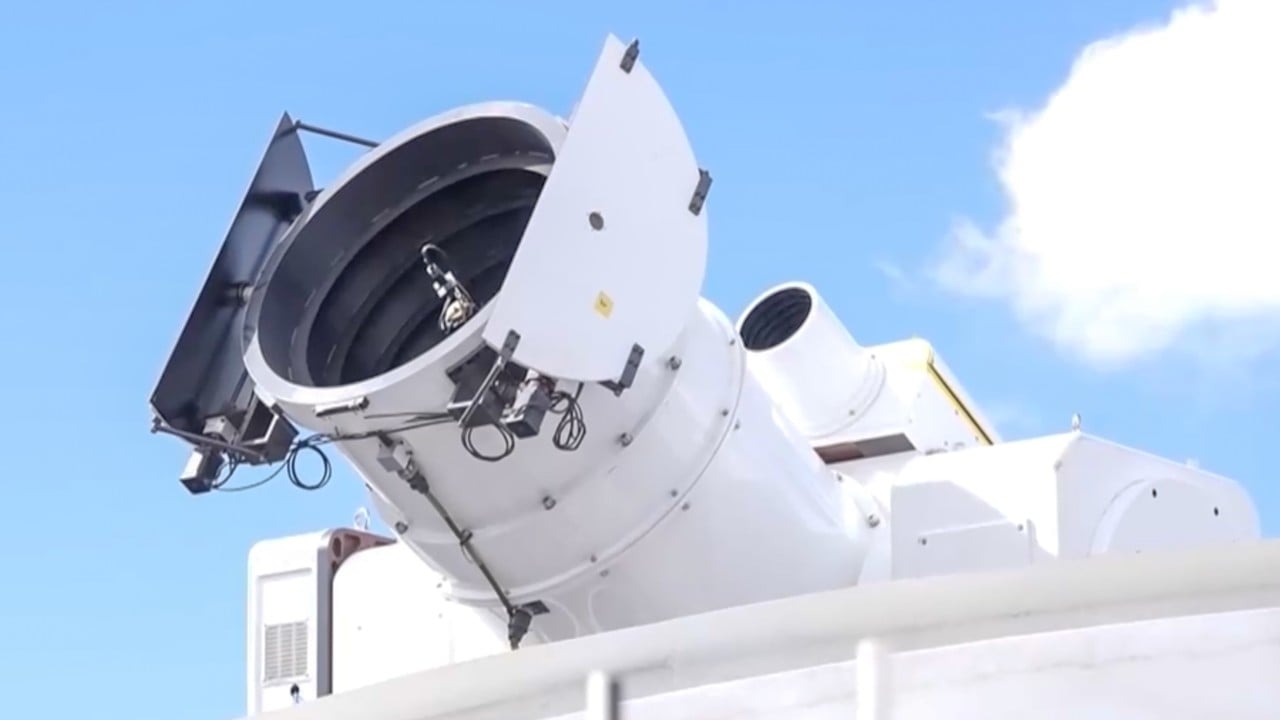
Dr. Elena Vance stared at the glowing amber line tracing its way across her monitor, feeling the cold weight of history press against her ribs. It was 2026. Humanity was back on the cusp of permanent lunar footprints, planting habitats in the dust of craters that had never seen a sunrise. Yet, the data scrolling down her screen whispered a bizarre truth, one that felt less like a leap into the future and more like digging through an old attic.
China’s newest lunar laser communication system was broadcasting data back to Earth at a speed that felt suspiciously modest. Measured against modern terrestrial networks, it was impressive. Measured against the ghost of a decade past, it was a ghost story.
Back in 2013, NASA’s Lunar Atmosphere and Dust Environment Explorer, better known as LADEE, fired a near-infrared laser across 239,000 miles of absolute vacuum. That single beam achieved a download rate of 622 megabits per second. It was a dazzling feat of engineering that briefly made the Moon feel as close as a fiber-optic cable running down the street.
Elena leaned back, listening to the hum of her lab. Why, thirteen years later, was a modern lunar laser link operating at speeds that lagged behind what an American spacecraft accomplished when smartphones still had home buttons?
The answer lived far away from the glossy press releases. It lived in the friction between raw ambition and the brutal physics of space.
Space does not care about national pride. It does not care about headlines. It cares about power, thermal dissipation, atmospheric distortion, and pointing accuracy so fine it makes threading a needle from a mile away look like child's play.
Imagine standing on a swaying ship in the middle of a dark ocean, trying to shine a laser pointer at the eye of a needle held by a friend on another ship moving at thousands of miles per hour. Now add vacuum, cosmic radiation, and a thick soup of Earth's atmosphere that scatters light like a prism. That is the reality of deep-space optical communication.
When LADEE flew in 2013, it was a technological sprint. NASA poured massive resources into a specialized, single-purpose demonstration mission. It was a proof of concept designed to dazzle the world, operating under tightly controlled conditions with massive ground-based telescopes tracking it with laser-like precision. It proved the physics worked. But proving physics works in a lab or a one-off demonstration is entirely different from building a sustainable, everyday infrastructure.
When engineers talk about communication speeds in deep space, they are often comparing apples to rocket engines. A high-speed link requires a colossal amount of onboard power, highly sophisticated error-correction algorithms, massive apertures on both ends, and a pointing mechanism that can compensate for the rotation of two celestial bodies simultaneously.
China’s current lunar efforts are not trying to win a solitary drag race. They are laying down the gravel for a highway.
To understand why a modern system might prioritize reliability, mass constraints, or power efficiency over sheer, blistering speed, we have to look at what these missions are actually trying to achieve. A 2013 demonstration is a fireworks display. A 2026 operational relay is a utility pole.
(Note: When comparing these systems, it is vital to remember that theoretical downlink speeds heavily depend on ground station network density, atmospheric weather windows, and whether the spacecraft is using a dedicated experimental terminal or a shared, multi-use transceiver designed to handle telemetry, voice, and science data simultaneously.)
Elena remembered the sleepless nights of her own early career, working on orbital sensors. Everyone wants the big number. Everyone wants the headline that says Gigabits per second! But the astronauts sitting in a crater on the Moon do not care about download speeds if the link drops every time a high-altitude cloud passes over a ground station in Yunnan or Tenerife. They care if they can stream a high-definition medical diagnostic to a surgeon in Beijing without a stutter. They care if the signal stays alive when the solar wind gets angry.
Speed without reliability is just noise.
The narrative that space exploration is a clean, linear upward staircase is a comforting myth we tell ourselves. We love the idea of progress as an arrow pointing forever upward, steeper and faster with every passing year. But true technological evolution is messier. It involves trade-offs. It involves stepping back from peak performance to achieve durability, mass reduction, or cost efficiency.
If China’s lunar laser link is operating at a more modest throughput than NASA’s historic 2013 benchmark, it is because they are engineering for a different ecosystem. They are building for a permanent presence. They are designing hardware that can survive the lunar night, the thermal shocks of baking sun and freezing shadow, and the grueling demands of a multi-decade space program.
Sometimes, the tortoise does not just beat the hare; the tortoise builds a brick house while the hare's fireworks burn out in the upper atmosphere.
Elena looked back down at her monitor. The amber line continued its steady, unglamorous march across the screen. It wasn't breaking any speed records. It wasn't stealing the front page of tomorrow's newspapers. But it was steady. It was connected. Across a quarter-million miles of dead, silent space, a tiny beam of light was carrying the pulse of humanity, one steady byte at a time.
And out there in the dark, that was enough to keep the lights on.