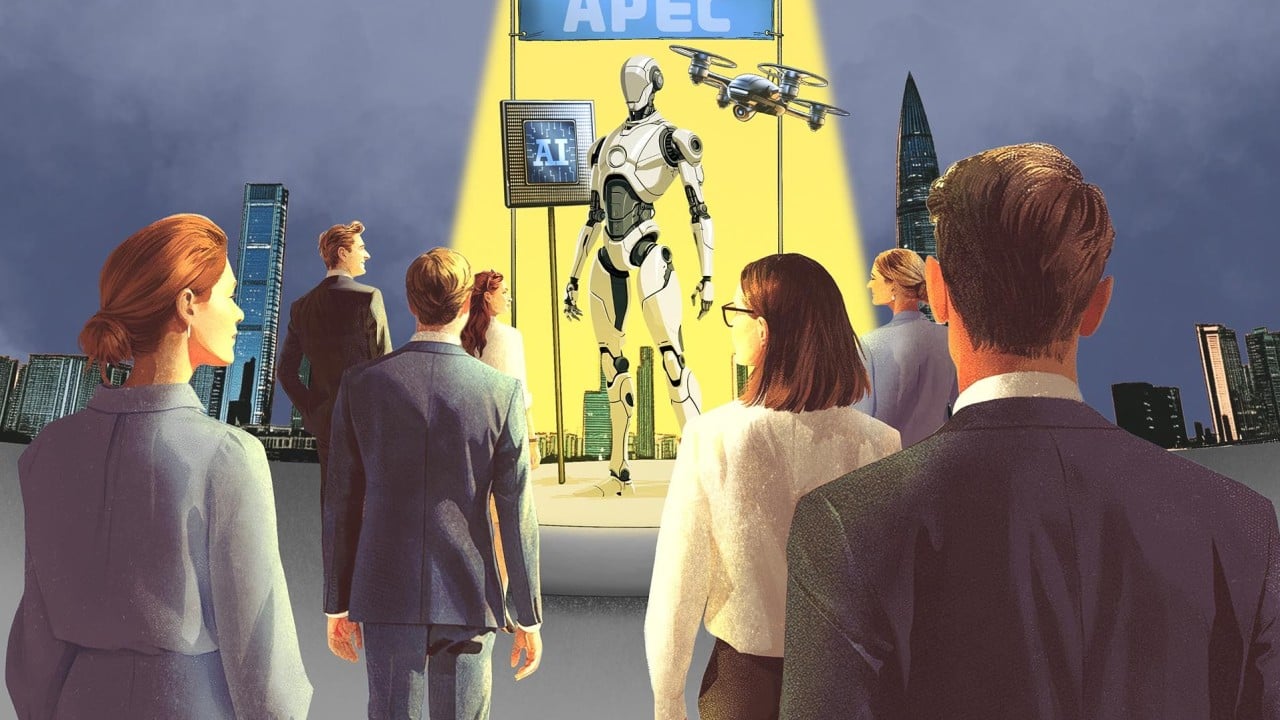
Salt still clings to the air in the older pockets of Shenzhen if you know where to stand when the Pearl River tides turn. Walk three blocks inland from the reclaimed mudflats of Bao’an, past the last surviving banyan trees whose roots look like clenched fists, and the smell changes instantly. Ozonic. Metallic. The sharp, warm tang of reflow solder and freshly milled aluminum.
Forty-six years ago, an old man named Chen—let us call him Uncle Chen, a composite of the thousands of Hakka and Cantonese fishermen who once worked these brackish waters—would have spent his mornings mending nylon gillnets on wooden docks. His son would have learned to read the barometer in the clouds over Deep Bay. Instead, earlier this month, Uncle Chen’s grandson stood inside a climate-controlled exhibition hall as trade ministers from twenty-one Pacific Rim economies watched a bipedal machine pour tea without spilling a drop.
Shenzhen hosted the Asia-Pacific Economic Cooperation leaders’ summit in November 2026. To the casual observer scanning headlines from across the ocean, the event looked like standard diplomatic theater. Handshakes. Flags. Carefully rehearsed remarks about supply chain resilience and regional trade. Yet beneath the velvet ropes and simultaneous translation headsets, something far stranger and more consequential occurred. A city that did not exist on global industrial maps half a century ago quietly audited the future of human labor—and handed the world the receipt.
The Myth of the Overnight Miracle
We love a neat origin story. Journalists repeat the same four words whenever Shenzhen comes up: from fishing village to... Fill in the blank. Tech hub. Factory of the world. Silicon Valley of hardware. Now, Robot Valley.
The cliché is comforting because it makes transformation sound like magic, as if someone snapped their fingers in 1980 when Deng Xiaoping drew a circle around Bao’an County and declared it a Special Economic Zone. Magic requires no explanation. You don't have to examine the blistered thumbs, the dormitory bunks stacked four high, or the terrifying speed at which an entire civilization teaches itself to fail faster than anyone else on earth.
I remember my first night in Huaqiangbei years ago, standing beneath fluorescent tubes that hummed like angry wasps. Around me, teenagers with magnifying visors soldered surface-mount capacitors onto green fiberglass boards at speeds that blurred the eye. One block away, stall owners sold reels of micro-motors, lithium pouches, and optical sensors by weight, like dried chilies at a wet market. If you needed a custom CNC-milled titanium joint by Tuesday, you didn't file a purchase order with a procurement committee. You walked across the street, drank a cup of bitter pu-erh with a guy named Lin, and picked up the prototype before breakfast.
That proximity—what economists dryly call agglomeration—is the secret engine nobody puts on a summit brochure. Imagine trying to bake a wedding cake when the flour mill is in Ohio, the sugar refinery is in Brazil, the dairy farm is in New Zealand, and every ingredient requires six weeks of customs clearance. That is how hardware gets built in Munich, Boston, or Tokyo. In Shenzhen, the cow, the wheat field, the oven, and the pastry chef share an elevator.
When that ecosystem turned its attention from smartphones and consumer drones to embodied artificial intelligence, the timeline collapsed.
Why Steel Needs a Nervous System
For decades, industrial robotics meant massive orange cages bolted to concrete floors in Stuttgart or Nagoya. Dumb muscle. Blind strength. Those machines welded car doors with lethal precision, repeating a single choreographed arc ten million times without complaint, provided nothing ever moved two millimeters out of place. If a bolt dropped on the floor, the robot kept welding thin air.
What is emerging from Shenzhen’s Nanshan and Longgang districts is an entirely different species of machine.
Consider what happens when you try to teach a machine to fold a wrinkled cotton shirt or pick up a ripe persimmon without bruising the skin. Math breaks down. Physics becomes messy. You cannot hard-code every possible fold of fabric or every slight variation in fruit ripeness. To survive outside a factory cage, a robot needs two things that historically refused to coexist: physical dexterity cheap enough to mass-produce, and a digital brain capable of improvising when reality misbehaves.
This is where the APEC stage in November 2026 became an unveiling rather than a routine diplomatic conference.
Throughout the summit venues—from the Shenzhen Bay waterfront to the gleaming halls of the Futian convention center—delegates encountered machines that did not look like heavy industrial equipment. Humanoids from local pioneers like Ubtech, Unitree’s nimble quadrupeds, and agile robotic arms from Dobot operated not behind glass barriers, but in open corridors. They sorted luggage tags, navigated unpredictable crowds of security personnel and journalists, and assisted logistics crews moving crates backstage.
Let’s be honest about what those demonstrations actually meant, because the hype around humanoid robots often borders on delusion. Most bipedal robots today are still clumsy toddlers compared to a ten-year-old child. Batteries drain too fast. Actuators overheat under sustained torque. A flight of wet stairs remains a mortal enemy.
Yet dismissing them because they occasionally stumble misses the structural shift happening underneath the chassis.
Every single component inside those machines—the harmonic drives, the brushless frameless torque motors, the solid-state LiDAR pucks, the tactile fingertip sensors—is sliding down the exact same cost curve that turned flat-screen televisions from luxury status symbols into disposable commodities. Five years ago, a research-grade humanoid prototype cost upwards of two million dollars. By late 2026, Shenzhen supply chains had compressed bill-of-materials costs for commercial bipedal units below thirty thousand dollars, with stripped-down industrial variants dipping even lower.
Thirty thousand dollars is less than one year of fully burdened wages for a warehouse worker in California, Bavaria, or increasingly, coastal China itself.
The Demographic Cliff Nobody Wants to Stare Over
To understand why Shenzhen poured billions into Robot Valley—why municipal planners zoned entire industrial parks specifically for embodied AI and subsidized actuator foundries—you have to look past pride and toward panic.
China is growing old faster than any major economy in recorded history.
Between 2012 and 2025, the country’s working-age population shrank by tens of millions. By 2035, roughly four hundred million Chinese citizens will be over the age of sixty. Look closely at any assembly line in Guangdong province today and you will notice an uncomfortable truth: the young migrant workers who built the modern world in the 1990s and 2000s have gone home, opened small shops, or refused to spend twelve hours a day screwing tiny casings together under fluorescent lights. Their children hold university degrees. They want desk jobs, creative careers, or air-conditioned studios—not repetitive strain injuries on a Foxconn line.
Factory owners in the Pearl River Delta didn't embrace automation out of sci-fi romanticism. They embraced it because nobody showed up to work after Lunar New Year.
Think of Shenzhen’s robot obsession as a civilization building its own prosthetic limbs before the muscle atrophies.
Take a hypothetical afternoon inside a mid-sized electronics plant in Guangming District—a composite drawn from dozens of real facilities operating across the city right now. Five years ago, Floor Three held four hundred workers seated shoulder-to-shoulder along green conveyor belts, snapping power supply housings together. Today, Floor Three holds forty-five human technicians monitoring three hundred articulated arms and autonomous mobile carts.
The air on Floor Three isn't romantic. Nobody sings hymns to progress. A technician named Mei, twenty-nine years old, walks the aisle with a ruggedized tablet, recalibrating vision sensors when glare from an afternoon thunderstorm confuses an optical camera. Mei makes twice what her mother earned on an assembly line in 2004, works eight hours instead of twelve, and goes home without solvent burns on her hands. Meanwhile, the three hundred fifty-five jobs that vanished from Floor Three did not move to Vietnam or Mexico. They evaporated into code and copper windings.
This is the invisible stake that sat quietly at the center of the APEC table while trade ministers debated tariff schedules and digital commerce protocols.
The Diplomatic Chessboard Beneath the Carpet
When leaders from Washington, Tokyo, Seoul, Jakarta, and Santiago gathered in Shenzhen in November 2026, they walked across floors polished by machines built ten miles away.
For decades, global trade operated on a predictable staircase. Poor nations started with textiles and toys. As wages rose, they graduated to steel, chemicals, and consumer electronics, passing the low-wage ladder down to the next developing economy. That staircase lifted hundreds of millions out of poverty across East and Southeast Asia.
Shenzhen’s Robot Valley threatens to saw off the bottom rungs of the ladder.
If a robotic cell in Guangdong, Monterrey, or Ohio can stitch sneakers, assemble circuit boards, and pack boxes for pennies per hour without sleeping, striking, or requiring dormitory housing, what happens to the developing economies counting on cheap human labor to industrialize? Conversely, what happens to wealthy Western nations that spent forty years offshoring their manufacturing muscle, only to discover that you cannot build next-generation autonomous machines if you no longer remember how to cast aluminum or wind copper coils at scale?
It is an unsettling realization. Even after years of watching hardware supply chains evolve, I still feel a cold knot in my stomach when I look at how wide that capability gap has grown. You can write brilliant neural networks in San Francisco or London. You can train foundation models on clusters of ten thousand GPUs. But software without physical supply chains is a brain in a jar. To give intelligence hands, you need machinists, magnet suppliers, gearbox tolerances measured in microns, and engineers willing to sleep on cots beside injection-molding presses until a tolerance issue disappears.
Shenzhen has all of it within a forty-five-minute subway ride.
During the APEC summit, Chinese officials framed this ecosystem as an open invitation—a public utility for global modernization. Local firms inked supply agreements with logistics operators in Singapore, agricultural conglomerates in Chile, and hospital networks across Southeast Asia. The message was unmistakable: You don't need to build your own industrial base from scratch. Plug into ours.
For a hospital administrator in Manila facing an acute shortage of orderlies, or a mining executive in Peru struggling to staff remote high-altitude sites, that offer sounds less like geopolitical dominance and more like salvation. Yet accepting the offer means wiring the physical infrastructure of your economy into software stacks, sensor networks, and maintenance pipelines anchored in southern China. Every lidar scan, every warehouse floorplan, every movement routine flows back into training loops that make Shenzhen’s algorithms smarter with every deployed unit.
Data is the new oil, people used to say. They were wrong. Physical interaction data—millions of hours of machines touching, lifting, dropping, and adjusting to the messy friction of the real world—is far rarer and harder to fake than text scraped from the internet. You cannot synthesize the feel of wet cardboard slipping from a gripper. You have to drop the box a million times to learn how not to.
Shenzhen is dropping millions of boxes every single day.
What Survives When Machines Learn to Touch
Late in the evening, after the motorcades clear the boulevards around Shenzhen Bay Park and the drone light shows fade back into humid darkness, the city grows surprisingly quiet. Walk down toward the water where the mangrove reserves still cling to the shoreline, and you can look across the bay toward Hong Kong’s New Territories flickering on the horizon.
Down in the shallow mud beneath the boardwalk, fiddler crabs still emerge at low tide, waving single oversized claws in ancient, pointless territorial rituals. Above them rises a skyline of glass towers housing artificial intelligence labs, venture funds, and robotics showrooms that did not exist when the concrete in those boardwalk pilings was poured.
We tend to talk about technological revolutions in binary terms—utopia or dystopia, liberation or obsolescence, winners or losers. Reality refuses to cooperate with clean binaries. The same robotic hand that eliminates an exhausting, repetitive factory shift can also hollow out an entry-level career path for a young worker who needed a first rung to climb. The same autonomous delivery cart that brings medicine to an elderly shut-in on the twelfth floor of a walk-up apartment also concentrates immense economic power inside the handful of companies that own the fleet’s operating system.
Shenzhen itself carries the proof of both truths in its own soil. The fishing villages were swallowed whole; ancestral halls now sit wedged awkwardly between forty-story apartment blocks like stubborn boulders in a fast river. Yet the grandchildren of those fishermen walk streets free of the grinding scarcity their grandparents accepted as fate.
Across the pacific and around the world, boardrooms and parliaments will spend the next decade arguing over regulations, safety standards, and trade barriers for intelligent machines. Most of those debates will happen in rooms far removed from factory floors, conducted by people who have never smelled burning flux or watched a prototype servo strip its gears at three in the morning.
Meanwhile, in a warehouse off Bao’an Avenue, a technician adjusts a torque curve on a screen, hits enter, and watches five steel fingers close gently around a fragile glass cup—holding it firm enough not to fall, soft enough not to break.


