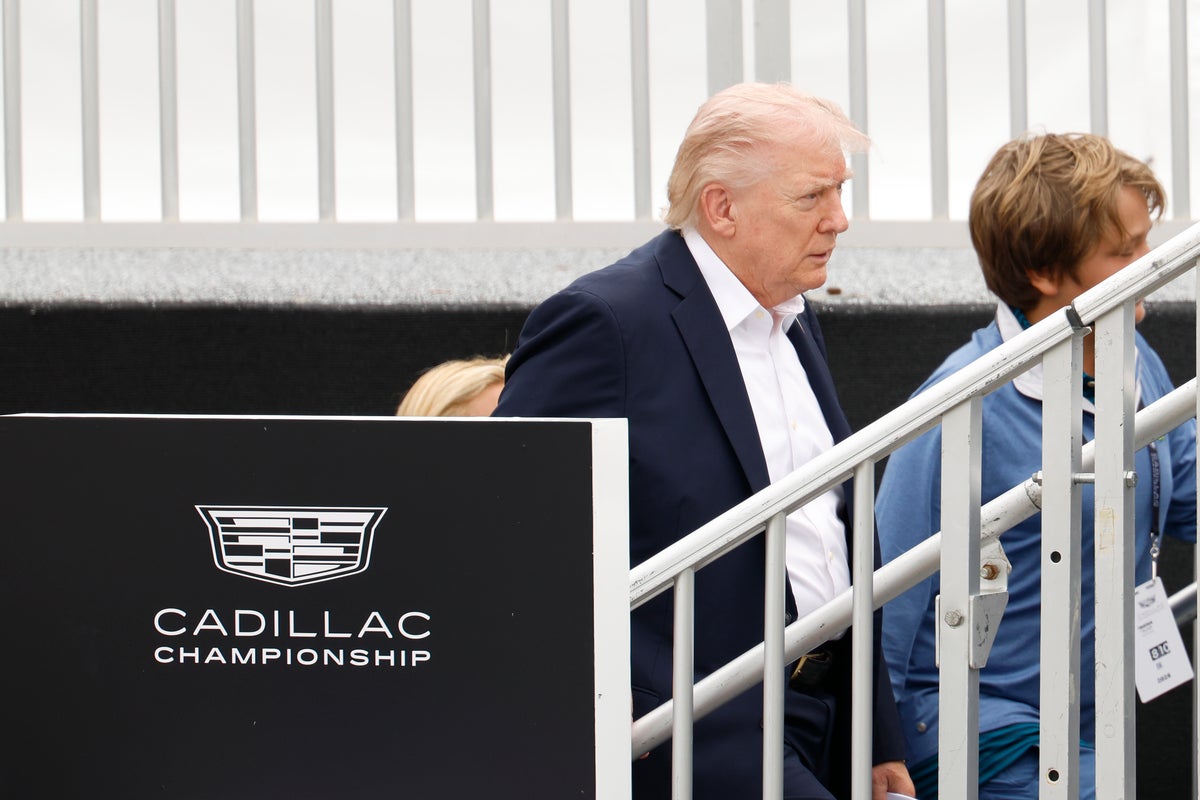
The grass at Trump International Golf Club is a shade of green that doesn’t exist in nature. It is the color of curated perfection, clipped to a precise fraction of an inch, smelling of expensive fertilizer and the salty, humid breeze of West Palm Beach. On this afternoon, the air carries something heavier than the scent of the Atlantic. It carries the vibration of a crowd.
Donald Trump stands near the clubhouse, his silhouette as familiar as a monument. He is watching the PGA event unfold on his own soil, and the reception is electric. The cheers aren’t just polite golf claps; they are guttural shouts of recognition. For a moment, the emerald horizon of the course feels like a sanctuary, a world where every problem is as simple as a twenty-foot putt.
But the world beyond the gates is screaming.
The Invisible Weight of the Grocery Bag
Consider a woman named Elena. She isn’t at the golf course. She is four miles away, standing in the fluorescent aisle of a Publix, staring at a carton of eggs. Two years ago, she didn't look at the price. Now, she performs a mental dance of subtraction.
The rising prices mentioned in the headlines aren't just statistics to Elena. They are the reason she didn't buy the brand of coffee she likes. They are the reason her car’s gas light is currently glowing like a tiny, angry ember on her dashboard.
While the crowd at the PGA event roars for a long drive, millions of Americans are experiencing a quieter, more exhausting kind of tension. It is the tension of the "slow squeeze." It is the realization that while the stock market might be flickering in the green, the actual cost of existing—of heat, of bread, of insurance—has shifted into a higher gear that shows no sign of downshifting.
There is a profound disconnect in the American psyche right now. On one side of the fence, there is the spectacle of wealth and the celebration of a political icon who embodies it. On the other, there is a mounting anxiety that the floor is becoming less stable.
Shadows Over the Fairway
The cheers in Florida don't exist in a vacuum. They are echoing at a time when the drums of war are beating with a frantic, uneven rhythm. The tension with Iran isn't just a "foreign policy update" scrolling across the bottom of a news feed. It is a variable that dictates the price of the fuel in Elena’s car and the stability of the global energy grid.
When we talk about geopolitical conflict, we often focus on the maps and the missiles. We forget the human heart. We forget the families watching the news with a knot in their stomachs, wondering if their sons or daughters in uniform will be the ones sent to stabilize a region that has known little but instability for decades.
The golf course is a fortress of order. The rules are clear. The bunkers are placed where they are supposed to be. If you hit a bad shot, you know exactly why. But the conflict in the Middle East offers no such clarity. It is a game played with invisible hands, where a single miscalculation in the Strait of Hormuz can send shockwaves through a suburban kitchen in the Midwest.
The Architecture of the Crowd
Why do they cheer?
To understand the fervor at the golf course, you have to understand the desire for strength in an era of perceived weakness. When the world feels like it is tilting—when the dollar buys less and the threat of war grows more certain—people gravitate toward symbols of defiance.
To his supporters, Trump’s presence at the PGA event isn’t just about golf. It is a performance of normalcy and power. They see a man who built the grass they stand on, a man who isn’t cowed by the complexities of the global stage. The cheering is an act of communal reassurance. It says: We are still here. We are still winning. Everything is under control.
But the "invisible stakes" are found in the silence between the shouts. The stakes are the eroding middle class, the young families who can’t imagine owning a home with current interest rates, and the older generation watching their fixed incomes get devoured by an invisible thief.
The Two Americas on the Green
Golf is often called the "gentleman’s game," a sport defined by etiquette and tradition. Yet, the scene in Florida is anything but quiet. It is a microcosm of a country that has forgotten how to speak in a whisper.
The golf course represents the "Ownership America"—the world of assets, real estate, and legacy. The people watching at home, worried about the next hike in the consumer price index, represent the "Operational America." They are the ones who keep the wheels turning, even as the friction grows.
We are living through a period where these two worlds are drifting further apart. One world watches the PGA event and sees a celebration of excellence and American grit. The other looks at the same image and sees a jarring juxtaposition: a playground of the elite while the clouds of a potential war gather on the horizon.
The Cost of the Game
Economics is rarely about numbers. It is about psychology. When people feel that the future is bright, they take risks. They start businesses. They buy houses. When they feel that the future is a minefield of rising costs and international conflict, they withdraw.
The "rising prices at home" isn't just a phrase. It is the death of a thousand dreams. It is the small business owner who can't afford the supplies to fulfill an order. It is the retiree who decides to go back to work because their pension isn't stretching as far as it used to.
The tension with Iran adds a layer of existential dread to this economic strain. It creates a sense that the world is no longer a safe place for the "long game." Everything becomes short-term. How do I get through this month? How do I pay for this tank of gas?
A Landscape of Contrast
The sun begins to dip lower, casting long, dramatic shadows across the fairways. The tournament continues. The golfers, focused and silent, move from hole to hole with a singular purpose.
This is the beauty of the sport: for four days, nothing matters but the ball and the hole. But for the man watching from the clubhouse, and for the thousands cheering his name, the game is much larger. It is a battle of narratives.
One narrative says that the current struggles are a temporary storm, and that a return to a specific kind of leadership will bring back the sun. The other narrative says that the world has changed fundamentally—that the old rules no longer apply, and that we are drifting into uncharted waters where no one is truly in control.
The irony of the Florida golf course is that it is a place designed for leisure, yet it has become a lightning rod for the most intense anxieties of the modern age. It is a stage where the drama of the American identity is being played out in real-time, amidst the applause of the crowd and the silent worry of the grocery store aisle.
The cheering eventually fades. The spectators head to their cars, checking their phones for the latest news out of Tehran or the latest update on the inflation numbers. The golf course remains, silent and perfectly manicured, a monument to a world that feels increasingly out of reach for the many.
We are left with the image of a man on a hill, a crowd in his hand, and a horizon that looks beautiful but feels precarious. The real tournament isn't being played on the grass. It's being played in the hearts of people who are trying to figure out if the world they knew still exists, or if they are just spectators in a game they can no longer afford to play.