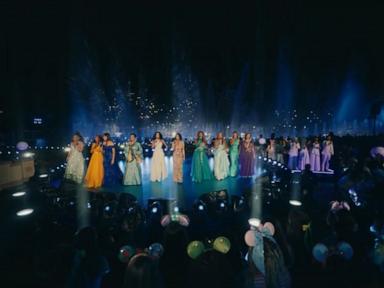
The air inside the Honda Center smelled of warm popcorn, melting sugar, and the distinct, electrostatic charge of ten thousand people holding their breath at once.
It was the opening night of D23, that massive, sprawling biennial pilgrimage where the faithful gather to worship at the altar of mouse-eared corporate mythology. But long before the trailers dropped or the studio executives took the stage to flash billion-dollar box office projections across towering LED screens, something older and stranger took hold of the room.
The lights dimmed.
Not the polite, house-dimming flicker of a Broadway theater, but a sudden, absolute blackout that swallowed the arena whole.
Then came the voices.
They did not start with a roar. They started with a single, fragile note, unaccompanied and unamplified, floating down from the rafters like a thread of spun glass. It was a melody most of us first heard through the static of a VHS tape or the tinny speaker of a cathode-ray television set in a carpeted living room twenty or thirty years ago.
Cue the orchestra.
Out from the shadows walked women who had spent decades as disembodied sounds. Jodi Benson stepped into the cerulean wash of a spotlight, the unmistakable timbre of Ariel lifting over the crowd. Beside her, or waiting in the wings to follow, was a living lineage of vocal royalty—performers who had given breath, cadence, and aching vulnerability to the animated heroines of our collective childhoods.
We talk about Disney princesses as commodities. We track their merchandise sales, analyze their cultural footprint, and debate their feminist credentials in academic journals and late-night social media threads. We treat them like intellectual property.
Standing in that roaring arena, surrounded by adults weeping openly into branded sweatshirts, it became glaringly obvious that we have missed the point entirely.
These characters are not merchandise. They are our shared emotional architecture.
Consider what happens next in the rhythm of a life. You grow up. You learn about taxes, heartbreak, structural inflation, and the quiet, crushing realization that prince charming was a marketing strategy. You put away childish things. You buy neutral-toned furniture. You learn to speak in corporate jargon and manage expectations.
And then, a woman in a glittering gown walks onto a stage in Anaheim and belts out a high note about wanting more than this provincial life, and the cynical armor cracks.
We do not cry because we believe in magic. We cry because we remember what it felt like to want something so badly it physically ached in our chests.
The D23 kickoff concert wasn't just a nostalgic variety show designed to juice ticket sales for upcoming sequels. It was a rare, collective exorcism of adult cynicism. For ninety minutes, the boundary between the audience and the myth dissolved. When Susan Egan launched into the brassy, defiant swells of "Megara," you could feel the collective shift in the room. This wasn't the sweet, passive maiden trope of the nineteen-thirties anymore. This was a woman who had been burned by love, cracking wise, standing tall, and refusing to apologize for her armor.
That is the hidden evolution of the princess archetype, played out in real time through the vocal cords of women who have aged alongside their audiences.
We watched them grow up. Or rather, they watched us grow up, holding the notes while we navigated divorces, career changes, midnight feedings, and quiet grief.
Music has a terrifying way of bypassing the logical brain and plugging straight into the hippocampus. You can forget a birthday. You can forget the address of the apartment you lived in during your twenties. But you cannot unhear the exact vocal inflection with which a cartoon mermaid asks about fire.
The concert leaned heavily into this neurological hijacking. There were no spoken introductions for many of the songs. The orchestra simply swelled into the opening chords of A Whole New World, and the arena didn't just applaud—it sighed. A singular, collective exhale of a generation collectively realizing how tired they were, and how desperately they needed to remember what wonder felt like.
Paige O'Hara's voice filled the cavernous space, carrying the bruised, bookish defiance of Belle. When she hit the chorus, the person in front of me—a broad-shouldered man in a rugged leather jacket—pulled his hands away from his face, his eyes shining in the stage lights.
Nobody was keeping score. Nobody was analyzing the framing or the socio-political implications of animated monarchies in the twenty-first century.
There was only the sound.
And the silence that followed each song was heavier than the music itself. It was the sound of ten thousand people realizing that the distance between childhood and where they stood now was bridged entirely by art.
We ask a lot of our modern entertainment. We demand high-concept world-building, gritty realism, and relentless subversion. We want our stories deconstructed, de-fanged, and analyzed for maximum cultural relevance.
Sometimes, though, you just need a choir of women in ballgowns to remind you that hope is not a character flaw.
The concert ended not with a bang of pyrotechnics, but with a massive, swelling ensemble number where all the voices braided together. Jasmine, Ariel, Belle, Mulan, Tiana, Moana—or rather, the flesh-and-blood vessels who gave them their souls—standing shoulder to shoulder under a shower of artificial gold confetti.
As the house lights finally came up, blinding and merciless, exposing the crumpled tissue papers and the sweat-stained lanyards, nobody rushed for the exits.
They stood there in the aisles, clapping until their palms stung, looking up at an empty stage where the magic had just been.
Outside, the California heat waited. The parking lot traffic would be a nightmare. The emails would still be waiting in the morning.
But for one night, under the humming lights of a convention center arena, the glass slipper didn't break. It resonated.


