The marble floors of the European Parliament are designed to swallow footsteps. They stretch through cavernous corridors of glass and steel, where thousands of bureaucrats, lobbyists, and elected officials walk at a brisk, purposeful rhythm, carrying the heavy invisible weight of continental governance. On most days, the air smells of old paper, espresso, and the quiet urgency of compromise.
Then came the gold. Meanwhile, you can read similar developments here: The Failure Architecture of Child Protection Systems.
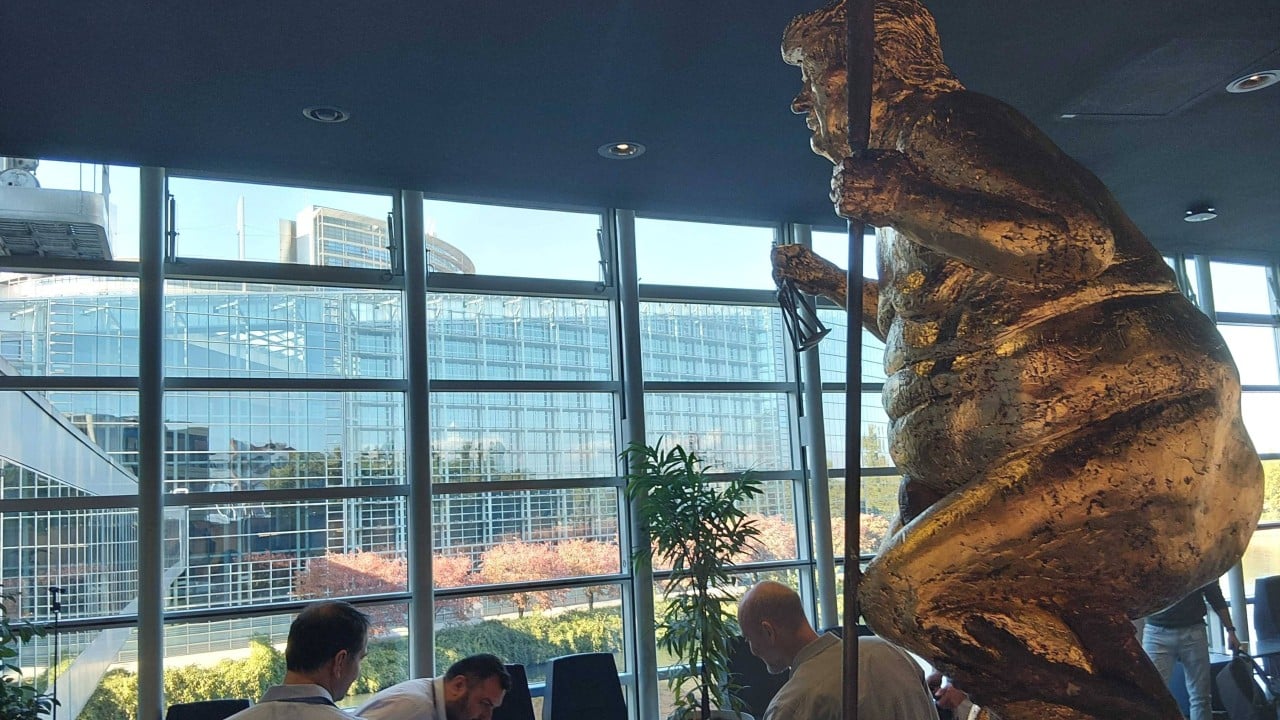
It arrived without an invitation, though it found a prominent spot. Imagine walking past a security checkpoint in Brussels, rounding a corner beneath the towering geometric arches, and stopping dead in your tracks. There, standing on a modest plinth, is a human figure rendered entirely in blinding, reflective metallic gold.
It is naked. It is absurd. And it is unmistakably Donald Trump. To see the full picture, check out the recent article by Reuters.
The statue does not shout. It gleams. Every curve of the exaggerated physique catches the harsh fluorescent overheads of the corridor, bouncing light against the solemn grey stone. In its hand, it holds a smartphone like a scepter. Its posture is rigid, defiant, and strangely vulnerable all at once.
Passersby freeze. Some cough into closed fists, trying to mask sudden laughter. Others pull out their own devices, angling for a quick selfie with a piece of political theater that defies every traditional protocol of diplomatic architecture. Staff members in sharp suits shake their heads, torn between dismissing it as a stunt and staring at it because looking away feels impossible.
This is not a monument erected by a government. It is a provocation. It is an art installation smuggled into the heart of European institutional life, designed to force a room full of policy wonks to confront the inescapable, magnetic, and deeply unsettling shadow cast across the Atlantic.
To understand why a naked, gilded effigy of a former American president belongs inside the parliament of the European Union, you have to look past the initial shock value. You have to look at the anxiety that built it.
The Anatomy of an Obsession
Europe has a complex relationship with American power. It is an alliance forged in the fires of mid-century catastrophe, bound by shared values, security pacts, and sprawling supply chains. Yet, beneath the polished surface of transatlantic handshakes lies a profound, low-grade vertigo.
European politics operates on procedure. It is built on committee meetings that stretch into decades, obscure regulatory directives, and the belief that the world can be managed through consensus, treaties, and polite diplomacy.
Trump represents the exact opposite. He is the wrecking ball in the china shop of international relations. He treats alliances like real estate transactions, international bodies like subscription services, and political survival as a nightly broadcast.
When an artist—or a group of satirists—decides to cast that persona in shiny, cheap gold and leave it bare for thousands of international civil servants to inspect, they are doing something ancient. They are engaging in the political tradition of the court jester. They are holding up a mirror that is too bright to look at directly.
Consider what happens in Brussels when a major election approaches in the United States. The atmosphere shifts. Diplomats who spend their mornings debating agricultural subsidies suddenly spend their evenings glued to cable news feeds, calculating the fallout of a single rally speech or a midnight social media post. The fate of European defense, trade tariffs, and climate commitments can pivot on the mood of a single voter in a swing state thousands of miles away.
That dependency is terrifying for a continent that prides itself on sovereign independence. And when fear gets too big for a policy paper, it demands physical form.
The Currency of the Spectacle
Gold has always meant power. From the burial masks of ancient pharaohs to the vaulted ceilings of central banks, the yellow metal speaks a universal language of wealth, permanence, and divine right.
By wrapping a modern populist leader in that traditional iconography, the creators of the statue achieved a brilliant visual irony. They stripped him of his suit—the universal armor of the Western politician—leaving only the raw, exposed silhouette. Yet they coated that vulnerable flesh in the ultimate symbol of untouchable luxury.
It is a monument to contradiction.
Think about the way modern political figures survive in the digital age. They are no longer just people; they are brands, avatars, and projection screens for our deepest hopes and darkest fears. To a supporter, the gold represents unbreakable strength, a billionaire outsider who broke the system to fight for the forgotten. To a critic, the gold represents crude narcissism, a tacky veneer masking a hollow core.
Both sides look at the exact same statue and see completely different truths.
That is the genius of the installation. It does not tell you what to think. It simply sits there in the hallway, forcing you to declare your own bias. If you walk past it with a scowl, you are revealing your exhaustion with the constant media circus. If you laugh, you are acknowledging the absurdity of an era where global stability hangs on the whims of polarizing personalities. If you ignore it, you are practicing a very sophisticated form of denial.
The Long Shadow Over the Parliament
The European Union was built to ensure that war on the continent would become unthinkable. Its architects believed in reason, law, and the steady march of integration. They built institutions designed to outlive politicians, insulated from the volatile swings of public passion.
Yet, as the statue gleams under the Brussels lights, a quiet realization settles over the corridor. Institutions are only as strong as the people who inhabit them, and the world outside the parliament doors is burning with populist energy.
You can feel the friction. On one floor, diplomats are drafting a solemn declaration on digital privacy and green transition standards. Just around the corner, a naked, golden Trump stares down a security guard with a plastic smile.
This juxtaposition captures the precise cultural moment we are living through. We are caught between two epochs. One is the old world of institutional order, white papers, and quiet backroom deals. The other is the new world of hyper-visibility, theatrical confrontation, and algorithmic tribalism.
The statue is a physical manifestation of that collision. It asks a silent, uncomfortable question: How do you negotiate with a storm when you spent your whole life learning how to build an umbrella?
The Echo in the Stone
As the evening shift begins, the crowds in the European Parliament thin out. The cleaning crews wheel their carts past the plinth. The harsh lights reflect off the metallic surface, casting long, distorted shadows across the polished floor.
No speeches were given to inaugurate this art piece. No ribbon was cut by a parliament president. It exists in a legal and bureaucratic gray zone, much like the diplomatic tensions it represents. It is there because someone dared to push the boundaries of what is permissible inside a temple of serious statecraft.
When historians look back at this decade, they will sift through thousands of policy documents, economic forecasts, and diplomatic cables. They will document the trade wars, the security summits, and the shifting alliances.
But they might also pause at a strange photograph taken in the winter of 2026—a snapshot of a gilded, naked figure standing defiantly beneath the steel arches of European democracy, holding a phone, watching the world spin on its axis.
The marble floors still swallow footsteps. The air still smells of espresso and bureaucracy. But the mirror has been placed in the hallway, and nobody walking past can pretend they don't see their own reflection in the gold.