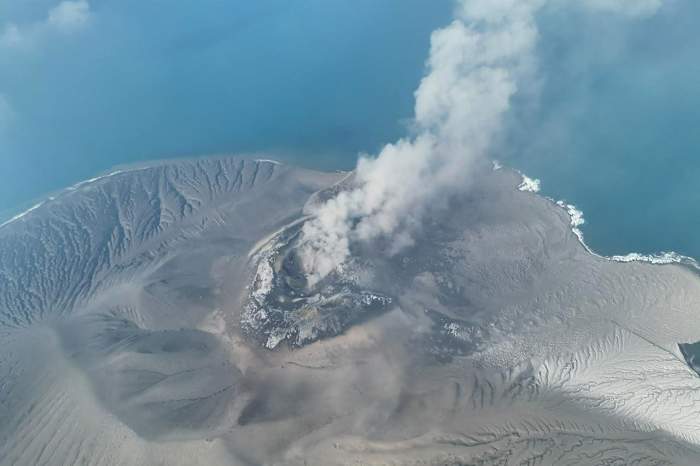
The media treats every plume from Mount Anak Krakatau like a rehearsal for an extinction-level event. When Indonesian authorities shut down multiple airports across Java and Sumatra, grounding hundreds of flights and stranding tens of thousands of passengers, the aviation establishment clapped for safety. They pointed to the standard playbook: volcanic ash melts inside jet turbines, turns into glass, and stalls engines.
It is the lazy consensus. It relies on outdated risk models that treat all ash clouds as identical concrete walls in the sky. Building on this theme, you can also read: Why Canadian Travelers Are Ghosting America Right Now.
Let us look at the actual physics. Volcanic ash is not uniform smoke. It is pulverized rock, glass, and mineral fragments. Jet engines operating at high thrust ingest this particulate matter, where temperatures exceed the melting point of silicate minerals—typically around 1,100 degrees Celsius. The molten glass adheres to the cooler turbine blades turbine nozzles, disrupting airflow and causing flameouts. This happened to British Airways Flight 9 over Mount Galunggung in 1982 and KLM Flight 867 over Mount Redoubt in 1989. Both crews glided their jumbo jets through miles of unpowered terror before restarting engines below the ash layer.
Those near-disasters occurred decades ago. They forged an institutional trauma response across global civil aviation that persists today: zero tolerance, immediate closure, and total paralysis at the first hint of mineral dust in a satellite image. Experts at The Points Guy have provided expertise on this situation.
The aviation industry operates on blunt instruments because liability law punishes nuance. If a transport ministry keeps airspace open and an engine fails, heads roll. If they shut down eight airports over a 30-second puff of Anak Krakatau, inconvenience is free, and safety theatre is rewarded.
This model ignores spatial variability. An ash cloud is not a static, impenetrable solid block. It is a dynamic, drifting plume with massive density gradients. Modern meteorological agencies track sulfur dioxide concentrations and silicate densities with satellite scatterometers and lidar systems. Yet, aviation regulators default to blanket airspace bans that cover entire provinces because managing localized, risk-adjusted corridors requires operational competence they refuse to fund.
Imagine a scenario where airline dispatchers are legally permitted to use real-time particle density mapping to route modern high-bypass turbofans around dense core plumes instead of cancelling flights to Bali and Singapore preemptively. Modern turbine metallurgy uses single-crystal superalloys and sophisticated internal cooling channels that handle particulate ingestion far better than the primitive powerplants of the 1980s.
Instead of smart routing, we get blunt force trauma to regional economies. Tourism operators in Java and Sumatra absorb millions in losses because a volcano did what volcanoes have done for four billion years. Passengers sleep on airport terminal floors while bureaucrats wait for a weather modification plane to drop salt water on clouds just to wash the sky clean.
The real vulnerability is not the ash in the stratosphere. It is an administrative system completely incapable of proportional response.
Stop pretending every minor eruption requires a regional transport halt. Update the risk models, empower airline meteorologists, and stop treating the sky like a fragile glass ceiling.