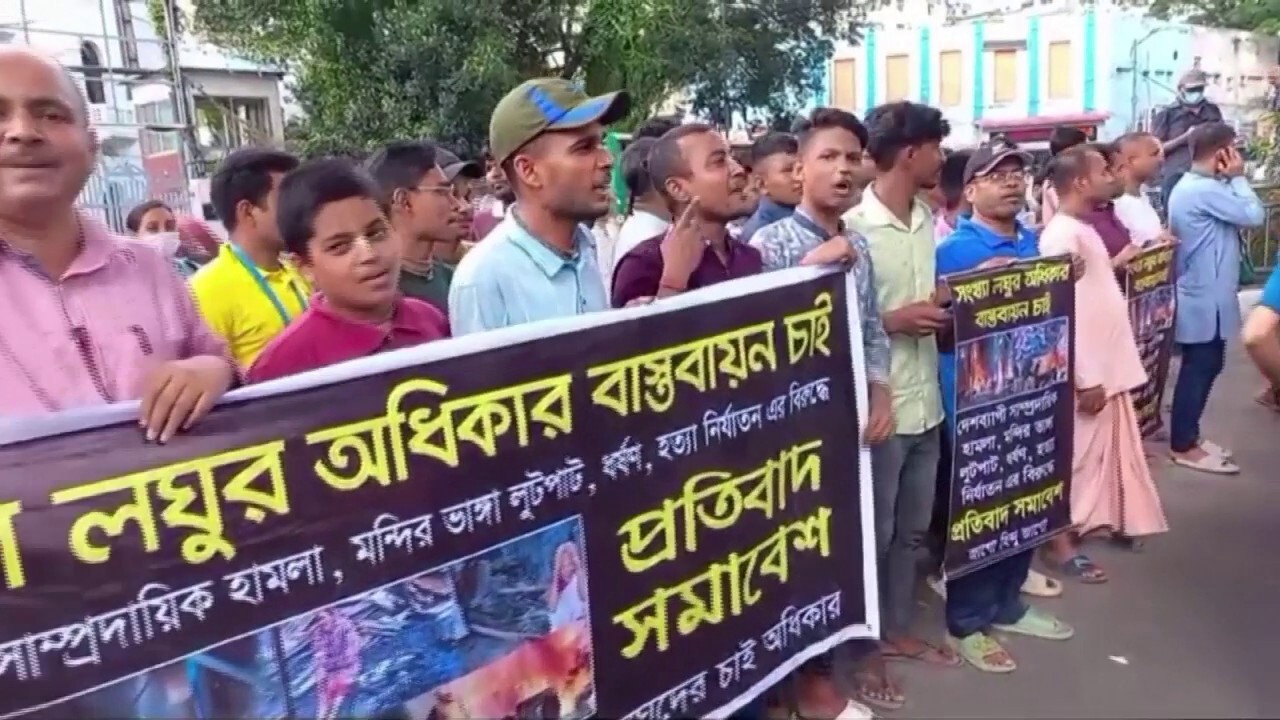
Fear doesn't wait for an official police report. For the Hindu community in Bangladesh, the discovery of a body hanging from a tree isn't just a crime scene. It's a loud, terrifying message. Recently, the discovery of a Hindu man’s body in Netrokona has reignited a firestorm of anxiety across a country already grappling with deep-seated sectarian tensions. People are tired of the same cycle where a minority member dies under suspicious circumstances, and the investigation moves at a snail's pace.
This isn't an isolated incident. You can't look at this death without looking at the broader, messy reality of being a minority in a region where political shifts often lead to localized violence. Whether it’s land disputes or outright religious targeting, the outcome for the victim’s family remains the same. Total devastation. Discover more on a similar topic: this related article.
Justice Delayed for the Netrokona Victim
The specifics of the Netrokona case are grim. Local residents found the victim, identified as a member of the Hindu community, suspended from a tree branch. While the authorities often jump to the "suicide" label before the autopsy is even dry, the local minority groups aren't buying it. They’re demanding a transparent, fast-tracked investigation. They've seen too many cases get buried in bureaucracy.
Minority rights organizations like the Bangladesh Hindu Buddhist Christian Unity Council (BHBCUC) have been vocal. They aren't just asking for a police report. They're demanding accountability from the top down. When a body is found like this, it sends shockwaves through every Hindu household in the district. It’s about the right to feel safe in your own backyard. More analysis by The Washington Post explores comparable views on the subject.
The Pattern of Minority Targeted Violence
We need to talk about the numbers because they tell a story that political speeches try to hide. In recent years, reports from human rights organizations have documented hundreds of attacks on minority homes, businesses, and temples. According to data from the BHBCUC, the months following major political transitions often see a spike in these incidents.
It’s a power play. When the central government is in flux, local actors often take the opportunity to settle old scores or grab land. Hindu families, often being more vulnerable, become the easiest targets. The "hanging body" trope is particularly dark because it mimics historical methods used to intimidate communities into fleeing their ancestral homes.
Why the Suicide Narrative is Often Questioned
Whenever a minority man is found dead in a public or semi-public space, the initial police statement frequently leans toward suicide. Why? Because it’s easier. A suicide requires no massive manhunt. It doesn’t spark communal riots. It doesn't put the local administration under the microscope of international human rights observers.
But the families often point to different clues. Bruises that don't match a fall. Missing personal items. Threats received days before the "suicide." In the Netrokona case, the demand for "strong action" stems from a lack of trust in the local precinct. If you don't trust the guy holding the pen, you won't believe the report he writes.
The Role of Land Disputes in Sectarian Violence
If you want to understand why these tragedies happen, look at the ground. Land is the most precious commodity in Bangladesh. A significant portion of violence against Hindus is actually motivated by property greed masked as religious fervor.
Vested Interest Groups use intimidation to force families to sell their land for pennies on the dollar. If they don't leave, things escalate. A suspicious death serves as the ultimate "eviction notice" for the rest of the community. It’s a brutal, effective strategy that has been stripping minority communities of their assets for decades. We shouldn't pretend it's just about religion. It's about money and power.
International Pressure and the 2026 Reality
The world is watching Bangladesh more closely than ever. With 2026 bringing new international scrutiny on human rights records, the government can't just brush these incidents under the rug. International bodies, including the UN and various human rights watchdogs, have started linking trade preferences and diplomatic relations to how a country treats its most vulnerable citizens.
The "minority group demands strong action" headline isn't just local news anymore. It’s a global concern. When the diaspora in the US, UK, and India starts tweeting and lobbying, the pressure on Dhaka mounts. The government knows that a single mishandled investigation can lead to a diplomatic headache. Yet, the disconnect between the high-level promises in the capital and the reality in rural villages like those in Netrokona remains massive.
The Problem with Local Law Enforcement
The local police are often in a tough spot. Or they’re part of the problem. Many officers are locals themselves and have ties to the dominant political or social groups in the area. When a minority member is killed, the pressure to protect "one of their own" (the perpetrator) can outweigh the duty to serve justice.
This is why the demand for judicial inquiries—rather than just police investigations—is so common. A judicial inquiry brings in a judge, someone outside the local police hierarchy, to look at the facts. It’s a way to bypass the local "old boys' club" that often protects criminals.
How to Support Minority Safety
Words of sympathy don't keep people safe. Action does. If you're looking at how to actually change the situation for Hindu minorities in Bangladesh, it starts with documentation and visibility.
- Support Local NGOs: Groups on the ground are the only ones providing legal aid to families who can't afford a lawyer.
- Demand Transparency: Social media pressure works. When a case like the Netrokona death goes viral, it's harder for the police to ignore the evidence.
- Legal Reforms: There needs to be a push for specific laws that protect minority-owned land from illegal seizure.
- Independent Monitoring: International observers should have access to these rural areas to verify police findings independently.
The death in Netrokona is a tragedy, but it’s also a test. It’s a test for the local police to see if they’ll do their jobs. It’s a test for the government to see if they’ll protect their citizens. And it’s a test for us to see if we’ll keep paying attention after the headline fades.
Don't let the news cycle move on. Keep asking about the autopsy report. Keep asking why the suspects haven't been questioned. Real change happens when the cost of injustice becomes higher than the cost of doing the right thing. The Hindu community in Bangladesh isn't asking for special treatment. They’re asking for the basic right to live without a target on their backs. Stop waiting for the next body to be found and start demanding accountability for the one found today.