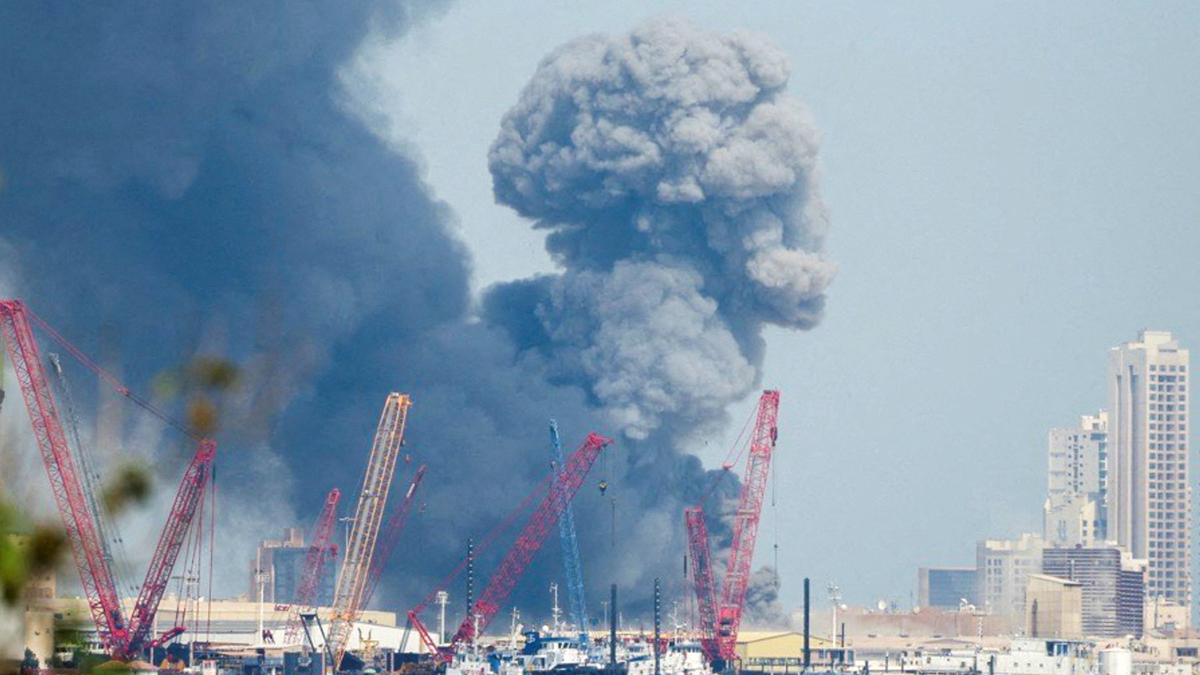
The headlines are screaming about a missile strike in Abu Dhabi. One casualty. Shrapnel in the sand. Every mainstream analyst is dusting off the 1990s playbook, talking about "escalation ladders" and "regional stability." They are looking at the wrong map.
If you think this is about a single missile or a territorial dispute between Tehran and the Emirates, you are missing the structural shift in modern power. Kinetic strikes—the kind that blow things up and make for dramatic evening news footage—are becoming the expensive, clunky distractors of the 21st century. While the world stares at the smoke over the Gulf, the real war is being won through supply chain strangulation and digital infrastructure capture.
The "lazy consensus" says this is a sign of Iran’s strength. It isn't. It is a sign of their desperation to remain relevant in a world where physical borders matter less than the fiber optic cables running beneath them.
The Mirage of Deterrence
Western defense contractors love these moments. They use them to sell more Terminal High Altitude Area Defense (THAAD) systems and Patriot batteries. But here is the brutal reality: you cannot buy your way out of a geography problem with hardware that costs $1 billion per battery.
The math is broken. An adversary can swarm a multi-billion dollar defense grid with "suicide" drones and mid-tier cruise missiles that cost less than a luxury SUV.
- Cost of an Interceptor: $2 million to $5 million.
- Cost of the Threat: $20,000 to $50,000.
I have sat in boardrooms where executives treat "defense" as a static shield. It’s a lie. In the modern theater, the offense has a 100x cost advantage. Every time a missile is intercepted over a Gulf city, the attacker wins the economic war. They forced the defender to burn millions in capital for a net-zero gain. We are watching the slow-motion bankruptcy of traditional defense logic.
Why One Casualty is a Tactical Failure for the Aggressor
The media fixates on the tragedy of the "one killed." From a cold, geopolitical standpoint, that single casualty proves that Iran’s kinetic capabilities are a spent force. If you launch a sophisticated missile at a global hub like Abu Dhabi and only manage to hit a single non-combatant, you haven't projected power. You’ve projected a lack of precision.
True power today is surgical. It is the ability to shut down a desalination plant’s software without firing a shot. It is the ability to de-platform a nation’s banking system. A missile is a loud, messy, and ultimately inefficient way to exert influence. It invites international sanctions and physical retaliation.
Compare this to a "silent" attack on the logistical software of Jebel Ali port. If the ships stop moving because the manifests are corrupted, the economic damage is in the billions. No smoke. No headlines. Just total paralysis. The fact that we are seeing missiles suggests that the aggressor has lost the ability to compete in the invisible war.
The Insurance Premium Trap
The real target wasn't a building or a person. The target was the risk profile of the United Arab Emirates.
The UAE has spent two decades rebranding itself as the "Switzerland of the Middle East"—a safe, neutral ground for global capital. A missile strike is a direct attack on that brand.
- Marine Insurance: Rates for tankers in the Strait of Hormuz spike instantly.
- FDI (Foreign Direct Investment): Boardrooms in New York and London start asking if their regional HQ should be in Riyadh or Singapore instead.
- Tourism: The perception of safety evaporates.
The "insider" secret is that the Gulf states know this. They aren't worried about the physical damage; they are worried about the Bloomberg terminal. When an oil facility gets hit, the repair bill is a rounding error. The real cost is the 2% "instability tax" that gets baked into every contract for the next five years.
The Myth of "Regional Escalation"
Stop asking if this will lead to "World War III." It won't. The world is too interconnected for a 20th-century total war. China is the largest buyer of Iranian crude and a massive investor in Emirati infrastructure. Beijing does not permit its gas stations to burn each other down.
The "lazy consensus" ignores the "custodian" role of the East. While the US provides the hardware, China provides the economic floor. Neither side can afford a full-scale kinetic conflict. This missile strike is "performative warfare." It is a violent press release intended to gain leverage in a different room—likely the nuclear negotiations or a maritime transit dispute.
The Sovereignty Delusion
The most uncomfortable truth? Small, wealthy states like the UAE and Qatar are realizing that traditional sovereignty is a myth. You can have the best air force money can buy, but you are still a "price taker" in the global security market.
If you want to survive in this environment, you don't buy more missiles. You make yourself too useful to fail. You embed your wealth into the global tech stack. You become the primary node for AI compute or the essential hub for the green energy transition.
The Failure of Intelligence
Why did this happen now? Because Western intelligence agencies are still obsessed with "intent" and "rhetoric." They listen to what leaders say.
The smarter play is to watch the commodity flows.
Whenever you see a spike in shadow-banking activity or a sudden shift in "dark fleet" tanker movements, a kinetic event follows. The missile is just the punctuation mark at the end of a very long, very visible sentence that the "experts" failed to read.
Stop Asking "Who Fired?" Start Asking "Who Gains?"
When a missile lands in Abu Dhabi, don't just look at the launch site. Look at who benefits from the resulting price of Brent Crude. Look at which defense contractors just saw their stock tick up. Look at which regional rivals are suddenly looking like "safer" investment alternatives.
The tragedy isn't that a missile was fired. The tragedy is that we are still using a 1940s lens to view a 2026 problem.
Move your capital out of firms that rely on "stability" and into firms that profit from "resilience." In a world of performative missiles and constant low-level friction, the winners aren't the ones with the biggest shields. They are the ones who can lose a node and keep the network running.
If you’re waiting for the "peace" to return, you’re holding a dead asset. This friction is the new baseline. Manage for it.
The era of the "safe haven" is over. Welcome to the era of the "redundant hub." If your business model can't survive a stray missile in a desert, you aren't an industry leader—you’re a historical footnote.
Dispose of your "stability" playbooks. Buy volatility. Build for disruption. The smoke in Abu Dhabi is just a signal that the old world is finally out of breath.