The air inside Madison Square Garden during a playoff run doesn’t feel like normal air. It is heavy, thick with the distilled anxiety of eight million people, smelling of stale beer, burnt pretzels, and the distinct, metallic tang of collective hope. To understand what happened during Game 3, you have to understand the specific geometry of New York fandom. It is a fragile ecosystem built on decades of heartbreak, where a single sideways glance from the universe can dismantle a season.
Basketball in this city isn't entertainment. It's a psychological diagnostic tool.
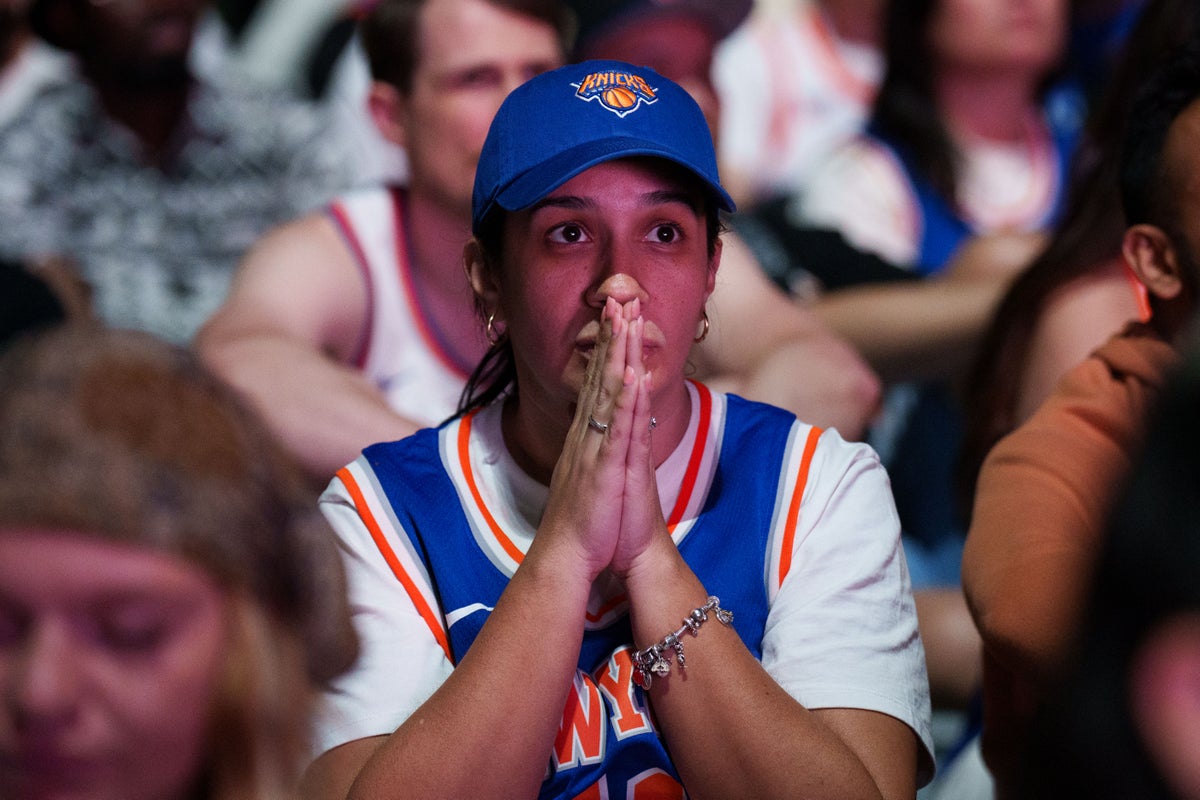
When the San Antonio Spurs walked into the arena, the narrative seemed pre-written. The New York Knicks were supposed to protect the home floor. Instead, the night devolved into a slow-motion car crash that left thousands of grown men and women staring blankly into the middle distance. By the fourth quarter, the energy had shifted from defiant screaming to a eerie, collective murmur.
The scoreboard told one story—a devastating loss that swung the momentum of the series. But on the concourses, by the escalators, and on the platforms of Penn Station below, the conversation wasn't about field goal percentages or missed rotations.
It was about the curse.
The Gravity of the Baseline
Every arena has its VIPs, its courtside fixtures who become as much a part of the local lore as the rafters. For decades, Spike Lee in his orange-and-blue cap served as the emotional barometer of the franchise. When he jumped, the city jumped. But during Game 3, a different kind of political and cultural gravity warped the room.
Donald Trump sat courtside.
To the uninitiated, a celebrity presence at a basketball game is background noise. In New York, it is an omen. Long before he occupied the Oval Office, Trump was a permanent thread in the city’s tabloid fabric, a polarizing figure whose relationship with local sports teams fluctuated between boosterism and distraction. His appearance at Madison Square Garden wasn't just a fan buying a ticket; it was an event that altered the atmospheric pressure of the building.
Consider the layout of the Garden. The courtside seats are so close to the action that players can hear the ice rattling in a spectator's glass. The energy of the crowd bleeds directly onto the hardwood. When a figure of that magnitude—carrying the immense, polarizing weight of modern American culture—takes up space on the baseline, the game ceases to be just about basketball. It becomes a theater of distraction.
The shift was palpable from the opening tip.
The Chemistry of Superstition
Athletes are creatures of intense, almost pathological routine. They wear the same socks. They eat the same pre-game meal at exactly 3:45 PM. They dribble the ball precisely three times before a free throw. This isn't madness; it's a desperate attempt to control chaos in a game dictated by millimeter margins.
When an external force disrupts that routine, the machinery breaks down.
During the second half of Game 3, the Knicks looked like a team playing underwater. Passes that usually found the pocket were half a second late. Shots that normally rattled home clanged violently off the back iron. The defense, usually a suffocating web of communication, looked disjointed.
"You could feel it in the building," said Marcus, a season-ticket holder from Queens who has sat in section 212 since the Patrick Ewing era. "It wasn't just that we were losing. It felt like the air had been sucked out of the room. Every time the camera cut to the baseline, you knew the internet was melting down. The players aren't blind. They see the screens. They feel the shift."
This is where the concept of the "Trump curse" began to take shape in real-time. It isn't supernatural, of course. It is behavioral psychology dressed up in sports folklore. When a crowd is unified in its cheering, it creates a slipstream that carries a home team through tired stretches. But when a crowd becomes divided, distracted, or hyper-aware of a political lightning rod in their midst, the unified wall of sound fractures into pockets of murmurs and debate.
The home-court advantage didn't just evaporate; it inverted.
The History of the Hex
New York sports fans possess a deep, encyclopedic memory for misery. They can tell you about the curse of the Bambino, the curse of the Billy Goat, and the specific, agonizing history of the Rangers' fifty-four year drought. We invent these mythologies because the alternative is far more terrifying: that sometimes, your team just isn't good enough on a Tuesday night in June.
The idea of a political figure hexing a team is rooted in this need for narrative order. By attributing the loss to a singular, external bad omen, fans protect themselves from the brutal reality of a flawed game plan. It wasn't that the Spurs executed a flawless pick-and-roll; it was that the universe was displeased.
Let us look at the cold reality of the box score. The Knicks shot under forty percent from the field. They turned the ball over fifteen times, leading directly to twenty-two transition points for San Antonio. These are tangible, verifiable metrics of a basketball game gone wrong.
Yet, as the final buzzer echoed through the arena, the post-mortem on sports radio didn't focus on the pick-and-roll defense. It focused on the seat next to the technical director's box.
The Cost of the Spectacle
There is a unique pain in paying hundreds of dollars to watch your hopes dismantled in real-time. Madison Square Garden is the most expensive arena in the league, a place where working-class fans save for months just to sit in the upper bowls, breathing in the history of the world's most famous arena.
When that experience is hijacked by the circus of celebrity politics, a sense of resentment festers. The game stops belonging to the people who care the most and starts belonging to the people who can afford to look bored while sitting three feet from the baseline.
The "Trump curse" is ultimately a metaphor for the intrusion of the loud, divisive outside world into our remaining sacred spaces. Sports used to be the one place where the political alignment of the person sitting next to you didn't matter, as long as they high-fived you when the home team hit a three-pointer at the buzzer.
When that boundary dissolves, the loss feels heavier. It feels permanent.
The crowds shuffled out into the damp Manhattan night, their blue-and-orange jerseys catching the reflection of the neon signs outside the Pennsylvania Station entrance. A man in an authentic Walt Frazier jersey stopped to look back up at the marquis, spitting a piece of gum onto the concrete.
Tomorrow, the sports analysts would talk about adjustments, about moving the ball quicker, about defensive rotations and bench depth. But tonight, walking down 33rd street toward the subway, everyone knew the truth. The game had been lost long before the opening tip, decided by the ghost of a distraction that sat close enough to touch the baseline.