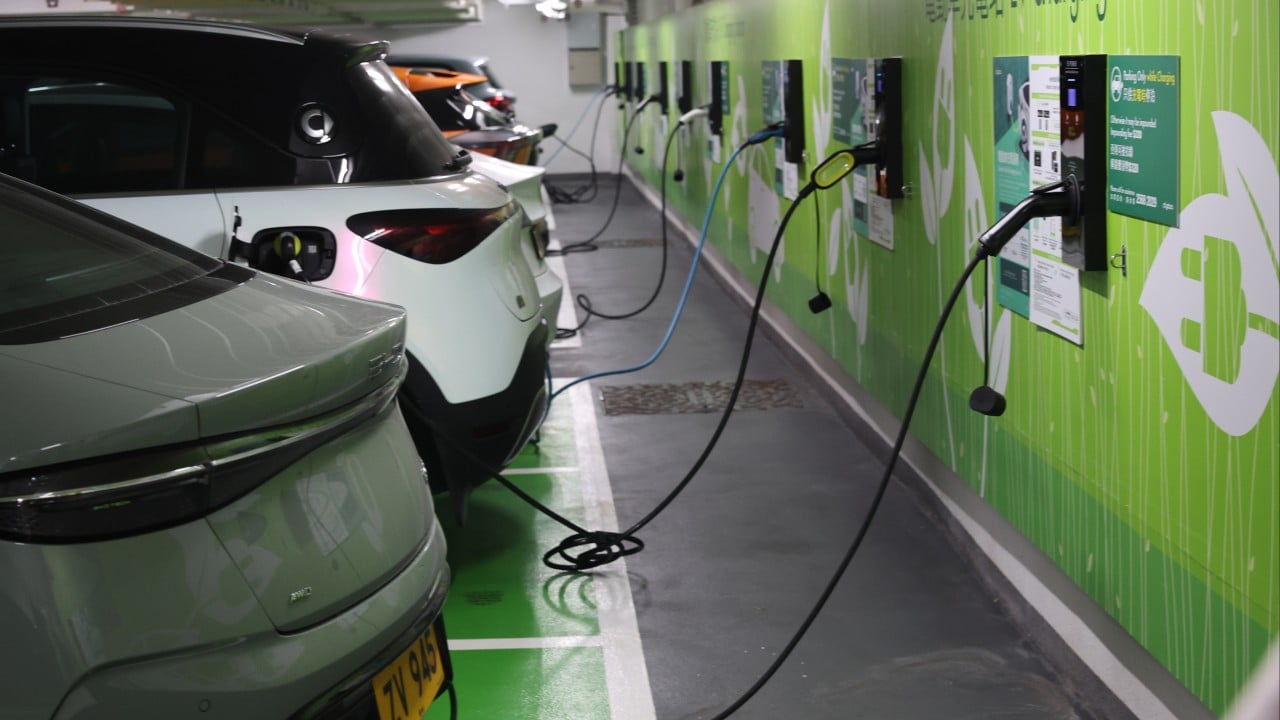
Five hundred kilograms.
That is the dead weight sitting beneath the floorboards of a standard electric family sedan, a silent, lithium-packed slab of chemistry that has spent the last decade promising to save our lungs and cool our streets. You do not see it when you slide into the driver's seat in Kowloon Tong, and you certainly do not hear it when you press the accelerator and glide effortlessly up the incline toward Lion Rock Tunnel. It feels light. It feels like the future.
Until you have to figure out where it goes to die.
Consider a hypothetical scenario set in a cramped, grease-stained garage in To Kwa Wan a few years from now. Let us call the mechanic Uncle Fai, a man whose knuckles are permanently darkened by forty years of transmission fluid and brake dust. Uncle Fai knows how to strip a Toyota Crown down to its bare steel frame and rebuild it before lunch, a skill honed in a city where space is rented by the square inch and waste is an existential threat. Today, however, Uncle Fai is staring at a totaled electric SUV hoisted on his hydraulic lift, its undercarriage twisted from a rainy-night collision on the Tolo Highway. Beneath that crumpled aluminum sits a damaged battery pack weighing nearly half a ton, volatile, toxic, and worth precisely nothing on the open scrap market.
He cannot toss it in a dumpster. He cannot leave it behind a shuttered warehouse in the New Territories. And if he tries to dismantle it without specialized thermal-runaway gear, he risks burning down the entire block.
For years, Hong Kong has celebrated its electric vehicle boom as an unmitigated environmental triumph, a glossy success story told through tax breaks, tax-waiver schemes, and gleaming showrooms in Wan Chai. Drivers rushed to trade in their gas-guzzlers, lured by the "One-for-One Replacement" scheme that shaved tens of thousands of dollars off the sticker price of a new EV. By the mid-2020s, electric cars accounted for the vast majority of newly registered private vehicles in the territory, turning one of the world's densest urban jungles into a quiet showcase of battery-powered mobility. We patted ourselves on the back every time we walked past a tailpipe-free taxi rank, breathing easier, convinced we had solved the pollution crisis.
We forgot to ask who was going to pay for the funeral.
The Six-Dollar Reckoning
In the quiet offices of the Environmental Protection Department, bureaucrats have been staring at a ticking clock, watching the registration numbers climb while calculating the inevitable wave of retirement that follows eight to ten years behind every new car sale. Lithium-ion batteries do not last forever; they degrade, losing capacity cycle by cycle until a car that once easily cleared the round trip from Tung Chung to Chai Wan struggles to make it across the harbor without an anxious glance at the dashboard. When those first massive waves of subsidized EVs hit the end of their roadworthy lives later this decade, Hong Kong will face a mountain of hazardous chemical waste on a landmass with nowhere left to bury it.
That brings us to the cold arithmetic of 2028.
Under Hong Kong's proposed Producer Responsibility Scheme for retired electric vehicle batteries, the government plans to impose a mandatory recycling levy of HK$6 per kilogram on battery suppliers, taking effect in 2028. Read that number again slowly, because on paper it looks almost laughably small, the kind of pocket change you drop into a convenience store charity box without breaking stride. Six Hong Kong dollars buys you half a carton of lemon tea, a short ride on the Star Ferry, or a single newspaper at a street kiosk.
Multiply it by five hundred, however, and the math changes entirely.
For a standard mid-sized electric vehicle carrying a 500-kilogram battery pack, that six-dollar levy instantly translates into a HK$3,000 fee before the car ever touches the asphalt. For heavier luxury SUVs, commercial vans, or electric buses whose battery arrays tip the scales at 700, 800, or even 1,000 kilograms, the bill jumps to HK$4,200, HK$4,800, or HK$6,000 per vehicle. And because the government intends to collect this fee upfront from suppliers—meaning the automakers, importers, and distributors bringing those vehicles and replacement packs into the city—every single dollar will weave its way into the complex financial bloodstream of Hong Kong's automotive market.
Follow the Weight
To understand how a levy on suppliers reshapes daily life for ordinary drivers, you have to understand how an automaker thinks when margins tighten. Think of an electric vehicle battery like a massive, non-refundable deposit on a glass bottle, except the bottle weighs as much as a grand piano and contains cobalt, nickel, lithium, and flammable electrolytes. When the government tells an importer in Tsuen Wan that every kilogram of battery crossing the border now carries a HK$6 liability, that importer does not simply absorb the hit out of civic goodwill.
They pull out a spreadsheet.
First, they look at the showroom sticker price. While HK$3,000 might seem minor compared to a HK$300,000 vehicle, it lands right on top of a market already adjusting to the gradual scaling back of first-registration tax concessions. For budget-conscious buyers eyeing entry-level electric hatchbacks—the exact demographic Hong Kong needs to convert if it wants to hit its zero-emission targets—every extra thousand dollars stings. Second, suppliers look at the replacement market, where a driver whose battery fails outside the factory warranty already faces a repair bill that often exceeds the residual value of the car itself. Adding thousands of dollars in statutory levies onto replacement packs makes repairing older EVs even harder to justify, accelerating the exact throwaway culture the policy is meant to tame.
But the real problem lies elsewhere, hidden in the engineering choices manufacturers make when weight suddenly carries a direct tax penalty.
For the past decade, automakers solved range anxiety by simply stuffing bigger, heavier batteries into larger frames, treating mass as a free resource. If a car needed another hundred kilometers of range, engineers bolted on another hundred kilograms of cells. A weight-based levy flips that incentive on its head overnight. Suddenly, every extra kilogram of lithium-iron-phosphate or nickel-manganese-cobalt chemistry costs cold cash at the port of entry. In a small way, Hong Kong's six-dollar rule nudges manufacturers toward energy density over brute bulk—rewarding lighter, smarter battery architectures while penalizing bloated, oversized packs.
A City Built on Small Margins
I remember walking through the recycling yards along Ping Ha Road in Yuen Long a few summers ago, the air thick with the metallic tang of shredded copper and the humid heat radiating off corrugated iron roofs. In Hong Kong, waste management has never been an abstract policy debate; it is a physical battle against geography. Our landfills in Tseung Kwan O, Ta Kwu Ling, and Nim Wan are towering monuments to consumption, pushed right up against country parks and residential estates because there is literally nowhere else to put the garbage of seven and a half million people.
We have seen this movie before, and we know how badly it ends when a city waits until the trash piles up at the door.
Look back at how Hong Kong handled glass beverage bottles, plastic shopping bags, and waste electrical and electronic equipment—the familiar "four regulated electrical items" scheme that forced appliance stores to charge recycling fees on air conditioners, refrigerators, washing machines, and televisions. When those levies rolled out, people grumbled. Consumers complained about paying extra when buying a new fridge, while small shopkeepers fretted over paperwork, storage rules, and licensing headaches. Yet without that financial pipeline, illegal fly-tipping in the rural New Territories would have drowned the countryside in broken compressors and shattered cathode-ray tubes.
EV batteries, however, make an old refrigerator look like a child's toy.
If you dump a washing machine in an illegal scrapyard near Kam Tin, it rusts, leaks a little oil, and ruins the soil. If you dump a damaged lithium-ion EV battery pack in an unlicensed lot, expose it to summer monsoon rain, or let an untrained worker puncture a cell with a crowbar, it triggers a self-sustaining chemical fire that water cannot easily extinguish. Fire crews in Hong Kong have already had to adapt their tactics for electric vehicle blazes, deploying specialized containment blankets and tens of thousands of liters of water just to keep thermal runaway from reigniting hours after the flames appear dead. Leaving retired EV batteries to the mercy of informal scrap dealers is not just an environmental failure; it is an invitation to disaster in one of the most densely populated cities on earth.
The Invisible Economy of Second Lives
So where does the HK$6 per kilogram actually go, and why does it take until 2028 to flip the switch?
Building a closed-loop battery recycling ecosystem from scratch in a high-cost city is agonizingly slow work. Unlike mainland China, which has spent years constructing massive hydrometallurgical processing plants capable of shredding thousands of tons of batteries and extracting battery-grade lithium carbonate and cobalt sulfate, Hong Kong has historically lacked the industrial scale to make local recycling profitable on its own. When global lithium prices swing wildly—crashing from record highs down to levels that barely cover the cost of chemical extraction—private recyclers cannot survive on scrap value alone. Without a guaranteed gate fee funded by a statutory levy, no sane investor will pour hundreds of millions of dollars into specialized, fire-suppressed recycling facilities in EcoPark in Tuen Mun.
That gap is what makes the 2028 timeline both necessary and nerve-wracking.
Between now and then, thousands of early-generation electric vehicles—the Nissan Leafs, the early Teslas, the first wave of commercial electric vans—will quietly reach the end of their useful lives on Hong Kong's steep hills and stop-and-go avenues. Some packs will be healthy enough for a "second life," stripped from cars and wired together as stationary energy storage banks for construction sites, remote telecom towers, or solar microgrids where weight no longer matters. Others, damaged by collisions or deep degradation, will need safe dismantling, discharging, and crushing into "black mass"—the dark, powdery concentrate of valuable metals that can be shipped to regional refineries for rebirth into new cells.
Let us return for a moment to Uncle Fai in his To Kwa Wan garage, standing beneath that wrecked electric SUV.
In a world without a funded recycling framework, Uncle Fai faces an impossible choice between losing money to dispose of that 500-kilogram battery legally or handing it off to a shady middleman who promises to "make it disappear" behind a locked gate in the New Territories. Under the 2028 Producer Responsibility Scheme, the equation shifts. Because the supplier paid that HK$3,000 levy at the very beginning of the car's life, a licensed collection network has the financial backing to send a specialized truck to Uncle Fai's shop, haul that hazardous half-ton slab away safely, and process it without bankrupting the mechanic or poisoning the ground.
What We Actually Bought
It is tempting to look at a new government charge and see only another bite taken out of an already expensive city. Living in Hong Kong means constantly paying a premium for space, for air, for convenience, and for the sheer friction of moving millions of people across mountains and harbors every single day. Nobody cheers when a new levy shows up in a legislative paper, and anyone claiming they fully understand how global commodity prices will interact with local recycling fees five years from now is selling certainty they do not possess.
Yet there is a quiet honesty embedded in that HK$6-per-kilogram figure that our earlier green enthusiasm conveniently glossed over.
For years, we treated clean air as something you could purchase at a discount, subsidized by tax breaks and measured purely by the absence of exhaust smoke at street level. We celebrated the silence of the electric motor while ignoring the heavy industrial footprint hidden beneath the chassis. Every battery that glides silently past a pedestrian crossing in Central carries a future obligation inside its aluminum casing—a chemical debt that eventually comes due when the cells lose their spark and the car reaches the breaker's yard.
Six dollars a kilogram is simply the price of admitting that nothing disappears just because we stop looking at it.
Picture a container ship gliding out of Kwai Tsing Container Terminals at dusk, stacked high with sealed steel drums of black mass recovered from thousands of retired Hong Kong taxis and family sedans, heading toward a refinery to be reborn as the next generation of batteries. Behind that quiet departure sits a ledger balanced to the gram, paid for years earlier when someone first turned the key on a brand-new electric dream.