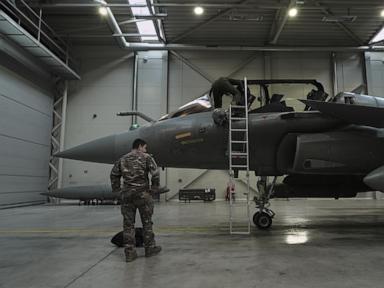
Living near the Baltic coast means getting used to a specific kind of thunder. It isn't always the weather. Often, it’s the roar of an afterburner as a NATO Typhoon or F-16 scrambles to meet an unannounced guest. We’re talking about a narrow strip of international airspace where the world’s most advanced fighter jets fly inches away from a catastrophic mistake. It’s tense. It’s constant. And honestly, it’s a miracle nobody has started a world war by accident yet.
While the ground war in Ukraine grabs every headline, the silent, high-speed shadowboxing over the Baltic Sea is where the real risk of escalation lives. Pilots from the UK, Germany, Poland, and the US are essentially playing the most dangerous game of "I’m not touching you" in history with Russian Su-27s and Il-20 surveillance planes. They call it Baltic Air Policing. I call it a high-wire act without a net.
Why the Baltic Airspace is a Powder Keg
Russia needs a corridor to reach Kaliningrad. That’s their heavily armed exclave sandwiched between Poland and Lithuania. To get there from mainland Russia, their planes have to fly through a thin straw of international airspace. The problem? They often "go dark." They turn off their transponders. They don't talk to civilian air traffic control. They don't file flight plans.
This forces NATO’s hand. You can’t just let an unidentified, armed supersonic jet fly toward your border and hope for the best. So, the sirens wail at bases like Šiauliai in Lithuania or Ämari in Estonia. Within minutes, NATO pilots are in the air, pulling up alongside the Russian wings to identify them and "escort" them through the corridor.
It’s an expensive, exhausting routine. Each scramble costs thousands in fuel and airframe wear. But more than that, it’s a psychological grind. Imagine sitting in a cockpit, looking across a twenty-foot gap at a guy who technically represents your greatest existential threat. You can see his helmet. You can see his patches. Sometimes, you can see his middle finger.
The Unwritten Rules of the Intercept
There’s a weird professional etiquette up there. Pilots on both sides are elite. They know the stakes. Most of the time, the Russian pilots are "professional," a word the Pentagon uses to mean they didn't do anything crazy. They fly straight. They acknowledge the NATO presence. They move on.
But then there are the "unprofessional" days.
We’ve seen Russian jets pull "thump" maneuvers, where they fly directly in front of a NATO plane and kick in the afterburners. The resulting wake turbulence can throw a smaller jet around like a leaf in a hurricane. There are barrel rolls over the top of surveillance planes. There are aggressive "wing flashes" to show off a full load of missiles.
Why do they do it? It’s not just for fun. It’s about data. Every time a NATO jet scrambles, Russian sensors on the ground and in the air are watching. They’re timing the response. They’re recording the radar frequencies. They’re looking for patterns. They want to see how tired the crews are getting. It's a massive, ongoing intelligence-gathering mission masked as a series of petty provocations.
The Gear That Keeps the Peace
You don't send rookies into this environment. The pilots flying these missions are often some of the most experienced in their respective air forces. The tech is equally heavy-duty.
The Eurofighter Typhoon is currently the workhorse for many of these rotations. It’s got a climb rate that feels like a rocket ship. That’s vital. When a Russian "Bears" or "Flankers" pop up on radar, the NATO jets need to be at 30,000 feet yesterday.
Then there’s the F-35. The introduction of fifth-generation stealth into the Baltic has changed the math. Now, the Russians often don't even know they’re being watched until the NATO jet is right there. It’s a subtle shift from "we see you" to "we’re already here."
But technology can’t solve the human element. The "hotline" between NATO’s Combined Air Operations Centre in Uedem, Germany, and the Russian military district in St. Petersburg exists for a reason. It’s the "oops, sorry" button. If a pilot crosses a line or a mechanical failure sends a jet into sovereign airspace, that phone line is the only thing stopping a local incident from becoming a global funeral.
Misconceptions About the Baltic Front
People think this is a new Cold War. It’s not. It’s actually much weirder. During the Cold War, there was a sense of static dread. Today, the Baltic is a busy commercial hub. While these fighter jets are dancing around each other, hundreds of civilian airliners are carrying tourists to Tallinn or business travelers to Riga.
The risk isn't just a military clash; it’s a mid-air collision with a Boeing 737. When a Russian Su-27 flies without a transponder, it’s invisible to the TCAS (Traffic Collision Avoidance System) that civilian pilots rely on. NATO pilots often act as "sheepdogs," flying between the "dark" Russian planes and the civilian corridors to make sure everyone stays separated. It’s a thankless job that the average traveler never even knows is happening.
How This Ends Without a Bang
There is no "winning" the Baltic air war. There is only "not losing." Success is defined by a day where nothing happened.
NATO has increased its presence significantly since 2014, and even more so since 2022. We’ve gone from a single four-ship detachment to multiple units across the region. Sweden and Finland joining NATO has basically turned the Baltic Sea into a "NATO Lake," but that only makes the remaining Russian pilots more desperate to prove they still own their little corner of the sky.
If you’re watching this from the outside, don't look for a grand peace treaty. Look for the small signs of stability. Look for the days when the "scramble" numbers go down. Look for the reports of "professional" intercepts.
Pay attention to the Baltic Air Policing mission reports released by the Lithuanian Ministry of Defence. They provide weekly tallies of how many times the jets went up. If you see those numbers spike, something is brewing on the diplomatic front. If they stay steady, the game of chicken continues as usual.
Stop thinking of the Baltic as a secondary theater. It’s the front line. Every time a pilot decides not to pull the trigger despite a provocation, we all win another day of peace. Don't take that for granted. The silence in the skies is the most expensive thing we own.
Keep an eye on the deployment schedules of the RAF and the Luftwaffe. When they rotate in, the tempo usually shifts. Watch the Suwalki Gap on a map. If you understand the geography, you understand why those pilots are sweating in those cockpits. Stay informed by checking the NATO Allied Air Command updates directly. They don't give you the drama, but they give you the truth about how often those sirens are actually screaming.


