We love a good sunken treasure hunt.
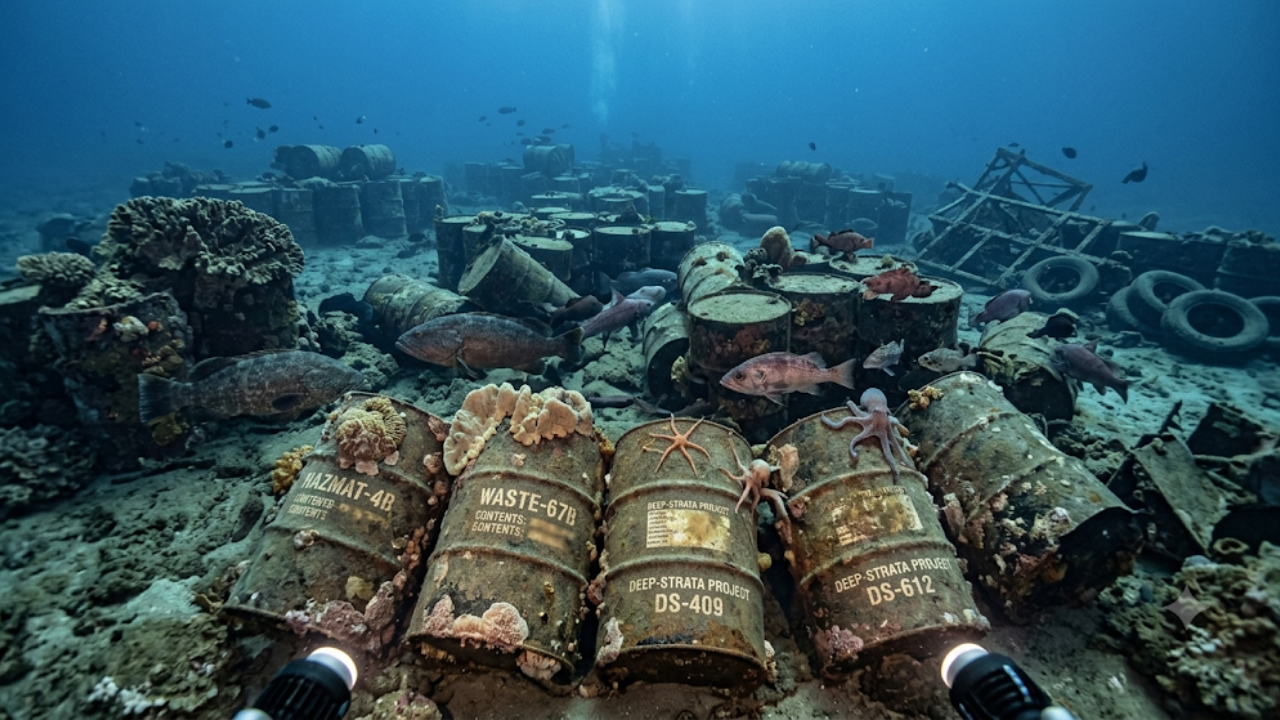
Give the public a headline about 200,000 barrels of radioactive waste rotting at the bottom of the Atlantic Ocean, and the collective imagination runs wild. Images of glowing green slime, mutated deep-sea monsters, and ticking ecological time bombs dominate the narrative. Marine scientists secure massive grants. Environmental groups launch fundraising campaigns. The media gets weeks of easy clicks.
It is a masterclass in manufactured panic.
The frantic rush to locate, catalog, and potentially recover these legacy industrial drums is not just a scientific misallocation of resources. It is an exercise in profound ignorance regarding nuclear physics and ocean chemistry.
I have spent years analyzing energy infrastructure and the regulatory theater that surrounds waste management. I have watched governments burn through millions of dollars to mitigate risks that exist only on paper, while ignoring real, systemic failures right in front of them. The hunt for the Atlantic's dumped nuclear barrels is the ultimate manifestation of this hysteria.
Stop looking for the barrels. Leave them exactly where they are.
The Phantom Menace of the Deep Sea
The competitor narrative relies on a simple, flawed premise: Container breach equals catastrophe.
They want you to picture 200,000 flimsy metal trash cans dissolving in seawater, releasing a wave of apocalyptic radiation that will poison the food chain and destroy the marine ecosystem. It sounds terrifying. It is also physically impossible.
To understand why, you have to look at what was actually dumped between the 1940s and 1980s by nations like the UK, Belgium, and the United States. This was not high-level spent fuel fresh from a reactor core. This was low-level waste (LLW). We are talking about contaminated lab equipment, protective clothing, tools, and water filtration resins embedded in solid matrices.
The barrels were not filled with liquid sloshing around. They were packed with concrete, bitumen, or polymers. The metal drum on the outside was never the primary containment mechanism; it was just the mold used to cast the solid block inside.
When those metal hulls corrode away—as many already have over the last eighty years—the radioactive isotopes do not suddenly burst into the water column. They remain trapped inside a dense, solid block of concrete sunk deep into the abyssal plain.
Dilution Is the Literal Solution
Let us look at the raw mechanics of ocean chemistry. The ocean is not a stagnant bathtub. It is a massive, dynamic system that is already naturally radioactive.
The global ocean contains roughly 4 billion tons of dissolved uranium. It holds massive quantities of potassium-40, a naturally occurring radioisotope. The background radiation of the sea is immense and permanent.
If every single one of those 200,000 legacy barrels disintegrated simultaneously tomorrow, the resulting release of isotopes like cesium-137 and strontium-90 would be a literal drop in the bucket. The half-lives of these primary fission products are roughly thirty years. Because the dumping ceased decades ago, a massive portion of this radioactivity has already decayed into stable, harmless elements while locked inside the concrete matrix.
What little leaks out is subjected to the law of infinite dilution. The volume of the Atlantic Ocean is roughly 310 million cubic kilometers. The concentration of leaked isotopes at the seafloor is so infinitesimally small that it cannot even be distinguished from natural background variation more than a few meters away from the source site.
To suggest this poses a threat to commercial fisheries or human health is to misunderstand basic math.
The True Risk of the Recovery Illusion
The public wants these barrels pulled up. "Clean up the ocean," they cry.
This is where the lazy consensus becomes actively dangerous. The moment you attempt to disturb, lift, or recover eight-decade-old concrete blocks from a depth of thousands of meters, you transform a stable, contained situation into an active environmental hazard.
+------------------------------------------------------------------------+
|                      THE INTERVENTION PARADOX                          |
|                                                                        |
|  [Status Quo: Deep Sea] ------------> Solid concrete matrix            |
|                                        Safe, localized decay           |
|                                        Zero human contact              |
|                                                                        |
|  [Attempted Recovery] --------------> Mechanical stress & fracturing   |
|                                        Particulate dispersion          |
|                                        Surface handling exposure       |
+------------------------------------------------------------------------+
Imagine a scenario where a remote operated vehicle (ROV) hooks into a degraded concrete block at 4,000 meters. Under the immense pressure changes and mechanical stress of retrieval, the block fractures. Instead of a localized, solid mass resting harmlessly in the silt, you have now created a cloud of radioactive particulates. These fine grains can be carried by deep-ocean currents, spreading across the seafloor and potentially entering the benthic food web in ways the solid block never could.
Furthermore, if you successfully bring a barrel to the surface, what do you do with it? You have now created a high-profile, politically radioactive public relations nightmare. You must transport it, store it on land, and find a community willing to accept legacy waste that was perfectly safe at the bottom of the ocean.
You have traded a zero-risk deep-sea reality for a high-risk terrestrial logistical bottleneck. It is engineering malpractice driven by emotional optics.
Dismantling the Panic Economy
The current hunt for these barrels is fueled by a broader, institutionalized flaw in how we perceive environmental risk. The "People Also Ask" columns are flooded with variations of: Is it safe to swim in the Atlantic? and Are deep-sea fish radioactive?
The honest answer is yes, they are radioactive—but because of the earth's crust and cosmic rays, not because of some rusty barrels from 1954.
We are systematically incapable of assessing relative risk. We will obsess over a few thousand curies of decaying low-level waste buried under miles of water while ignoring the literal gigatons of heavy metals, plastics, and chemical agricultural runoff pouring into our coastal estuaries every single day.
Why? Because the word "nuclear" bypasses the rational brain. It triggers an immediate emotional response that makes for excellent fundraising copy.
The International Atomic Energy Agency (IAEA) and organizations like the Nuclear Energy Agency (NEA) have monitored these dump sites for decades. Their reports consistently reach the same conclusion: the radiological impact on human health and the environment is negligible. Yet, we see research vessels deployed to "rediscover" these sites as if they are a ticking time bomb.
It is a circus. It is a distraction from the real, immediate challenges of modern waste management and energy transition.
The Cost of Virtue Signaling
Every dollar spent mapping these benign dump sites is a dollar stolen from meaningful conservation and technological advancement. We have limited scientific capital, limited shiptime, and limited public patience.
If we genuinely care about ocean health, we should be funding the deployment of advanced autonomous fleets to track illegal industrial overfishing, monitoring ocean acidification, or scaling up carbon sequestration tech. Instead, we are playing detective for eighty-year-old trash that has already settled into its final, permanent resting place.
The downside to my argument is obvious: it requires admitting that the ocean can be used as a disposal mechanism. It sounds callous. It flies in the face of modern ecological sensibilities. Nobody wants to defend the mid-century policy of dumping waste into the sea. It was a crude, lazy practice born of an era that did not understand long-term environmental stewardship.
But there is a vast difference between opposing future dumping and wasting billions trying to reverse past dumping that has already neutralized itself.
We must learn to accept historical anomalies when the cost of fixing them exceeds the risk of ignoring them. The barrels are integrated into the deep-sea landscape. They are being covered by sediment. They are decaying into stability.
Turn the research ships around. Stop funding the panic. Let the deep sea do its job.