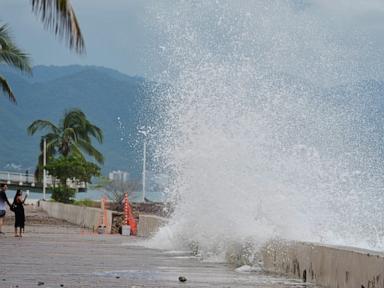
Salt arrives before the rain.
You taste it on your tongue two hours before the squall line reaches the palapas, a metallic, oceanic sting carried forward on warm gusts that bend the coconut palms until their fronds scrape the gravel. Along Mexico's Pacific coast, when a major cyclone like Hurricane Simon spins up over warm eastern Pacific waters, the ocean stops looking like a postcard and starts looking like an engine. Whitecaps tear loose from swells. Pelicans drop low into the troughs between waves. Down at sea level, the air grows heavy and strange, pressed down by millions of tons of moving moisture while gulls shriek inland toward the foothills of the Sierra Madre del Sur.
I have stood behind corrugated tin shutters during coastal storms in western Mexico and watched how quickly a familiar street turns unrecognizable. You hear the wind first as a low hum behind your ribs, then as a freight train rattling every sheet of zinc on the block, until rainwater finds a seam in the mortar and turns a dry concrete floor into a mirror of gray sky. When a storm slams into a stretch of shoreline where luxury infinity pools sit ten minutes by dirt road from cinder-block homes with unpaved drainage ditches, two worlds meet the same wall of water—and they do not absorb the blow equally.
(Note: The individuals and scenes below are composite and hypothetical illustrations created to show how coastal storm impacts unfold across both resort zones and vulnerable neighboring towns, grounded in established meteorological and coastal hazard realities of Pacific hurricanes affecting Mexico.)
Two Coastlines Under the Same Sky
Consider what happens when a storm system like Hurricane Simon pushes heavy surf, torrential rain, and gusting winds toward Mexico's western shore. On a weather map, a hurricane looks like a neat spiral of clouds with a red track line and wind-speed numbers. On the ground, it is a shifting geography of exposure.
Twenty miles apart, two communities can experience the same cyclone as two different emergencies.
In a hypothetical resort enclave north of a fishing town—let's call the town Puerto Arena and the resort corridor Punta Brava—the morning before landfall begins with frantic choreography. Guests who flew in for turquoise water and quiet mornings are suddenly asked to pack carry-on bags, move away from glass balcony doors, and gather in interior ballrooms with backup generators humming in the basement. Bellhops tape windows or haul patio furniture into storage rooms. Palm trees that framed sunset photos an hour earlier are lashed or pruned where branches might snap into power lines.
Down the coast in Puerto Arena, there are no backup generators humming in reinforced basements. There is no concierge handing out bottled water or arranging charter flights out of a coastal airport before flight cancellations hit. There is Mateo, a hypothetical boat mechanic and father of two, walking his street at dusk with a flashlight to check whether the culvert at the bottom of the hill is clogged with branches and trash. When heavy rain falls onto steep coastal hills and drains into low-lying neighborhoods built on sandy soil or old floodplains, water does not politely wait for municipal pumps. It rushes wherever gravity points.
If you ask how a hurricane damages a coastline, people usually picture snapped palm trees, flooded lobbies, and dramatic footage of waves crashing against seawalls. Those images are real, and they matter. Yet they often miss the quieter, heavier toll that lingers after the cameras pack up: a roof tarp flapping in the afternoon breeze, a fishing skiff half-swamped in a lagoon, a clinic floor slick with mud, or a week of lost wages when tour boats stay tied to their moorings.
Why Pacific Storms Catch People Off Guard
Eastern Pacific hurricanes have a reputation among storm watchers for moving fast and sometimes intensifying rapidly over warm water. Unlike broad, slow-drifting systems that soak a region for days, a compact, punchy Pacific storm can whip up fierce winds and heavy rain bands in short bursts, then push inland toward rugged mountain terrain where moisture wrings out in sudden downpours.
Even people who live by the sea every single day can feel rattled by how quickly conditions turn. I remember talking to a fisherman years ago after a Pacific blow who told me, "The sea doesn't warn you in Spanish or English. It changes color, and then it changes its mind." That sentence has stayed with me because it captures the honest uncertainty of coastal weather. Forecasts improve every decade, with satellites and aircraft reconnaissance giving meteorologists sharper eyes than ever, yet a wobble of thirty miles in a storm's track can mean the difference between glancing squalls and direct battering surf.
Vulnerability is not just a matter of wind speed. It is a matter of elevation, drainage, construction materials, and how much margin a household has when everything stops at once.
Think of a coastal town's defenses like a pair of shoes worn on a rocky trail. A well-built resort with engineered drainage, deep foundations, insurance policies, and corporate reserve funds is wearing thick-soled boots; the rocks still bruise, and the walk is rough, but the sole holds together. A family living in a home built incrementally over years with a sheet-metal roof, an unpaved access road, and income tied day-to-day to fishing, market stalls, or hourly hospitality shifts is walking barefoot on those same stones. When a storm knocks out power lines, washes out a bridge, or floods a ground floor, the recovery clock runs differently for each of them.
What Happens When the Tourism Engine Stalls
Resorts along Mexico's Pacific coast are often portrayed in headlines as fortresses of wealth untouched by ordinary hardship. That contrast is real, especially when you compare manicured gardens and backup power with flooded streets a few miles away. Still, the relationship between resorts and nearby towns is tightly knotted.
When a hurricane pounds a resort zone, glass may shatter, landscaping may be stripped bare, and beaches may erode, but major properties usually have corporate capital and engineering teams to begin repairs. What happens next in the neighboring town is more complicated. Thousands of cooks, housekeepers, gardeners, drivers, and vendors rely on steady occupancy and safe roads. A major storm can trigger cancellations, flight disruptions, and weeks of cautious travel—even after skies clear and hotel lobbies reopen.
Imagine Elena, a hypothetical line cook in Puerto Arena whose shift starts before sunrise. When coastal roads flood or public transit pauses during a storm warning, getting to work becomes unsafe or impossible. If the resort closes temporarily or cuts hours while waiting for power restoration and beach cleanup, her paycheck shrinks right when groceries cost more and her own home may need minor repairs. One storm does not just bend metal and uproot trees; it sends ripples straight through household budgets that had almost no slack to begin with.
We should also be honest about how confusing storm advisories can feel when you are staring at a grey sky and trying to make a practical choice. Should you stay put or head inland? Is the flooding near your house going to rise another foot, or peak and recede? When rumors travel faster than official updates—a washed-out highway here, a downed transformer there—fear and fatigue set in together. Admitting that uncertainty is part of living with big weather makes us more patient with people making hard calls under pressure, rather than judging them from afar with a coffee mug and a radar screen.
Between Wind and Water, Memory Remains
The day after a storm passes along the Pacific coast often feels surreal. The air is washed clean, almost startlingly clear, with mountains standing out sharp against pale blue sky. Birds test the branches again. Neighbors step onto porches with brooms, shovels, and buckets, pushing mud out of doorways and clearing palm fronds from driveways.
For travelers watching from afar or planning a trip to Mexico's Pacific coast, the aftermath raises a fair question: what does responsible attention look like when a storm like Hurricane Simon hits? First, it means looking past single-angle stories—whether those angles focus solely on glamorous beachfront property damage or treat an entire coastline as permanently broken. A hurricane is an event, not the whole identity of a place, yet pretending nothing happened erases the people who weathered the worst of it. Second, it means checking real-time local advisories, road conditions, and municipal updates rather than relying on recycled social media clips that often mix old storm footage with new events.
Down in Puerto Arena, Mateo finishes clearing mud from the front step as his neighbor walks past carrying two jugs of clean water. Somewhere up the coast, a resort crew is already sweeping sand off a terrace and checking lines on a hotel generator. Both places are dealing with the same ocean's reach, shaped by geography, economics, and sheer human grit.
Out where the Pacific meets the sand, the tide keeps coming in, long after the storm's name fades from the headlines, carrying dark driftwood, tangled sea grass, and the quiet mark of every wave that reached a little too far.

