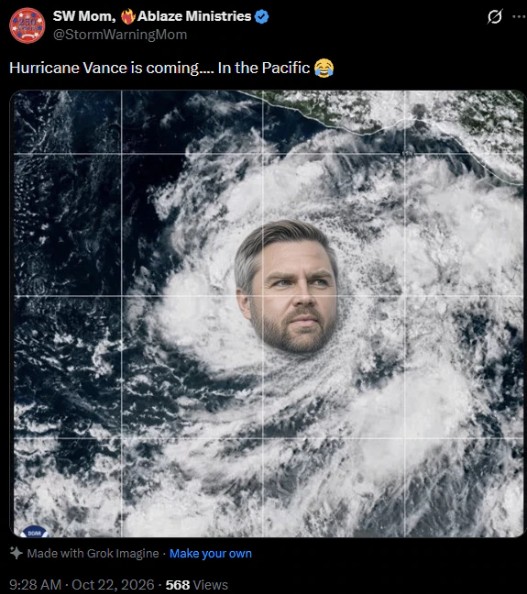
When meteorologists officially designated a tropical system as Hurricane Vance, social media feeds immediately erupted with jokes, edited satellite maps, and sharp political commentary aimed at JD Vance. The internet did not invent a weather conspiracy; it simply reacted to a predictable collision between standardized meteorological naming conventions and hyper-partisan digital culture. Within hours of the National Hurricane Center issuing its advisories, the storm’s name became shorthand for political turbulence, drawing millions of impressions from both critics and supporters who seized on the coincidence to score rhetorical points.
This phenomenon happens every hurricane season, yet the velocity of the Hurricane Vance meme cycle reveals how modern political discourse absorbs and repurposes apolitical events. Rather than engaging with meteorological tracking data or emergency preparedness updates, online audiences treated the storm's nomenclature as an open-source comedy prompt. Understanding why this specific storm captured the collective imagination requires looking at how the World Meteorological Organization selects storm names, how political figures become accidental punchlines, and why algorithmic platforms reward this exact kind of low-effort, high-engagement humor.
The Bureaucracy Behind Hurricane Names
The internet loves a good conspiracy, especially when a storm shares a surname with a prominent national figure. Yet the reality behind the naming of Hurricane Vance is entirely mundane, rooted in decades-old international protocol rather than political trolling.
The World Meteorological Organization (WMO) maintains six rotating lists of names for Atlantic and Eastern Pacific tropical cyclones. These lists are recycled every six years, meaning a name like "Vance" was slated for use long before JD Vance entered national politics, published Hillbilly Elegy, or stepped onto a campaign stage. The WMO establishes these lists years in advance so emergency managers, broadcasters, and government agencies can communicate clearly without confusing multiple active storms in the same basin.
Historically, forecasters used phonetic alphabets, latitude-longitude coordinates, or the names of saints' days to identify hurricanes. By the mid-twentieth century, the U.S. Weather Bureau shifted to short, distinct human names because radio operators found them far easier to transmit without error during chaotic weather events. In 1979, men's names were officially integrated alongside women's names into the rotating lists.
A name is only removed from the rotation under one condition. If a storm is so deadly or costly that future use of its name for another storm would be insensitive or confusing, a WMO committee votes to retire it permanently. Famous examples include Katrina, Sandy, Harvey, and Ian. Unless a storm causes catastrophic loss of life or billions in structural damage, its name quietly returns six years later, completely indifferent to whoever happens to hold public office at the time.
How a Weather System Becomes a Political Punchline
Meteorology operates on a six-year calendar. Politics operates on a six-minute news cycle. When those two timelines intersect, digital culture invariably flattens complex reality into digestible satire.
For JD Vance, whose public profile has been defined by sharp-elbowed media appearances, populist rhetoric, and intense scrutiny from both sides of the aisle, sharing a name with a swirling mass of low pressure was an unavoidable setup. Critics immediately deployed predictable metaphors. They overlayed the politician’s face onto radar loops, joked about the storm "shifting its track" to match evolving policy positions, and framed the weather event as a literal manifestation of political chaos.
Supporters, meanwhile, leaned into the absurdity with equal enthusiasm. Right-leaning meme accounts repurposed the exact same satellite imagery to portray the storm as an unstoppable force sweeping across the map, turning an accidental weather moniker into a badge of populist strength.
This dynamic illustrates a core mechanic of modern online politics. Satire no longer requires clever writing or deep policy knowledge. It relies entirely on semantic collision—taking two unrelated concepts that share a word and smashing them together until an algorithm notices.
The Anatomy of an Algorithmic Meme Wave
To understand why these posts spread so rapidly, you have to look at the incentives governing major social platforms. Recommendation engines do not measure truth, nuance, or civic value. They measure dwell time, reply velocity, and share ratios.
A post containing a real National Hurricane Center advisory gets modest engagement from people living in the cone of uncertainty. A post pairing that same advisory with a punchline about JD Vance triggers an immediate emotional response across the political spectrum. Critics share it to mock. Supporters quote-post it to defend or reclaim the joke. Casual observers stop scrolling simply because the juxtaposition is jarring.
In this environment, nuance is a liability. Nobody stops to explain that the Eastern Pacific hurricane list has included the name Vance since the 1990s, or that tropical storm tracks are governed by atmospheric steering currents rather than campaign strategists. The joke works precisely because it ignores context.
Historical Precedents of Political Storm Naming
The Hurricane Vance frenzy is hardly an isolated incident. Whenever a tropical cyclone shares a name with a polarizing public figure, the exact same media cycle plays out with clockwork predictability.
Consider Hurricane Hilary in 2023. As the rare tropical storm barreled toward Southern California—a region unaccustomed to tropical cyclone warnings—social media instantly transformed the weather event into a referendum on former Secretary of State Hillary Clinton. Despite the slight spelling difference, the memes flooded every major platform. Pundits cracked jokes about the storm's path, partisan accounts revived decades-old political grievances, and emergency officials had to compete with political humor just to get basic flood safety warnings in front of California residents.
A similar pattern emerged during Hurricane Harvey in 2017, though the tragedy of the historic Texas flooding quickly sobered the online conversation. Before the catastrophic rainfall totals became clear, early social media chatter briefly toyed with pop-culture references. Once the scale of the human suffering became undeniable, the jokes evaporated, and the WMO subsequently retired the name forever.
Even Hurricane Bret, Hurricane Marco, and Hurricane Laura experienced brief flashes of political or celebrity association during their respective news cycles. In every instance, the pattern remains identical:
- Phase One: The National Hurricane Center upgrades a tropical depression to a named storm.
- Phase Two: Political commentators notice the name overlap and post initial observational jokes.
- Phase Three: Partisan meme creators produce visual edits, deepfakes, and mock weather graphics.
- Phase Four: Mainstream digital outlets write roundup articles covering the social media reaction, cementing the meme cycle into the broader news narrative.
The Hidden Cost of Turning Forecasts into Satire
While political memes are largely harmless entertainment, veteran emergency managers view the gamification of hurricane coverage with quiet frustration. Weather communication relies on clarity, trust, and urgency. When a storm's name becomes a partisan football, vital public safety messaging gets buried beneath layers of irony.
During active tropical events, local meteorologists and emergency response agencies rely on social media hashtags to distribute evacuation orders, storm surge warnings, and shelter locations. When those hashtags are hijacked by tens of thousands of politically motivated memes, the signal-to-noise ratio collapses. Residents looking for genuine updates on wind speeds or flash flood risks have to wade through doctored radar maps and partisan bickering.
Furthermore, associating a storm with a political figure subtly encourages audiences to view the weather event through a tribal lens. Research in risk communication consistently shows that people evaluate threats differently depending on how those threats are framed. If a storm becomes a running joke on cable news and social media, individuals in the projected path may subconsciously downgrade the seriousness of the forecast.
Meteorologists work under immense pressure to translate complex atmospheric modeling into actionable advice. They deal with cone-of-uncertainty misconceptions, model fluctuations, and rapid intensification events. Adding a layer of political theater to an already difficult communication challenge does not help anyone prepare for high winds or coastal flooding.
Why Political Brands Are Vulnerable to Coincidence
Public figures spend millions of dollars carefully curating their public image. Campaigns hire teams of strategists, speechwriters, and digital directors to control every frame of video and every line of copy associated with a candidate's name. Yet no amount of strategic planning can insulate a politician from the sheer randomness of the internet.
JD Vance represents a textbook case of how high-visibility political figures become magnets for unrelated cultural noise. Because his name already carries intense ideological weight in American media, any external event featuring that name instantly inherits his existing political baggage. The storm did not create new opinions about Vance; it simply provided a fresh canvas for people to project the opinions they already held.
In an earlier media era, a coincidence like Hurricane Vance might have merited a throwaway line from a late-night monologue host before vanishing by the next morning. Today, decentralized content creation ensures that thousands of amateur comedians, political operatives, and engagement farmers extract every ounce of value from the overlap.
The lifespan of these digital storms is remarkably short. Just as a real hurricane weakens once it moves over cooler waters or makes landfall, a political meme cycle loses energy the moment a newer, louder distraction enters the feed. Within days, the radar loops are forgotten, the edited photos are buried beneath fresh headlines, and the political conversation moves on to the next manufactured outrage.
Meanwhile, the World Meteorological Organization's rotating list continues turning silently in the background, entirely indifferent to election cycles, trending topics, or the fragile egos of the people whose names happen to appear on the chart.


