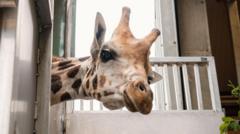
The arrival of a newborn giraffe at a major metropolitan zoo is a guaranteed public relations triumph. Cameras flash, press releases champion the birth as a vital victory for an endangered species, and ticket sales spike as families rush to see the wobbly-legged calf. This narrative frames captive breeding as the frontline defense against extinction. However, this is an expensive illusion. The survival of Africa's dwindling giraffe populations cannot be bought or secured inside a paddock. Zoo births do almost nothing to reverse the complex geopolitical, ecological, and economic pressures driving wild giraffes toward what scientists call a silent extinction.
To understand why a new captive arrival will not save rare giraffes, one must look at the widening disconnect between ex-situ conservation (zoo breeding) and in-situ reality (wild survival).
While captive programs maintain a genetic safety net, the true crisis unfolds on the African continent, where habitat fragmentation, civil conflict, and illegal poaching are decimating wild herds. Zoos operate as isolated islands of security. They are completely detached from the ecosystems they claim to protect.
The Genetic Cul-de-Sac of Captive Populations
Captive breeding operates on a fundamental flaw. It prioritizes the preservation of a species in a vacuum. For decades, institutions managed giraffes under a generalized umbrella, frequently interbreeding distinct subspecies. This created a managed population that often lacks the genetic purity required for meaningful wild reintroduction.
Scientists now recognize four distinct species of giraffe: the northern giraffe, southern giraffe, reticulated giraffe, and Masai giraffe. Many individuals currently residing in global zoos are the product of historic cross-breeding between these distinct groups.
Introducing a genetically muddled captive animal into a highly adapted wild population can introduce maladaptive traits, threatening the survival of the remaining wild herds.
Furthermore, the physical changes that occur over generations in captivity cannot be ignored. Captive giraffes do not learn the predator avoidance behaviors, foraging strategies, or spatial awareness required to survive in the Serengeti or the Sahel. A calf born on concrete and fed high-quality alfalfa pellets is fundamentally unequipped for the harsh realities of the wild.
Reintroduction is not as simple as opening a crate. It is an incredibly expensive, logistically nightmarish process that frequently ends in the death of the released animal.
Where the Money Goes and Who It Benefits
Conservation is a game of resource allocation. It is a game where the math rarely favors the animals in the wild. Maintaining a giraffe in a modern, climate-controlled habitat in North America or Europe requires hundreds of thousands of dollars annually in veterinary care, specialized diets, and infrastructure maintenance.
Compare this to the cost-efficiency of protecting wild habitats. A fraction of the money spent on a single zoo habitat could fund an entire anti-poaching unit in Niger or Kenya for a year.
These field teams protect hundreds of wild giraffes simultaneously, alongside the entire ecosystem they inhabit.
- Zoo Habitat Maintenance: High capital expenditure, localized economic benefit to the host city, zero direct impact on wild poaching rates.
- Field Anti-Poaching Units: Low relative cost, direct protection of wild breeding pools, employment of local communities to incentivize conservation.
The public relations machinery of modern zoos creates a comforting narrative for donors. It is far easier to raise money for a visible, charismatic baby animal in a local zip code than it is to solicit donations for a community-led land management initiative thousands of miles away.
This creates a perverse incentive structure. The institutions pulling in the most funding are often the ones least capable of executing large-scale, wild population recoveries.
The True Drivers of the Silent Extinction
The term "silent extinction" describes the rapid decline of wild giraffes over the last three decades, a collapse that has gone largely unnoticed by the global public. While elephants and rhinos dominate the headlines, giraffe numbers plummeted by nearly 40 percent. This decline is driven by factors that a new zoo calf cannot fix.
Habitat Fragmentation and Human Conflict
Africa's human population is projected to double by 2050. This growth requires land for agriculture, infrastructure, and urban expansion. As roads and fences cut through historic migratory corridors, giraffe populations are sliced into smaller, isolated pockets.
These fragmented groups face severe inbreeding depression in the wild, cut off from the broader gene pool. A baby giraffe born in Chicago or London does nothing to clear the agricultural encroachment blocking a migration path in Tanzania.
The Bushmeat Trade and Commercial Poaching
Giraffes are increasingly targeted for their meat, hide, and bones. In regions destabilized by civil unrest or extreme poverty, a single giraffe provides hundreds of pounds of meat, making them highly lucrative targets for poaching syndicates and desperate local populations alike.
In some areas, there is a superstitious belief that giraffe bone marrow can cure ailments, driving up black-market prices. This is a law enforcement and socio-economic challenge. It requires a boots-on-the-ground response, not a captive breeding registry.
Flipping the Model toward Community Preservation
If captive breeding is a flawed solution, the path forward requires a radical shift in how we approach wildlife preservation. The most successful conservation models are not those that remove animals from their environment, but those that make the animals valuable to the people living alongside them.
In Namibia, the implementation of communal conservancies transformed the landscape of wildlife protection. By giving local communities ownership rights over the wildlife on their lands, the state turned potential poachers into protectors.
Tourism revenue flows directly into local economies, funding schools and clinics. In this framework, a living giraffe is worth significantly more to a villager than a dead one.
"True conservation succeeds only when the local population views wildlife as an asset rather than an economic burden or a threat to agriculture."
This model addresses the root cause of the crisis. It focuses on coexistence, land management, and economic alignment. It acknowledges that the fate of the giraffe is inextricably linked to the fate of the human communities sharing its soil.
The Ethics of the Spectacle
We must confront the uncomfortable reality of why we celebrate zoo births. These events serve the human desire for spectacle and emotional connection. They provide a comforting narrative that we are fixing a problem, allowing us to bypass the harder, uglier political and economic realities of global habitat loss.
A newborn giraffe in captivity should be viewed as a reminder of our failure to protect the wild, not a triumph of preservation. It is a living monument to a habitat we are actively losing. Until global conservation priorities shift away from high-visibility captive exhibits and toward aggressive, well-funded protection of African ecosystems, the silent extinction will continue unabated.
The survival of the world's tallest mammal will be decided by rangers holding the line against poachers and communities securing wild corridors, not by the birth of another calf behind glass.


