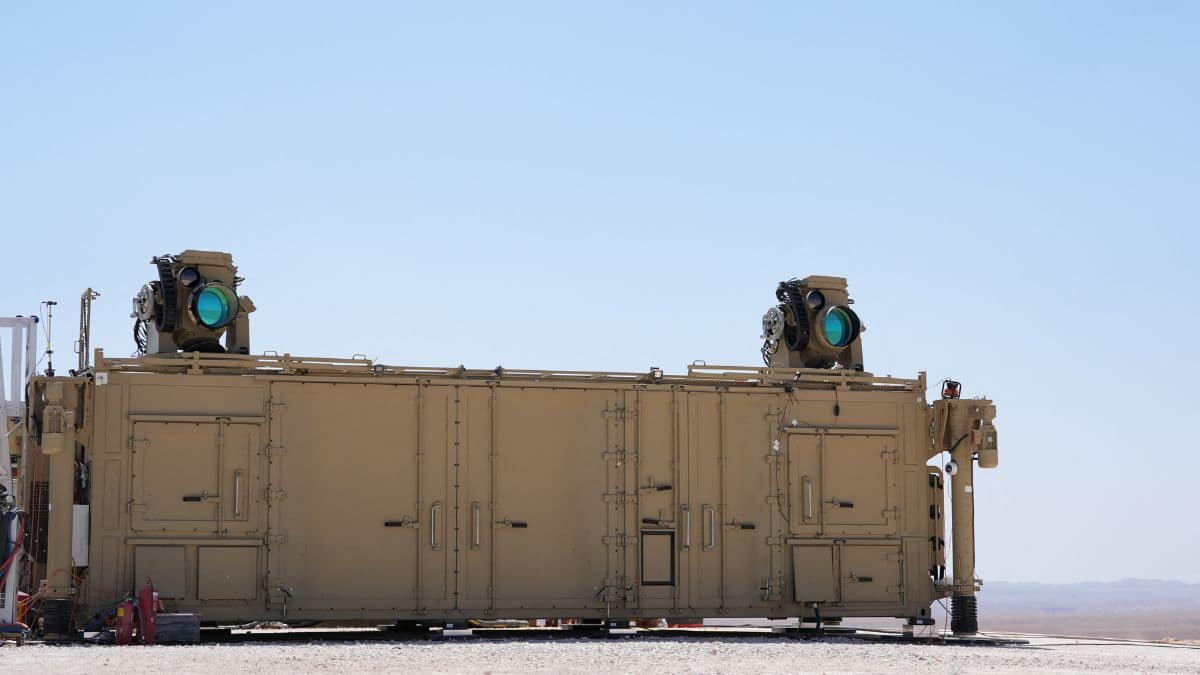
If you've been following the recent buzz around New Delhi and Tel Aviv, you know something big is brewing. Prime Minister Narendra Modi’s latest visit to Israel isn't just another diplomatic photo op. It's a signal that India is ready to stop playing catch-up and start leading in the next phase of warfare.
The star of the show? A sleek, futuristic 100kW laser weapon called the Iron Beam. While the world has spent years marveling at the Iron Dome's missile interceptions, India's looking at the math. And the math says that firing a $50,000 missile to take out a $500 drone is a losing game.
The economics of attrition
Modern war has a massive price tag problem. If you're defending a city against a swarm of cheap, off-the-shelf drones, you'll go broke long before the enemy runs out of plastic and propellers. This is exactly why the Iron Beam is such a huge deal for Indian defense planners.
Israel's Rafael Advanced Defense Systems claims the Iron Beam can neutralize targets for about $2 to $3 per shot. Compare that to the $50,000 or $100,000 you'd spend on a single Tamir interceptor for the Iron Dome. It’s not just a difference in cost; it’s a different league entirely.
- Unlimited Magazine: As long as there's electricity, the laser keeps firing. No waiting for reloads or worrying about empty silos.
- Speed of Light: You aren't calculating lead times or flight paths. If the sensor sees it, the beam hits it.
- Minimal Damage: There are no falling missile fragments to worry about in populated areas.
India’s interest isn't just about buying a few units. It’s about the transfer of technology (ToT). The Modi government wants to build these systems under the "Make in India" banner. They're eyeing a future where this tech is baked into India's own "Sudarshan Chakra"—a multi-layered shield designed to protect the country's massive borders by 2035.
Why India needs this tech right now
India’s security environment is getting complicated. Between the drone threats across the western border and the high-altitude challenges in the Himalayas, traditional air defense is hitting its limits.
We saw this play out in 2025. Reports suggest that drone swarms have become the go-to tactic for non-state actors and rival militaries alike. They're cheap, they're hard to track, and they're designed to overwhelm.
By integrating Iron Beam technology, India can save its expensive S-400 and Long Range Surface-to-Air Missiles (LR-SAM) for high-value targets like fighter jets or ballistic missiles. The "small stuff"—the drones, the mortar shells, and the small rockets—can be handled by the laser.
Bridging the gap with Project DURGA
India isn't starting from scratch. The Defence Research and Development Organisation (DRDO) has been quietly working on its own Directed Energy Weapon (DEW) project, known as DURGA-II (Directionally Unrestricted Ray-Gun Array).
In April 2025, India successfully tested a 30kW variant that could take down drones at a 5-kilometer range. But moving from a 30kW prototype to a battle-ready 100kW system like the Iron Beam is a massive leap. Collaborating with Israel would basically act as a supercharger for DURGA-II, potentially shaving years off the development timeline.
The US factor and the fine print
You can't talk about Israeli tech without talking about Washington. Much of the funding and development for systems like the Iron Beam involves American companies like Lockheed Martin. This means any deal between India and Israel likely needs a green light from the US State Department.
The US has its own set of rules, specifically ITAR (International Traffic in Arms Regulations). If a system has a single US-made component, the US gets a say in where it goes. However, given India’s growing role in the Quad and its strategic importance as a counterweight in Asia, the odds of a waiver or a joint-development agreement are higher than they've ever been.
Beyond the laser
Modi’s visit is about more than just one weapon system. It's the birth of what's being called a Special Strategic Partnership. We're looking at:
- Arrow and David’s Sling: Discussions are reportedly ongoing for longer-range interceptors that can hit targets outside the atmosphere.
- AI and Cyber: Joint labs for artificial intelligence and quantum computing are on the table.
- The "Hexagon" Alliance: Israel's Benjamin Netanyahu has hinted at an alliance connecting India, Israel, and several Arab and Mediterranean nations.
This isn't just about hardware; it's about shifting the geopolitical center of gravity. For India, it's about ensuring that by 2030, its cities are covered by an "impregnable" canopy that doesn't rely on expensive foreign imports every time a drone crosses the line.
The real test will be how quickly these MoUs turn into actual production lines on Indian soil. Laser weapons have always sounded like science fiction, but they're becoming a very real, very necessary part of the modern arsenal. Honestly, if India manages to pull off this tech transfer, it won't just be defending its borders—it'll be changing the rules of engagement for everyone.
Check the latest updates from the Ministry of Defence to see how the DURGA-II project is progressing alongside these new international partnerships.