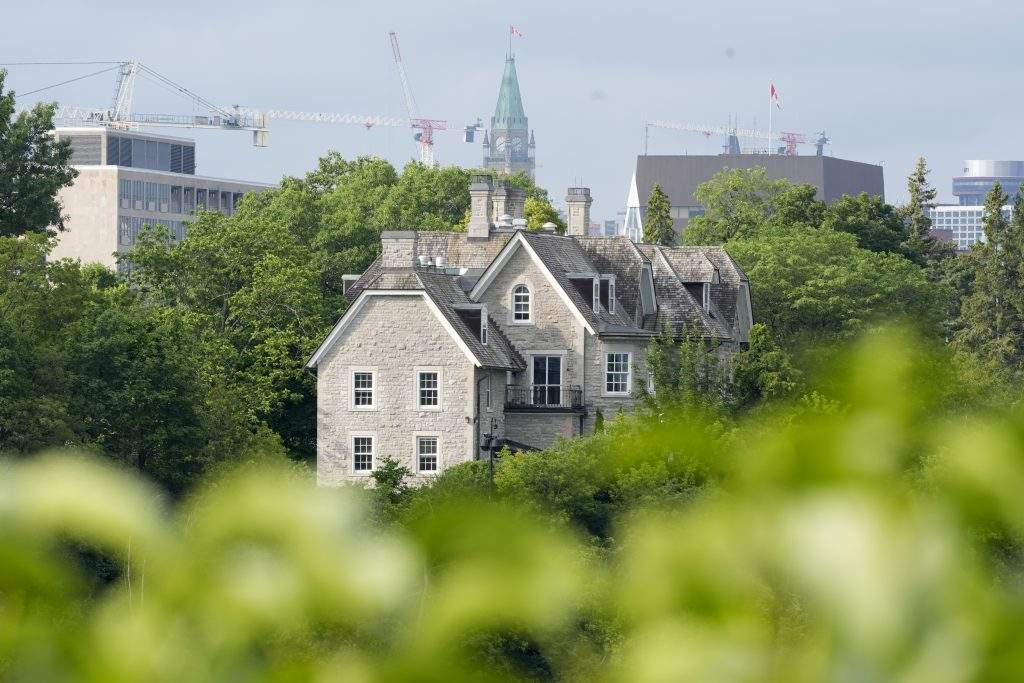
The campaign to restore 24 Sussex Drive has secured $5.7 million in initial pledges as organizers launch a public appeal to fund the rehabilitation of Canada’s vacant official prime ministerial residence. Led by a newly formed coalition of heritage advocates and civic leaders, the fundraising drive aims to break decades of political paralysis by bypassing taxpayer resistance through private philanthropy and public-private partnerships. While the $5.7 million seed fund represents the largest organized financial commitment from private donors to date, it covers only a fraction of the estimated $36 million to $40 million required to strip asbestos, replace failing mechanical systems, and bring the 19th-century limestone mansion up to modern security and accessibility standards.
Money has never been the actual problem at 24 Sussex Drive. Political cowardice is.
For more than a decade, the historic residence overlooking the Ottawa River has sat empty, slowly rotting from the inside out while successive prime ministers avoided the optics of spending public money on their own living quarters. When Justin Trudeau took office in 2015, he famously declined to move in, opting instead for Rideau Cottage on the grounds of Rideau Hall. That decision was supposed to buy time for the National Capital Commission to execute a comprehensive overhaul. Instead, it initiated a ten-year standoff in which no federal government wanted to sign off on a multi-million-dollar construction bill during periods of inflation, housing shortages, and fiscal austerity.
The launch of a public fundraising campaign changes the calculus, though not without introducing a new set of institutional headaches. By raising $5.7 million before going public, the campaign’s organizers—working alongside heritage preservationists and former public servants—are attempting to prove that Canadians will voluntarily pay to save a national symbol when politicians lack the nerve to allocate the budget.
The Anatomy of a Slow-Motion Collapse
To understand why a $5.7 million fundraising milestone feels simultaneously impressive and inadequate, you have to look at the sheer scale of neglect inside the building. Built between 1866 and 1868 by lumber baron Joseph Merrill Currier as a wedding gift for his wife, Hannah, the 34-room limestone house was expropriated by the federal government in 1943 and converted into the official residence of the prime minister in 1951. Louis St. Laurent was the first leader to live there. Every prime minister from St. Laurent through Stephen Harper occupied the house, and virtually every single one of them left behind a growing list of deferred maintenance.
By the time the National Capital Commission closed the doors to residents in 2015, the building was effectively a museum of obsolete infrastructure. A series of engineering audits released over the past eight years painted a grim picture of a structure held together by patchwork fixes.
The mechanical, electrical, and plumbing systems date largely to a major 1950 renovation. Knob-and-tube wiring remained active in portions of the walls well into the 21st century. The heating and cooling systems lacked basic zone controls, forcing staff to open windows in the dead of winter to regulate room temperatures while boilers burned fuel at maximum capacity. Worse still, the walls and ceilings are laced with friable asbestos, making even routine maintenance a hazardous-materials operation.
Then there is the building envelope itself. The limestone exterior requires extensive repointing, the windows leak air and moisture, and the roof has suffered repeated water infiltration. In 2022, rodent infestations became so severe that National Capital Commission workers had to seal off sections of the interior to prevent further contamination of the walls and subflooring.
In 2021, the National Capital Commission estimated the baseline cost of rehabilitating 24 Sussex Drive at $36.6 million. Given construction inflation in the National Capital Region over the past five years, industry analysts and heritage architects widely acknowledge that the true figure now sits closer to $45 million or $50 million, particularly once modern RCMP security requirements are factored into the blueprint.
Why Private Philanthropy Enters the Picture
Against a price tag north of $40 million, $5.7 million looks like a down payment on a down payment. Yet in the world of Canadian heritage preservation, securing nearly six million dollars in quiet-phase commitments before a public launch is a significant achievement.
Historically, Canadians have shown little appetite for donating personal wealth to government-owned real estate. Unlike the United States, where the White House Historical Association has raised tens of millions of dollars from private donors since Jacqueline Kennedy established it in 1961 to fund refurbishments and fine art acquisitions, Canada has operated under a strictly state-funded model for its official residences. The assumption was always that Parliament would pay for the upkeep of Rideau Hall, Stornoway, Harrington Lake, and 24 Sussex Drive.
That model broke down when the political cost of approving the expenditure exceeded the political cost of letting the building decay. Opposition parties in Ottawa have spent decades weaponizing any spending on prime ministerial accommodations. When Stephen Harper’s government faced criticism over modest upgrades, or when media reports highlighted the cost of air conditioning units at Rideau Cottage, the message to every sitting prime minister became clear. Touching 24 Sussex is a guaranteed negative news cycle.
The architects of the new public appeal are betting that a hybrid funding model can neutralize that political toxicity. If private citizens, foundations, and corporate sponsors underwrite the heritage restoration and public-facing elements of the house—such as the state dining room, the reception halls, and the preservation of historical masonry—the federal government can justify funding the strictly operational components like security perimeters, communications infrastructure, and basic code compliance.
How the Hybrid Funding Model Works
In practice, separating private philanthropic dollars from public security budgets requires strict accounting firewalls. Donors are rarely interested in paying for blast-resistant glazing, underground utility tunnels, or RCMP guardhouses. They want their names associated with craftsmanship, historical continuity, and cultural stewardship.
The campaign’s strategy divides the rehabilitation into distinct buckets:
- Architectural and Heritage Conservation: Restoring the 19th-century exterior stonework, rehabilitating the original woodwork, and preserving historical fixtures. This is the primary target for the $5.7 million initial fund and ongoing public donations.
- Interior Finishes and Canadian Art: Furnishing the state rooms with Canadian-made furniture, textiles, and art loaned or donated through national institutions, reducing reliance on taxpayer funds for interior design.
- Core Infrastructure and Abatement: Removing asbestos, installing geothermal or high-efficiency HVAC systems, and replacing plumbing and electrical grids.
- Security and Executive Operations: Implementing modern threat mitigation, secure communications, and accessibility upgrades required for a head of government.
By absorbing the visible, aesthetic costs through public appeal, the campaign gives the federal cabinet political cover. A prime minister is far less vulnerable to attack ads when a substantial portion of the restoration bill is paid by voluntary contributions rather than income tax revenue.
The Structural Flaws of Crowdfunding a National Symbol
While the $5.7 million launch gives the project momentum, relying on public appeals to fix core state infrastructure carries serious risks. Veteran observers of federal procurement and heritage projects point to several unresolved problems that could stall the restoration even if donations pour in.
First, there is the issue of donor influence and optics. In Canadian politics, large private donations toward a building occupied by the sitting prime minister invite immediate scrutiny from ethics watchdogs and opposition critics. Even if every dollar flows through an independent, non-partisan foundation or directly to the National Capital Commission’s trust accounts, questions will inevitably arise about who is writing the largest checks. Strict caps on individual corporate donations and radical transparency regarding donor lists are non-negotiable if the campaign wants to avoid becoming a partisan scandal of its own.
Second, private fundraising operates on a timeline that rarely aligns with construction realities. Raising $5.7 million during a quiet phase—when organizers can pitch wealthy philanthropists, family foundations, and heritage patrons one-on-one—is very different from raising the next $15 million or $20 million from the general public. Grassroots appeals generate broad civic engagement, which is politically useful, but small-dollar donations rarely close massive capital gaps quickly. Meanwhile, every year that construction is delayed adds roughly 4% to 6% to the total project cost due to material and labor escalation.
Third, the campaign does not solve the fundamental governance flaw that created this mess in the first place. The National Capital Commission manages 24 Sussex Drive, yet it lacks the autonomous funding authority to execute major capital projects without Treasury Board approval. Until Parliament establishes an independent, non-partisan statutory maintenance fund—similar to how parliamentary precinct renovations are insulated from day-to-day partisan interference—the house will remain vulnerable to political hesitation.
The Demolition Counter-Argument
Not everyone agrees that 24 Sussex Drive is worth saving, even with private money on the table. A vocal camp of urban planners, security experts, and fiscal hawks argues that pouring $40 million or more into a 158-year-old house that was never designed to be an official residence is a classic sunk-cost fallacy.
Their argument rests on three practical realities:
- Security Limitations: Situated on a narrow lot along Sussex Drive, the property sits uncomfortably close to a major public thoroughfare. Retrofitting a 19th-century stone house to meet modern counter-terrorism and surveillance standards is vastly more expensive and less effective than constructing a purpose-built residence on a more secure footprint, such as the expansive grounds of Rideau Hall.
- Functional Obsolescence: Unlike 10 Downing Street or the White House, 24 Sussex does not house the prime minister’s primary working offices, which are located blocks away in the Office of the Prime Minister and Privy Council on Wellington Street. Yet it still requires space for diplomatic receptions, household staff, and family living quarters. The existing layout is awkward, compartmentalized, and poorly suited for modern accessibility standards without gutting the interior.
- Environmental Performance: Even after a comprehensive retrofit, a 19th-century solid-masonry building will never match the energy efficiency or carbon footprint of a newly constructed, net-zero residence.
Advocates of demolition propose tearing down the existing structure—or salvaging its facade—and building a modern, sustainable official residence that showcases contemporary Canadian architecture and engineering. Under that scenario, the $5.7 million already raised could serve as seed capital for a national architectural design competition.
Heritage advocates counter that demolishing 24 Sussex would be an act of cultural vandalism, erasing a physical link to Confederation-era Ottawa and signaling that Canada is incapable of maintaining its own built history. More pragmatically, demolition would trigger years of environmental assessments, heritage board reviews, and legal challenges, likely pushing the timeline for a habitable residence well into the 2030s.
What the $5.7 Million Actually Buys
For now, the restoration camp holds the initiative. Securing $5.7 million before a single television ad or public solicitation went live proves there is genuine institutional backing behind keeping the limestone walls standing.
In immediate practical terms, that $5.7 million is enough to fund the critical pre-construction phases that have remained in limbo. It can underwrite detailed architectural drawings, engineering specifications for the asbestos abatement, and urgent stabilization work to stop further water and pest damage while the broader capital campaign scales up.
The broader test will unfold over the next twelve months. Public appeals for civic landmarks tend to experience an initial surge of media attention followed by a long, grueling middle phase where fundraising slows to a crawl. To cross the finish line, the campaign will need more than patriotic nostalgia from ordinary citizens; it will need major institutional commitments from Canadian corporations, foundations, and provincial counterparts—and, eventually, a federal cabinet willing to match private generosity with public treasury funds.
If the public appeal succeeds, it will accomplish something no prime minister in the last thirty years has been willing to do. It will force the federal government’s hand by removing the last political excuse for inaction.
Every month the scaffolding stays off 24 Sussex Drive, the limestone absorbs more moisture, the wiring grows more brittle, and the final invoice climbs higher.