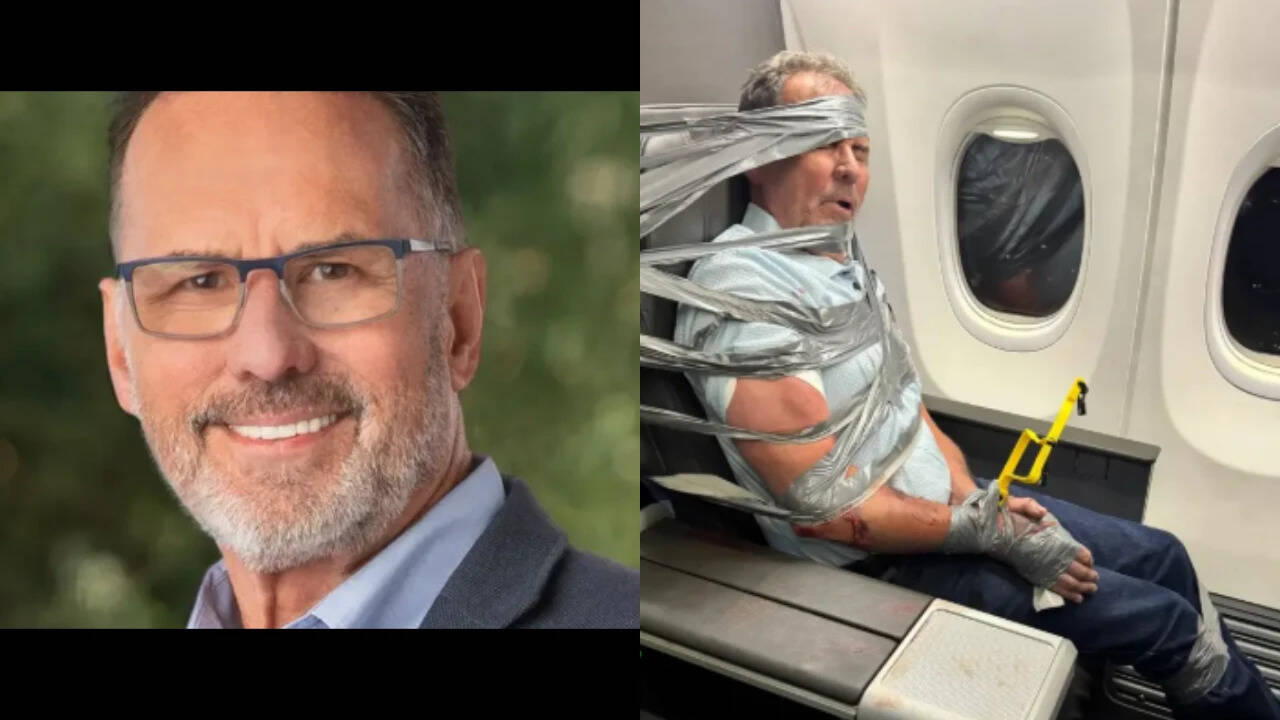
When 67-year-old Arizona real estate executive Arthur Lundeen found himself wrapped head-to-toe in industrial packing material aboard American Airlines Flight 618, he likely did not anticipate that his professional undoing would be broadcast globally within hours. Traveling from Dallas-Fort Worth to Newark, Lundeen allegedly transformed a routine domestic leg into a volatile spectacle of racial slurs, anti-gay remarks, and physical assaults against flight staff and passengers. The resulting viral imagery—showing a middle-aged man secured with zip ties and heavy-duty adhesive—forced his employer, Long Realty Company, to sever ties immediately, exposing the fragile boundary between corporate status and public accountability at thirty thousand feet.
This episode is far from an isolated aberration. Commercial aviation has mutated into a pressurized social experiment where civil discourse routinely frays under the weight of cramped cabins, scheduling delays, and an underlying ambient hostility among travelers. When an individual holding a corporate leadership role unravels mid-flight, the fallout transcends personal embarrassment. It triggers a swift, defensive corporate calculus designed to protect brand equity from airborne collateral damage.
The Anatomy of an Airborne Breakdown
The sequence aboard Flight 618 followed a depressingly familiar script. According to federal affidavits and witness accounts from passengers including former law enforcement officers, the disturbance began roughly two hours into the journey. Lundeen reportedly escalated from unfocused shouting to targeted verbal abuse directed at a Black flight attendant and nearby travelers.
Physical violence followed verbal degradation. Striking a seatmate, damaging personal electronics, and shoving intervening passengers transformed the cabin into an active threat zone. At that juncture, standard de-escalation protocols collapsed. Cabin crews and citizen passengers are forced to make split-second risk assessments.
Duct tape remains an improvised tactical restraint born of necessity. Aviation regulations do not provide law enforcement toolkits to flight attendants. When a body becomes a physical hazard to everyone else in an enclosed aluminum tube, passengers like Juan Mejia and Richard Olenick stepped into the void. Armed with zip ties provided by the crew and rolls of tape, they achieved what the modern commercial infrastructure struggles to maintain: immediate physical order.
Corporate Speed and the Severance Reflex
Long Realty Company acted with absolute velocity once the news cycle caught up with the manifest. Within days, public relations channels were saturated with corporate disavowals. Leadership stripped references to Lundeen from digital properties, clarifying that his executive title conferred no ongoing corporate endorsement.
This reflex highlights a modern reality of executive positioning. In an era of radical transparency, regional corporate entities cannot afford the reputational contagion of rogue personnel. A vice president is not merely an operational asset during working hours; they function as a walking billboard for the brand’s ethical framework.
When a senior staff member is arrested on state charges of second-degree assault and disorderly conduct—with federal FBI scrutiny looming over possible hate crime enhancements—the board room calculus simplifies instantly. Loyalty evaporates. Risk mitigation takes over. Long Realty’s statement emphasized that the behavior described was wholly inconsistent with internal expectations of respect and integrity. Translation: the liability of retention outweighed any historical contribution.
The Regulatory Vacuum and Legal Aftermath
As the aircraft diverted to Baltimore-Washington International Airport to offload the unruly passenger into the custody of Maryland Transportation Authority Police, a larger jurisdictional machinery swung into motion. State charges carry immediate penalties, but federal intervention via the Federal Aviation Administration (FAA) and the FBI points toward systemic deterrence.
The federal government has spent recent years attempting to curb the epidemic of unruly airline passengers through zero-tolerance policies and steep civil penalties. Yet, deterrence relies on the assumption of rational actor theory. It assumes that an individual sliding into a state of belligerence will weigh the prospect of a five-figure fine or prison time before shouting slurs at flight crew.
Incidents involving intoxicated or emotionally volatile flyers prove that rational calculations frequently vanish at altitude. The combination of high-density seating, diminished oxygen levels, and personal grievances creates a volatile psychological cocktail. For executives accustomed to corner offices and deference, the loss of control inside a commercial cabin can trigger explosive entitlement dynamics when minor inconveniences arise.
The legal process for Lundeen extends past initial bond reviews toward autumn court dates. Yet the permanent damage is already logged. A career built over decades within the Arizona real estate market dissolved in the span of a three-hour flight, captured pixel by pixel on consumer smartphones and beamed across social media networks.
The industry is left staring at the wreckage of another flight diverted, another community fractured by vitriol, and a stark reminder that anonymity no longer exists once the cabin door closes.