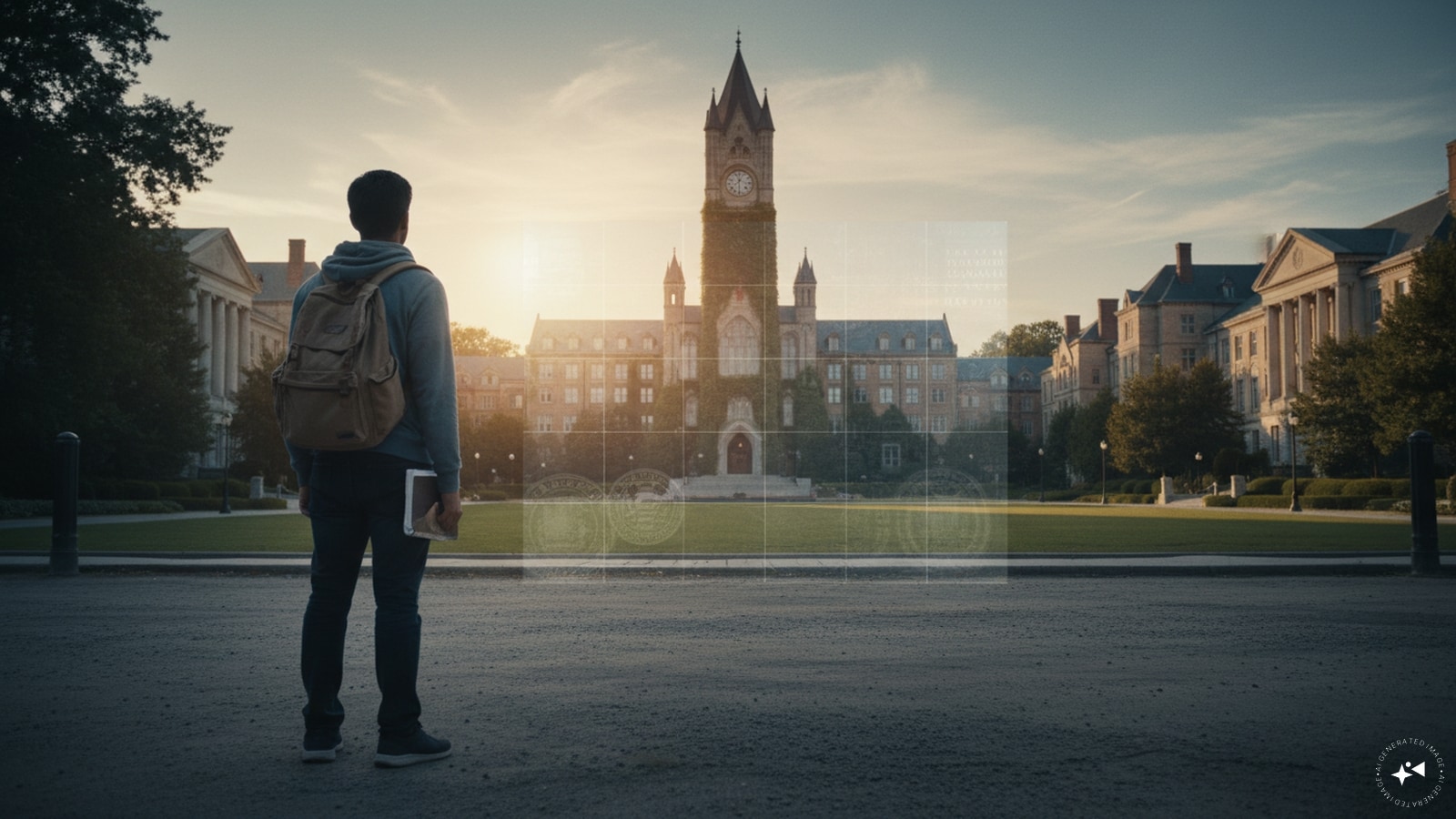
The numbers are finally out, and they confirm what regional education consultants have whispered for months. Indian student applications to United States colleges plummeted by fifteen percent during the recent admissions cycle, marking a sharp fracture in a migration pipeline that once felt invincible.
This sudden contraction is not a random statistical blip. It is the direct mathematical consequence of systemic policy hostility, compounding financial hurdles, and an evolving geopolitical climate that treats international tuition payers as economic targets rather than academic assets.
For decades, the American higher education machine operated on an implicit promise. You pay full out-of-state tuition, you endure four years of academic pressure, and you earn a shot at the Optional Practical Training program to bridge into corporate America. That formula is cracking.
The Anatomy of the Policy Shift
Washington administrative adjustments have transformed uncertainty from a minor friction point into a wall. The federal government recently dismantled the traditional duration of status system for student visas. Stays are now rigidly capped at four years, leaving zero room for program extensions, unexpected academic setbacks, or double majors without expensive and bureaucratic administrative filings.
At the same time, the grace period for transferring schools or changing legal status has been slashed from sixty days down to thirty.
The financial threat architecture is even more aggressive. Rumors and active policy proposals targeting a prohibitive one-hundred-thousand-dollar surcharge for foreign graduates utilizing the Optional Practical Training pathway have leaked into the public sphere. For middle-class families in Mumbai, Hyderabad, or Delhi who routinely liquidate generational property or take on massive collateralized loans to fund an American degree, this creates an intolerable risk matrix.
Consider a hypothetical student named Aarav, whose family mortgaged their family home in Pune to fund a bachelor of science in computer engineering at an American mid-tier university. Under previous rules, the return on investment calculation was tight but mathematically sound. A post-graduation job at a technology firm could clear the education debt within five years. Introduce a hundred-thousand-dollar administrative penalty just to work legally on American soil, and the math collapses entirely.
The Broader International Contraction
The fifteen percent drop in Indian applications is the sharpest dagger, but it belongs to a wider contagion. Overall international undergraduate applications fell by ten percent across major platforms, marking the steepest recorded contraction in modern tracking history.
Institutions that relied on international cash flows to subsidize domestic research budgets are watching their financial models unravel. Regional comprehensive universities and mid-tier private colleges, which lack the massive endowment shields of Ivy League flagships, are most exposed. When application pipelines dry up by twenty percent at mid-tier institutions, revenue deficits materialize almost overnight.
Higher education organizations like NAFSA have projected that tens of thousands of fewer international registrations will hit campuses nationwide, stripping billions of dollars from local college towns and regional economies.
Where the Talent is Redirecting
Talent does not simply evaporate when a door closes; it reroutes. Competitor destination countries are aggressively weaponizing American immigration friction to capture displaced Indian aspirants.
Canada, despite its own domestic housing and immigration adjustments, remains a major destination, while European nations offering low-tuition English-taught programs are seeing surges. Institutions across Germany, Ireland, and the United Kingdom have systematically revamped their post-study work visa structures precisely as American rules tightened.
An engineering graduate who looks at a four-year visa cap paired with prohibitive post-graduation work penalties in the United States will quickly pivot toward nations offering clear, uninterrupted paths to permanent residency.
The Quiet Crisis on Campus
The real cost of this drop will not be felt immediately in corporate boardrooms, but rather in the quiet seminar rooms and research laboratories of American universities. Graduate teaching assistant pools are shrinking. Undergraduate classrooms are losing the global perspectives that justified top-tier tuition costs.
American higher education spent half a century convincing the world that its campuses were the ultimate destination for global merit. By erecting financial ramparts and bureaucratic traps, domestic policy makers are signaling that the door is only open if the price is right and the political winds are favorable.
The fifteen percent decline is merely the initial tremor. If these regulatory proposals solidify into permanent law, the structural damage to America's academic supremacy will take generations to reverse.