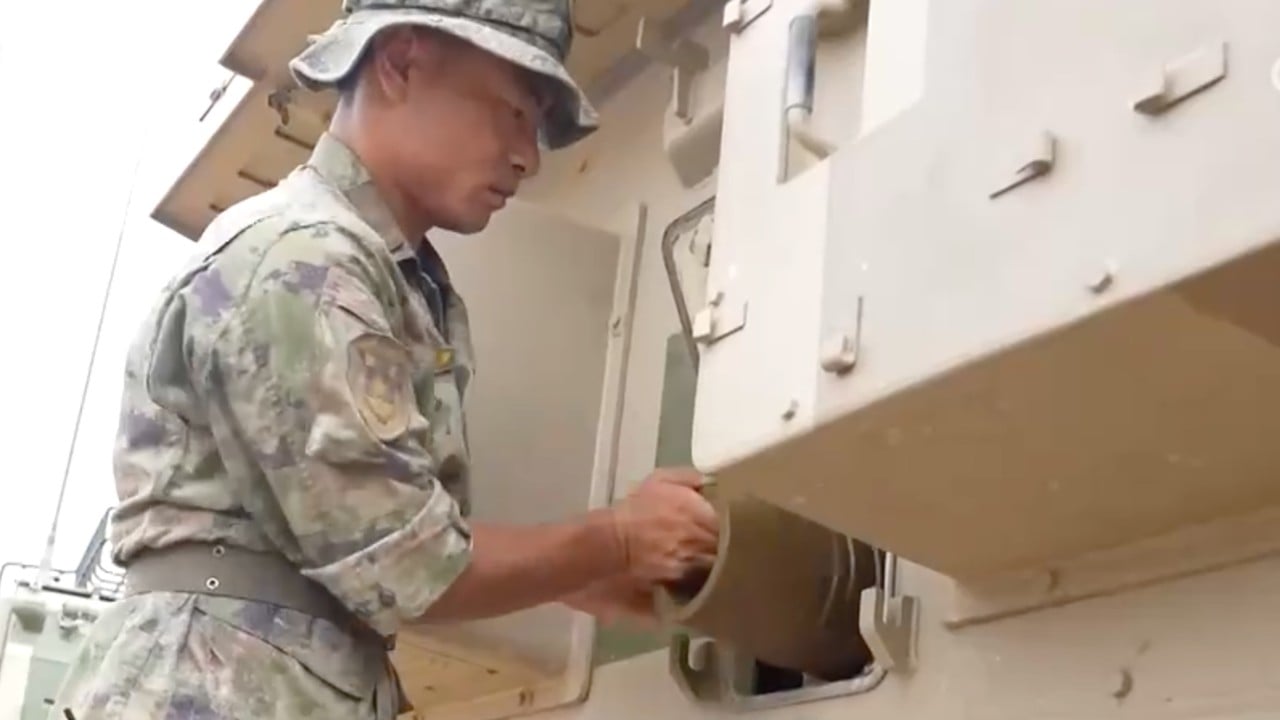
The recent brigade-level transition toward heavy 155mm ordnance facing Taiwan reveals a calculated modification in Beijing's military posture, moving away from pure missile-centric signaling toward sustainable, high-volume conventional fire support. Decades of defense analysis taught us to watch the skies for ballistic arcs and naval armadas, often overlooking the humbler steel tubes that dictate ground reality. When the People's Liberation Army embeds mobile 155mm howitzer systems directly into frontline theater formations, they are not just adding noise to an already crowded regional dispute. They are solving a fundamental economic and tactical bottleneck that has bedeviled amphibious invasion planners for generations.
Missiles are terrifyingly efficient, yet they suffer from a crippling financial and industrial reality. Each precision-guided ballistic or cruise missile costs millions of dollars, and national stockpiles are finite. A prolonged cross-strait conflict cannot be fought solely with high-end ordnance without exhausting deep strategic reserves within weeks. Artillery, by contrast, offers an entirely different expenditure curve. Modern truck-mounted or tracked 155mm platforms fire high-explosive, base-bleed, or rocket-assisted precision rounds at a fraction of a missile's cost. By upgrading brigade-level fire support along the eastern military commands, the operational structure gains the ability to sustain a continuous multi-day saturation campaign without hitting an immediate inventory wall.
Consider the mechanical evolution of these assets. For years, heavy artillery was plagued by mobility restrictions, requiring cumbersome tracked chassis that demanded frequent maintenance and heavy transport logistics. The introduction of automated, truck-mounted 155mm systems—such as the PCL-181 series widely integrated into southern and eastern theater units—drastically alters the deployment speed. These platforms weigh significantly less than their tracked predecessors, feature automated aiming and semi-automatic loading mechanisms, and can shoot and scoot before counter-battery radar can calculate their position. They travel on civilian highways just as easily as rough terrain, blending into the regional infrastructure until the exact moment of execution.
Strategic positioning along the coast tells only half the story. The tactical utility of a 155mm shell lies in its versatility. While multiple launch rocket systems handle deep-strike suppression against command nodes and air defense batteries further inland, 155mm howitzers provide the granular, responsive firepower required during the agonizing hours of a beachhead consolidation. When landing craft approach a heavily fortified coastline featuring concrete bunkers and interlocking trench networks, troops do not need a distant strategic missile strike that might miss by ten meters. They require relentless, point-blank artillery suppression that chews up reinforced positions meter by meter.
Military analysts tracking these movements often obsess over hardware counts while ignoring the command architecture behind them. Integrating brigade-level 155mm assets requires sophisticated digital fire-control networks that link reconnaissance drones, counter-battery radars, and frontline spotters into a single data stream. Every upgrade in caliber demands an equivalent upgrade in data processing speed. If a brigade cannot clear its targeting loop within minutes, even the most advanced gun becomes vulnerable to modern counter-fire loops. Beijing's structural emphasis on digital integration points to an army that has studied the lessons of recent European conflicts closely, absorbing the brutal necessity of decentralized, networked artillery direction.
Taiwan's defense planners are far from passive observers in this calculus. Taipei has spent years upgrading its own artillery branches, seeking self-propelled howitzers and long-range rocket systems designed to decentralize defensive forces and survive initial barrages. Yet geography remains an unforgiving master. The narrow body of water separating the mainland from the island creates a theater where mass and sustainment dominate all other variables. When a continental power optimizes its conventional artillery brigades for high-frequency deployment right on the doorstep of a maritime democracy, the psychological and physical pressure on coastal defenders intensifies exponentially.
This is not a sudden prelude to an imminent amphibious landing. Wars of this scale are rarely triggered by a single equipment upgrade, no matter how lethal. Instead, this deployment represents a steady tightening of the operational vice, shifting the baseline of regional friction upward. Every new brigade outfitted with heavy mobile howitzers normalizes a higher state of readiness, shortening reaction times and expanding the menu of coercive options available to eastern commanders. The hardware is locked in place, the logistics chains are tested against regional geography, and the doctrine matures with every passing drill.


