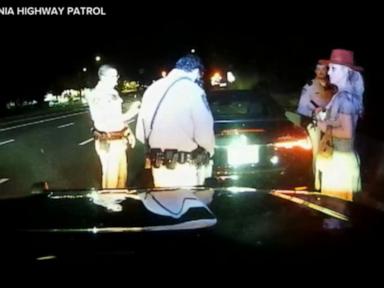
The release of raw law enforcement dashcam footage documenting Britney Spears’ March 2026 roadside arrest on U.S. Route 101 offers more than just another tragic addition to the celebrity tabloid machine. It exposes a profound structural breakdown in the infrastructure surrounding emancipated pop icons. While standard media accounts fixate on the theatricality of the footage—the erratic lane changes, the mimicry of a British accent, and offers of backyard lasagna to California Highway Patrol officers—the deeper reality points to an entirely different crisis. The infrastructure designed to support Spears after the 2021 termination of her 13-year conservatorship has fundamentally defaulted on its core purpose, leaving her trapped in a dangerous twilight zone between absolute personal autonomy and profound isolation.
This latest incident cannot be dismissed as a minor legal hiccup. It is a critical warning sign.
The Illusion of Freedom and the Reality of Isolation
When the Los Angeles Superior Court dissolved the legal apparatus controlling Spears' life, public sentiment celebrated the victory as a triumph of human rights. What the public failed to realize was that removing an oppressive legal cage also meant removing the entire ecosystem of immediate, albeit forced, operational support.
When an individual spends more than a decade stripped of basic executive functions—unable to choose their own medical providers, manage a bank account, or drive a vehicle without supervision—the sudden restoration of total freedom acts as a decompression chamber. Without a carefully managed, voluntary transition framework, the sudden lack of guardrails frequently results in structural collapse.
The Ventura County arrest footage displays this vulnerability with striking clarity. Spears did not simply fail a standard field sobriety test; she exhibited a total disconnect from the realities of civilian law enforcement interaction. For ten minutes, she refused to exit her BMW, citing a historical fear of being pranked or stalked. When she did step out, her behavior veered between defensive posturing and bizarrely hospitable invitations to her residence.
Timeline of the March 2026 Roadside Crisis
│
├── 09:15 PM: Multiple 911 calls report a black BMW swerving and braking erratically on U.S. 101.
├── 09:30 PM: California Highway Patrol executes a traffic stop near the Ventura County line.
├── 09:40 PM: Spears exits the vehicle after a 10-minute standoff, exhibiting slurred speech.
└── 03:00 AM: Booking process completed following blood draws and breathalyzer examinations.
This behavior is not indicative of simple malice. It highlights the behavior of an individual who has lived for nearly two decades behind a wall of security teams, handlers, and legal intermediaries, leaving her fundamentally unequipped to handle a routine interaction with the state.
The Medical Paradox of the Wet Reckless Plea
The legal resolution of the case saw Spears' legal counsel secure a "wet reckless" plea deal, a standard arrangement in California for first-time offenders with low blood-alcohol readings and no history of property damage. The breathalyzer tests registered at .05 and .06—technically under the state’s .08 legal limit for adult drivers.
However, looking strictly at the blood-alcohol content ignores the much larger medical issue documented in the police logs. Officers found an unprescribed bottle of Adderall in her handbag, and Spears herself openly stated to authorities that she had consumed Lamictal, Prozac, and Adderall earlier that same day.
"The chemical interaction between potent central nervous system stimulants, selective serotonin reuptake inhibitors, mood stabilizers, and even nominal amounts of alcohol creates a highly volatile state of cognitive impairment that a standard breathalyzer is completely unequipped to measure."
By focusing entirely on the fact that her alcohol levels fell below the legal threshold for a standard DUI conviction, both her legal team and the entertainment press are ignoring the actual danger. The issue isn't traditional drunk driving; it is the chaotic, unmanaged mixing of psychiatric medications. This chemical instability is further complicated by the absence of a reliable, trusted medical team to oversee her care.
The Failures of Post-Conservatorship Representation
In the wake of her arrest, a representative for Spears issued a public statement calling the event "an unfortunate incident that is completely inexcusable," adding a hope that it would serve as "the first step in long overdue change."
This statement reveals a glaring disconnect. If those paid to protect her interests recognize that systemic changes are "long overdue," why did it take a high-speed near-miss on a major California highway to spark action?
The professional circle currently surrounding Spears operates primarily in a reactive posture. High-earning defense attorneys are highly effective at minimizing criminal exposure after a crisis occurs, reducing charges to probation and mandatory classes. Entertainment agents are skilled at securing lucrative book deals and managing the quiet sale of music catalogs.
Yet, none of these corporate entities are built to handle day-to-day personal care. The contemporary celebrity management industry is designed to maximize the financial value of an intellectual property asset, not to preserve the physical safety of a fragile human being. When a star explicitly rejects traditional management structures out of a well-earned fear of exploitation, they are often left with no real defense against their own worst impulses.
The Complicity of Public Consumption
The final element of this structural crisis is the toxic relationship between Spears and her audience. The public consumption of her life has split into two equally damaging camps: voyeuristic media outlets capitalizing on her erratic behavior, and an overzealous online fanbase that reframes every clear sign of distress as an act of personal empowerment.
When Spears posts cryptic messages on digital platforms celebrating the spiritual symbolism of snakes and asserting that she is learning to be kind to herself, thousands of comments praise her independence. This uncritical validation creates a dangerous feedback loop. It convinces a deeply isolated individual that any outside concern for her well-being is actually an attempt to control her again.
True autonomy does not mean navigating profound psychological challenges entirely alone in a high-performance sports car on a dark highway. Until her inner circle and her global audience stop treating her evident crises as either clickable content or symbols of rebellion, the path Spears is on remains incredibly perilous. The wet reckless plea resolved her immediate legal vulnerability, but the underlying systemic failures exposed on that Ventura County highway remain completely unaddressed.
Britney Spears wet reckless plea deal details This broadcast outlines the specific legal mechanisms of the plea agreement that allowed Spears to avoid incarceration following her Ventura County arrest.