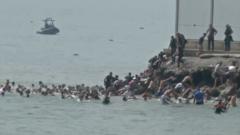
The water off the coast of Ceuta is cold, heavy, and unforgiving. When individuals attempt to swim around the maritime breakwaters of this Spanish enclave bordering Morocco, they are not merely crossing a physical boundary; they are navigating a complex geopolitical fault line forged by history, geography, and European immigration policy. Recent reports of migrants swimming around the border fences highlight an enduring flashpoint where the European Union meets North Africa, exposing the limits of physical barriers against human desperation.
Decades of reinforcement have turned Ceuta and its sister enclave, Melilla, into two of the most heavily fortified patches of European territory on earth. Double-layered fences topped with razor wire, thermal cameras, motion sensors, and constant patrols by both Spanish Guardia Civil and Moroccan forces form an imposing wall. Yet, the ocean remains open. When land routes become impassable, the Atlantic and the Mediterranean offer a perilous alternative. Understanding why people continue to brave the freezing currents requires examining the structural pressures driving migration through North Africa and the specific vulnerabilities of Spain's African borders.
The Geography of Separation
Ceuta spans roughly eighteen square kilometers on the northern coast of Morocco. This unique placement makes it the only land border between the European Union and the African continent, alongside Melilla. For policymakers in Madrid and Brussels, these enclaves function as both strategic footholds and permanent administrative headaches. For individuals fleeing economic collapse, political unrest, or violence in sub-Saharan Africa and the Middle East, Ceuta represents the closest physical manifestation of Europe.
The physical architecture of the border has evolved through successive waves of fortification. In the late nineteen nineties, Spain erected initial wire barriers. Over the years, these fences grew taller, doubling in height and incorporating anti-climbing mesh, optical sensors, and noise-detection systems. Millions of euros from European Union funds flowed into upgrading these defenses.
Despite these measures, physical engineering has a blind spot: the coastline. The border does not simply end at the sand; it extends into the sea via breakwaters designed to prevent unauthorized maritime entry. These barriers are frequently circumvented. Swimmers take advantage of heavy fog, nightfall, or rough sea conditions that impair surveillance equipment and hinder patrol boat response times.
The Moroccan Factor and Regional Diplomacy
Borders do not exist in a vacuum. The security of Ceuta relies heavily on the cooperation of Moroccan authorities. Morocco acts as a crucial gatekeeper for Europe, intercepting migrants before they reach Spanish territory, dismantling makeshift camps in nearby forests, and deploying security forces along the rugged terrain leading to the fences.
This cooperation is maintained through a delicate diplomatic dance. Migration control is frequently leveraged by Rabat in negotiations with Madrid and the European Union over trade agreements, fishing rights, and diplomatic recognition regarding the disputed territory of Western Sahara. When political tensions flare between Morocco and Spain, enforcement at the border often loosens noticeably.
The human cost of this geopolitical leverage is high. Individuals trapped in the buffer zone face repeated displacements, violent crackdowns by security forces, and prolonged uncertainty. Many spend months or years in Morocco working irregular jobs, saving money, and waiting for an opening in the border surveillance grid. By the time someone decides to swim around the breakwater, they have usually exhausted all other options.
Inside the Crossing Mechanics
Attempting to swim around the Ceuta border fence is an act of calculated risk. The distance may look manageable from the shore, but the marine environment presents immediate hazards. Strong underwater currents, sudden drops in water temperature, and heavy waves crashing against concrete tetrapods create treacherous conditions even for experienced swimmers.
Those who make the attempt often use improvised flotation devices, ranging from empty plastic jugs to discarded inner tubes or wetsuits bought on the black market. Hypothermia sets in quickly, particularly during the winter months when water temperatures plummet.
Patrol boats operated by the Guardia Civil and the Moroccan Royal Navy monitor these waters, but their response depends entirely on detection capability. When guards spot swimmers in the water, protocol dictates a rescue operation, bringing individuals onto patrol vessels to assess their medical condition. Once on Spanish soil, migrants are processed through temporary holding facilities known as CENTI (Centro de Estancia Temporal de Inmigrantes). These centers frequently operate above capacity, highlighting the strain on local infrastructure.
The Legal and Human Rights Quagmire
The arrival of swimmers on the shores of Ceuta triggers a complex legal process governed by Spanish and international law. Under international conventions, individuals have the right to claim asylum upon reaching a country's territory. However, the practical application of this right at land borders has faced severe legal challenges.
In the past, Spanish authorities engaged in immediate pushbacks, returning individuals directly to Morocco without formal identification or access to legal counsel. Human rights organizations and the European Court of Human Rights have scrutinized these practices. Legal battles center on the definition of a border crossing versus an unauthorized entry, and whether summary returns violate the principle of non-refoulement, which forbids returning a person to a country where they face persecution.
The political debate in Spain mirrors broader European polarization over immigration. Conservative factions argue for stricter enforcement, increased funding for border guards, and enhanced cooperation with third-party nations to deter departures entirely. Progressive groups and humanitarian organizations advocate for safe, legal pathways for migration, arguing that physical walls and maritime patrols only drive desperate people toward more dangerous routes while failing to address root causes.
Economic Undercurrents
Migration to Ceuta cannot be separated from the economic disparities driving global movement. Sub-Saharan African nations face severe structural challenges, including youth unemployment, inflation, the impacts of climate change on agriculture, and political instability. For a young person in countries like Guinea, Mali, or Senegal, the prospect of remitting money home from Europe outweighs the immense risks of the journey.
Informal economies inside European enclaves also play a role. While Ceuta is part of the Schengen area's customs territory with specific exemptions, its economy relies heavily on cross-border trade and labor. A shadow economy exists to support those living without legal status, offering precarious employment in construction, agriculture, and domestic service.
As long as economic inequality persists between the European Union and the Global South, border fortifications will remain temporary stopgaps rather than permanent solutions. Each barrier erected simply shifts the routes, forcing people into riskier maritime corridors or onto longer, more perilous land journeys through the Sahara desert.
The water off Ceuta remains cold, and the fences stand tall. Until structural drivers are addressed, individuals will continue to slip past the breakwaters, seeking a foothold on European soil despite the odds.