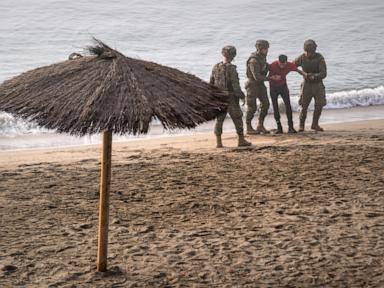
The Atlantic does not negotiate. It rolls against the breakwaters of Ceuta with an indifferent weight, indifferent to the bodies dragged from its surf or the teenagers shivering under wool blankets on Tarajal beach. When the death toll along the Spain-Morocco border crisis climbed to 67, official bulletins spoke of tragic accidents, sudden swells, and overwhelmed maritime patrols. They sanitized the geography of failure.
Ceuta is not merely a border zone. It is an administrative anomaly, a European Union enclave physically bolted to the North African coast, surrounded by barbed wire, high-tech surveillance towers, and six meters of galvanized steel. When tens of thousands of people rushed those fences and swam around the breakwaters, they did not just cross a physical line. They exposed the structural fractures of a migration containment model built entirely on deterrence rather than reality.
Understanding why 67 lives were lost in the shadows of European territory requires stripping away the diplomatic communiqués issued between Madrid and Rabat. The crisis was not an unpredictable act of meteorological violence. It was the predictable mathematical outcome of weaponized geopolitics colliding with genuine desperation.
The Anatomy of a Diplomatic Fracture
Borders do not exist in a vacuum. They function only as long as the state on the other side agrees to act as a jailer. For decades, Spain and the European Union outsourced their southern frontier management to Moroccan authorities, funding border patrols, barrier maintenance, and intelligence sharing in exchange for quiet containment.
Then came the diplomatic rupture. When Spain hospitalized Brahim Ghali, the leader of the Polisario Front fighting for the independence of Western Sahara, for COVID-19 treatment under a false identity, Morocco blinked its surveillance lights off.
We watched the machinery of control vanish overnight.
In May, instructions given to local Moroccan auxiliary forces changed without warning. Checkpoints that usually resembled militarized zones suddenly stood empty. Word traveled through social media channels and informal communication networks faster than any diplomatic cable. Thousands of young men, families, and unaccompanied minors packed into buses and walked toward the border town of Fnideq, knowing the gate was wide open.
This was the mechanism of the crisis. It was a pressure valve deliberately opened by Rabat to send a geopolitical signal to Madrid, using human lives as diplomatic leverage. When thousands of people are invited to walk through an open door, and then the door is slammed shut weeks later as negotiations resume, the people caught in the middle face an impossible choice. They either stay in a landscape of economic stagnation or brave the freezing Atlantic waters around the Tarajal breakwater.
The False Promise of the Double Fence
To grasp the physical reality of Ceuta, you have to look at the engineering of exclusion. The enclave is protected by a dual fence system equipped with motion sensors, noise traps, closed-circuit television cameras, and non-cutting mesh designed to slow climbers down without causing lethal harm.
Yet iron and concrete do not stop desperate human beings. They only alter the route.
When the land border became a militarized theater of mass pushbacks and tear gas, the migration vectors shifted to the sea. Swimming around the breakwaters guarding the Tarajal beach sounds deceptively simple on a map. A distance of a few hundred meters. A quick transit from African soil to European asphalt.
The reality is entirely different. The water temperature in the early spring months is paralyzing. Strong undercurrents sweep parallel to the shore, pushing swimmers away from the safety of the concrete barriers and out into the shipping lanes. Wetsuits are a luxury few migrants possess; most enter the water in denim jeans and heavy cotton jackets that absorb water like anchors.
When border guards deploy rubber bullets and tear gas canisters near the water line, panic sets in instantly. Panic kills in the water. Swimmers lose their orientation, swallow brine, and sink within minutes. The 67 deaths recorded during this crisis were not statistical anomalies. They were the direct design outcome of a border fortification strategy that pushes human traffic away from land checkpoints and into lethal maritime corridors.
The Legal Black Hole of Summary Returns
International law is clear on paper. The principle of non-refoulement prohibits countries from returning asylum seekers to a country where they face persecution or torture. European human rights courts have repeatedly ruled that collective expulsions without individual identification and assessment of protection claims are illegal.
Ceuta operates in a legal twilight zone where those rules bend until they snap.
During the height of the crossings, Spanish security forces utilized expedited administrative procedures known locally as devoluciones en caliente—hot returns. Individuals who managed to touch European soil were frequently intercepted, bundled back across the border gate within hours, and handed over to Moroccan police without ever seeing a lawyer, an interpreter, or a judge.
The Spanish government defended the practice by arguing that these were not formal expulsions, but rather containment actions at the immediate border line. Human rights organizations documented cases where minors, who enjoy special legal protections under international conventions, were swept up in these rapid roundups.
This is the hypocrisy at the heart of European border management. The Union demands adherence to the rule of law while constructing bureaucratic and physical architecture specifically designed to prevent people from reaching the threshold where those legal obligations apply. If you cannot touch the soil, you do not exist to the courts.
Economic Despair and the Myth of the Pull Factor
Politicians across Madrid and Brussels frequently rely on a comforting fiction to explain events like the Ceuta crisis. They point to the concept of the "pull factor," arguing that generous reception conditions, human rights protections, and the mere existence of a welfare state act as a magnet for unauthorized migration.
Walk through the neighborhoods of Tetouan, Casablanca, or Fnideq, and you find a different reality. The driving force behind the crossings is not an idealistic vision of European bureaucracy. It is an economic dead end.
Youth unemployment rates in Morocco have persistently hovered at crisis levels. Informal labor markets provide no safety nets, no pensions, and no path upward for young graduates who see their futures mortgaged by inflation and systemic corruption. For many, the choice to cross into Ceuta is not a calculated gamble on European social security. It is an act of absolute economic self-preservation.
When a young man sells his phone and borrows money from extended family to pay a smuggler, he is not responding to a European political speech. He is reacting to the immediate absence of survival alternatives in his home country.
The Geopolitical Bargain
Months after the peak of the crisis, diplomatic normalizations were quietly restored. Spain shifted its official position on the disputed territory of Western Sahara, endorsing Morocco's autonomy plan as the most serious and credible basis for resolving the decades-old conflict.
Shortly after that policy reversal, border surveillance in Fnideq tightened once again. Patrol boats resumed their intercept patterns. The flow of people across the Tarajal breakwater dropped to a trickle.
The dead were buried, their names logged in consular archives, while policymakers in Brussels praised the renewed cooperation with their trusted North African partner. Nothing fundamental about the economic drivers of migration has changed. No new legal pathways for labor mobility have been opened to alleviate the pressure on the southern border.
The system relies entirely on the willingness of an authoritarian security apparatus to use batons and tear gas on behalf of a democratic union that prefers its borders clean, quiet, and out of sight. Until policymakers confront the structural roots of economic disparity and construct functional, legal channels for human mobility, the next crisis is not a question of if, but when, and the next tally of lives lost will simply be written off as the cost of doing business.