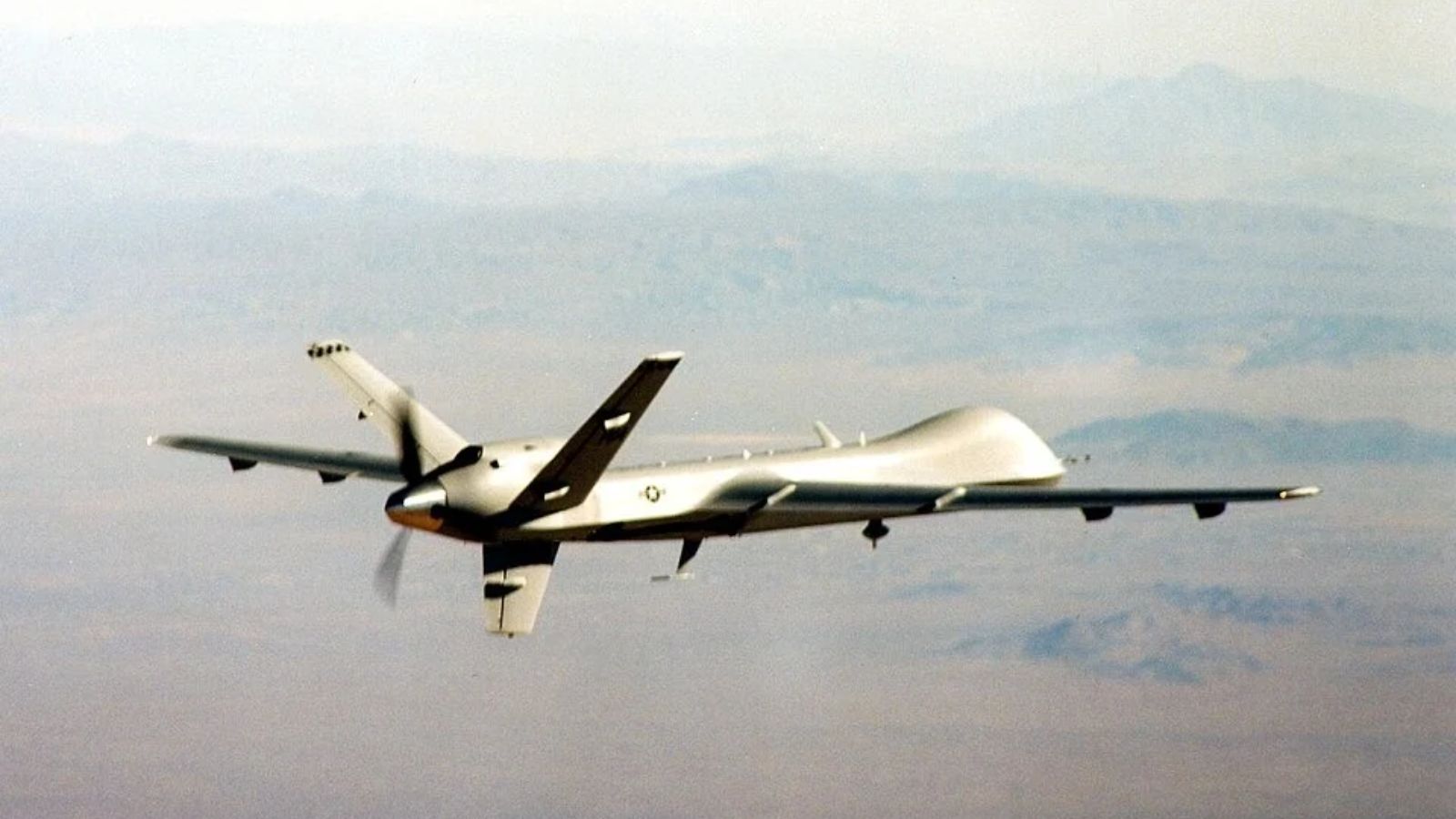
Reports of Iran claiming its 58th downed American drone alongside renewed air strikes in Yemen expose a brutal reality of modern warfare. The conflict across the Middle East has mutated into a sustained battle of asymmetric attrition, where multimillion-dollar reconnaissance aircraft are systematically traded against low-cost regional air defenses and decentralized proxy networks. While live news tickers focus on daily tally counts and individual strikes, the underlying story is about economic exhaustion, contested airspace, and the strategic limits of uncrewed aerial superiority.
The Numbers Game Behind Uncrewed Warfare
Live updates thrive on simple scorecards. A claim of 58 downed drones makes for an immediate, striking headline, yet raw numbers rarely tell the full operational story without context. In prolonged regional conflicts, belligerents routinely inflate enemy losses to project domestic strength and deter further incursions. Conversely, militaries operating uncrewed platforms frequently classify attrition data to avoid revealing vulnerabilities in their flight paths, sensor suites, or electronic countermeasures.
To understand what a claim like this actually means, you have to look at the hardware involved. The United States relies heavily on high-altitude, long-endurance platforms like the MQ-9 Reaper to maintain persistent intelligence, surveillance, and reconnaissance across vast stretches of territory from the Persian Gulf to the Red Sea. Each MQ-9 airframe costs roughly $30 million, before factoring in specialized sensor pods, satellite communication links, and the logistical tail required to keep them airborne for twenty-four hours at a time.
Compare that price tag to the interceptor. Iran and its regional partners, including the Houthi movement in Yemen, have spent years refining mobile, road-portable surface-to-air missile systems. Systems like the 358 loitering surface-to-air missile or modified Sevom Khordad launchers cost a fraction of the aircraft they target. Even if only a fraction of claimed shootdowns are verified by wreckage or independent satellite imagery, the exchange ratio heavily favors the defender. You do not need to win air superiority to make persistent surveillance prohibitively expensive.
Why Yemen and the Persian Gulf Are a Single Theater
Treating a drone shootdown near Iranian airspace and air strikes in Yemen as two separate news items misses the central architecture of the conflict. Geographically, these flashpoints sit over a thousand miles apart. Operationally, they function as connected pressure valves in a single regional campaign.
When coalition forces conduct air strikes in Yemen, the stated objective is almost always the degradation of launch capabilities threatening maritime shipping lanes in the Red Sea and the Gulf of Aden. Radar installations, underground storage bunkers, and mobile missile launchers become the primary targets. Yet the intelligence required to locate those mobile launchers depends directly on the very reconnaissance drones being targeted across the theater.
This creates a circular operational trap. To find and strike mobile launchers in rugged terrain like northern Yemen, commanders need continuous overhead video and signals intelligence. Satellites pass over a given point on a predictable schedule, leaving blind spots that ground operators quickly learn to exploit. Drones fill those gaps by loitering for hours. However, loitering at medium altitudes makes those drones predictable targets for ambush-style air defenses that keep their radars turned off until the last possible second.
The Mechanics of the Ambush
Modern air defense in asymmetric warfare rarely looks like a conventional Cold War radar grid. Turning on a powerful search radar immediately broadcasts your exact location to anti-radiation missiles and electronic warfare aircraft. Instead, regional operators rely on passive detection.
- Electro-optical and infrared tracking allows ground crews to spot the heat signature of a drone engine against a cold sky without emitting a single radio wave.
- Spotter networks positioned along common flight corridors use encrypted messaging or basic radio relays to alert mobile launch teams miles ahead of an approaching aircraft.
- Pop-up engagements limit radar illumination to a few seconds, giving the drone's onboard warning receivers almost no time to execute evasive maneuvers or deploy countermeasures.
By the time an operator sitting in a ground control station thousands of miles away sees a warning indicator, the missile is already in its terminal phase.
The Industrial Reality Nobody Wants to Discuss
Warfare at this tempo eventually stops being a question of tactics and becomes a question of industrial capacity. Every high-end drone lost in combat represents not just a financial write-off, but a months-long replacement bottleneck.
Defense manufacturing lines for complex aerospace platforms do not scale overnight. Supply chains for specialized optics, composite airframes, and encrypted satellite transceivers are tightly constrained. When attrition rates climb faster than peacetime production schedules anticipated, military planners face an uncomfortable choice: accept blind spots in critical intelligence coverage, or risk depleting reserves meant for other global contingencies.
This industrial friction explains why air strikes in Yemen follow a rhythmic, reactive pattern. Strikes target known infrastructure—weapons depots, training sites, and command nodes—because those targets are static and visible. Yet decentralized militant networks are specifically designed to survive the loss of fixed infrastructure. A bombed warehouse can be replaced by dispersing munitions into dozens of civilian garages, caves, or shallow trenches. An air strike destroys concrete and steel, while the human expertise and decentralized supply lines remain intact.
Consider a hypothetical example of how this asymmetry plays out over six months. Suppose a coalition force conducts fifty precision strikes against missile storage sites, expending millions of dollars in precision-guided munitions and jet fuel. During that same window, defensive forces expend a few dozen low-cost interceptors to down six reconnaissance drones. The coalition achieves tactical destruction on the ground, yet the defender successfully blinds the coalition's persistent eyes in the sky while preserving enough mobile launchers to fire another salvo the following week. Both sides claim operational success, and neither side resolves the underlying stalemate.
The Fog of Information Warfare
In any active conflict, the battlefield extends straight into the press room. Claims of downing dozens of aircraft serve multiple audiences simultaneously, and separating verified losses from psychological operations requires strict skepticism.
First, there is the domestic audience. Governments facing economic strain or internal dissent use high-profile military claims to project competence and technological parity against a superpower. Showing wreckage on state television provides tangible proof that an adversary is not invulnerable.
Second, there is the deterrence calculation. By publicizing a running tally of downed aircraft, regional actors attempt to raise the political cost of continued surveillance flights. Every reported loss forces defense officials to answer questions about mission necessity, asset vulnerability, and escalating expenses.
At the same time, official denials or silence from military spokespeople carry their own strategic intent. Acknowledging every lost airframe hands free battle-damage assessment to the enemy, confirming which tactics worked and which radar frequencies successfully bypassed electronic jamming. Consequently, the public is left navigating a gray zone where claimed numbers are almost certainly exaggerated, while official admissions are systematically understated.
What Live Updates Miss About Escalation Control
Breaking news coverage naturally gravitates toward kinetic events—an explosion in a port city, a missile intercept over a warship, a wreckage photo circulating on social media. What gets lost in the minute-by-minute reporting is the deliberate calibration happening behind the scenes.
Despite the intensity of air strikes in Yemen and the ongoing attrition of uncrewed aircraft, both Washington and Tehran have consistently operated within tacitly understood boundaries. Targeting an uncrewed drone is fundamentally different from shooting down a manned fighter jet. Losing a $30 million piece of aluminum and carbon fiber triggers budget reviews and tactical adjustments; losing a pilot triggers an immediate domestic political crisis and demands massive retaliatory escalation.
Uncrewed systems have inadvertently created a new rung on the escalation ladder. They allow states to conduct aggressive reconnaissance and lethal strikes without risking capture or casualties among their own flight crews. Simultaneously, they allow adversaries to shoot back, demonstrate capability, and inflict real material cost without crossing the threshold that forces full-scale conventional war.
The same logic applies to the air campaign in Yemen. Strikes are heavily telegraphed, focused on military hardware rather than leadership decapitation or critical civilian utilities, and paired with diplomatic backchannels aimed at keeping the conflict geographically contained. It is a controlled burn rather than an uncontrolled wildfire, though the margin for miscalculation narrows every time a missile leaves a rail.
The Vulnerability of Over-Reliance on Remote Tech
For nearly two decades, uncrewed aerial vehicles operated in largely permissive airspace. During counterinsurgency campaigns in Iraq, Afghanistan, and parts of Africa, militants possessed heavy machine guns and shoulder-fired rockets, neither of which could reach an aircraft cruising at twenty-five thousand feet. That era bred a dangerous operational habit: treating persistent, unblinking aerial surveillance as a guaranteed baseline of military planning.
The Middle East theater has shattered that assumption. When adversaries possess medium-altitude surface-to-air missiles, GPS spoofing tools, and electronic warfare suites, slow-moving propeller-driven drones become glaringly vulnerable. They lack the speed to outrun a missile, the stealth coatings to evade modern radars, and the maneuverability to break a radar lock.
Military planners are now caught between two generations of technology. Legacy platforms like the MQ-9 are too vulnerable for contested airspace, yet next-generation attritable drones—cheaper, faster, autonomous systems designed to operate in swarms—are not yet deployed at the scale required to replace them. Until that transition happens, commanders must continue flying expensive, vulnerable assets into threat rings because the alternative is flying blind.
Reading Between the Lines of Daily Reports
When the next alert flashes across a screen announcing another downed drone or another wave of air strikes in Yemen, ignore the scorecard mentality. Look instead at the geography and the hardware.
Watch where the interceptions happen. A shootdown over international waters signals an attempt to push surveillance boundaries further away from the coastline, expanding the buffer zone where mobile launchers can operate unseen. A shootdown deep inland indicates that intelligence priorities have shifted toward tracking specific high-value targets regardless of the material risk.
Pay attention to the type of munitions used in retaliatory strikes. Heavy reliance on long-range standoff weapons launched from ships or distant airbases suggests commanders are unwilling to risk manned aircraft near upgraded air defense networks. Conversely, the use of shorter-range precision bombs indicates that local air defenses have been temporarily suppressed or blinded.
The war of attrition in the skies over Yemen and the Persian Gulf is not being decided by who wins the daily headline cycle, but by whose supply chains, budgets, and air defense networks crack first under the relentless weight of sustained, low-grade combat.


